
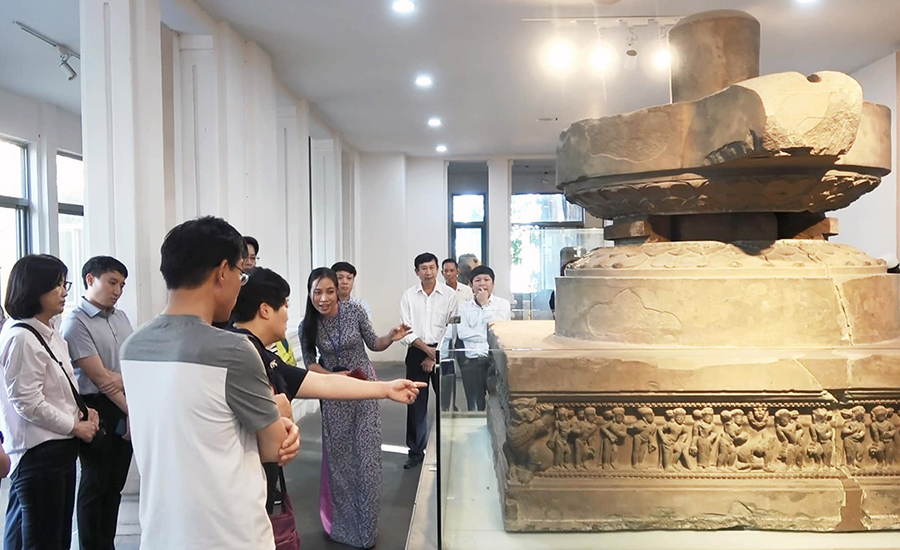
The Museum of Cham Sculpture is currently the largest repository of Champa cultural artifacts in the country. The museum currently stores and displays 9 national treasures, and is a must-see when travel to Da Nang.
1. Tra Kieu Pedestal
The Tra Kieu pedestal is the only Champa altar remaining relatively intact, with a square base and a round Yoni atop. The Tra Kieu Pedestal is made of sandstone from the Tra Kieu area and dates to the 7th – 8th centuries.
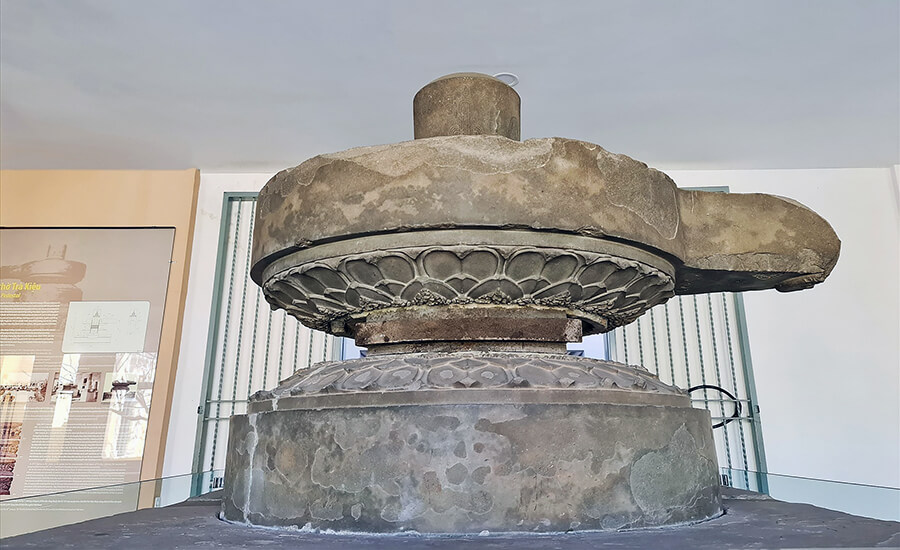
For the Cham people, the altar is the place that connects gods and temples, heaven and earth. The pedestal is placed in the center of the main tower. On top of the altar, a Linga-Yoni or a statue of the deity being offered to the tower is often placed. Each pedestal represents a different style and meaning. The Tra Kieu pedestal was brought to the museum in 1901.
The Tra Kieu pedestal is considered one of the masterpieces of sculpture. Immediately after its discovery, the Tra Kieu pedestal attracted many researchers to decode the stories of the characters depicted on it and determine its age.
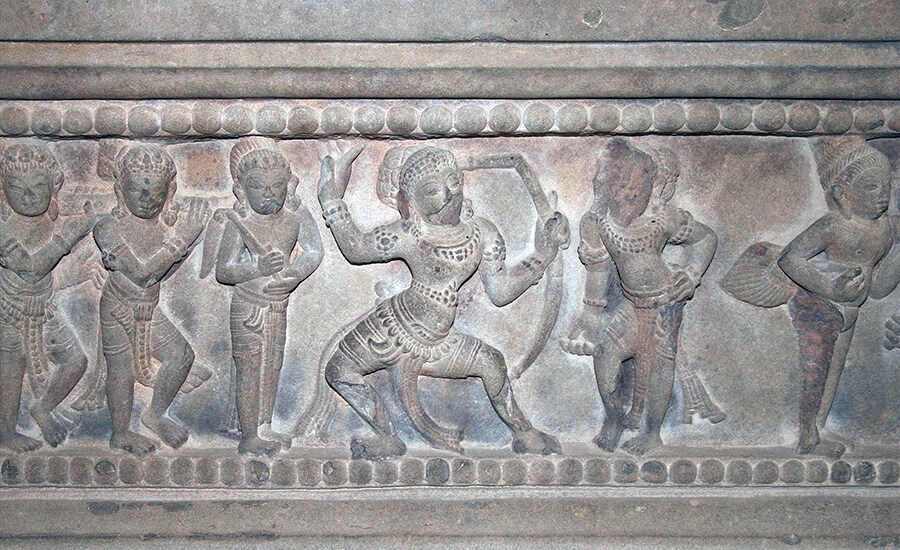
The carvings of human figures on the altar reflect the Champa art style, specifically the Tra Kieu style, with 4 decorative sides that depict a mythological theme, reflecting cultural exchange and influence between India and Southeast Asia. The artistic details in the hair buns, jewelry, costumes, and postures of the dancers on the Tra Kieu pedestal are sufficiently typical to generalize from when studying and comparing the art styles of Champa and other countries in Southeast Asia.
2, Statue of Shiva
The Shiva statue is made of sandstone, originating from My Son C1 tower, dated to the 8th century. The statue was found in 1903 in the My Son C1 tower in intact condition. The broken head and lower legs from the knee down have now been reattached with cement.
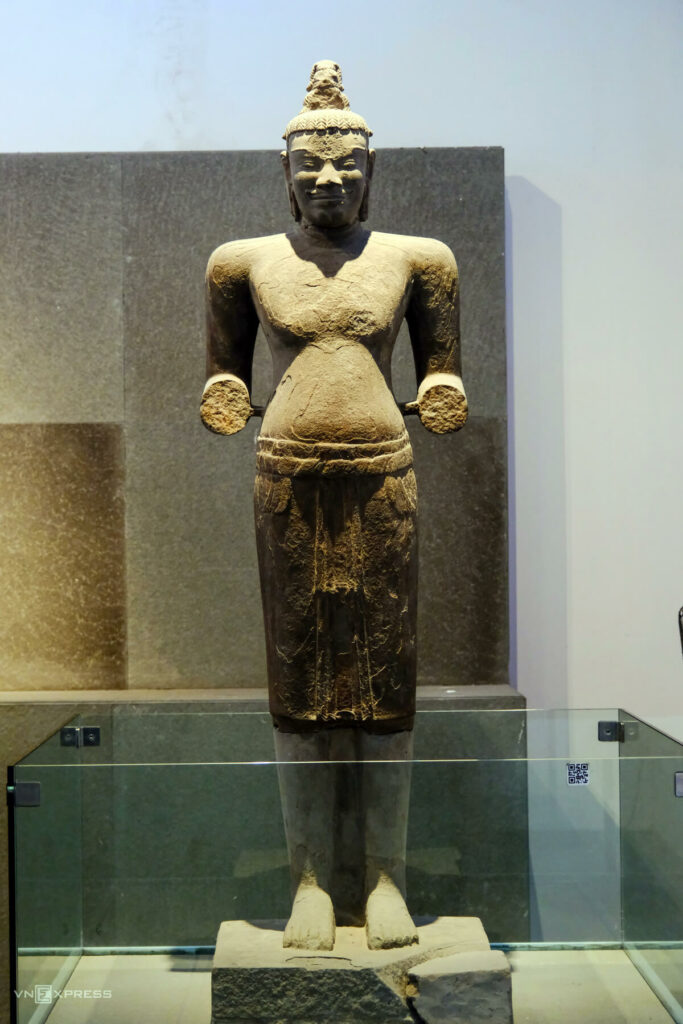
In the early 20th century, French archaeologists found the god statue’s jewelry in My Son C7 tower, near C1 tower, where the statue is located. This yellow metal jewelry set weighs 1.5 kg. It is possible that this is the jewelry set used to decorate the statue of the god during worship.
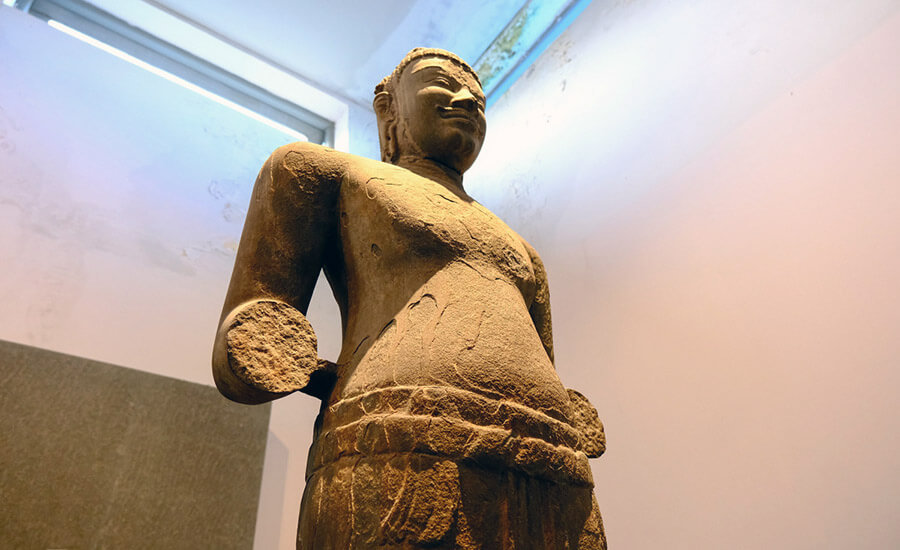
Currently, at the My Son relic site, a sculpture of the same type is also on display.
3, My Son E1 pedestal
My Son E1 pedestal, sandstone material, origin My Son, dated 7th – 8th centuries. This is the only pedestal found today that simulates the architectural decorative details of a tower, such as steps, arches, door pillars, animals, and flowers.
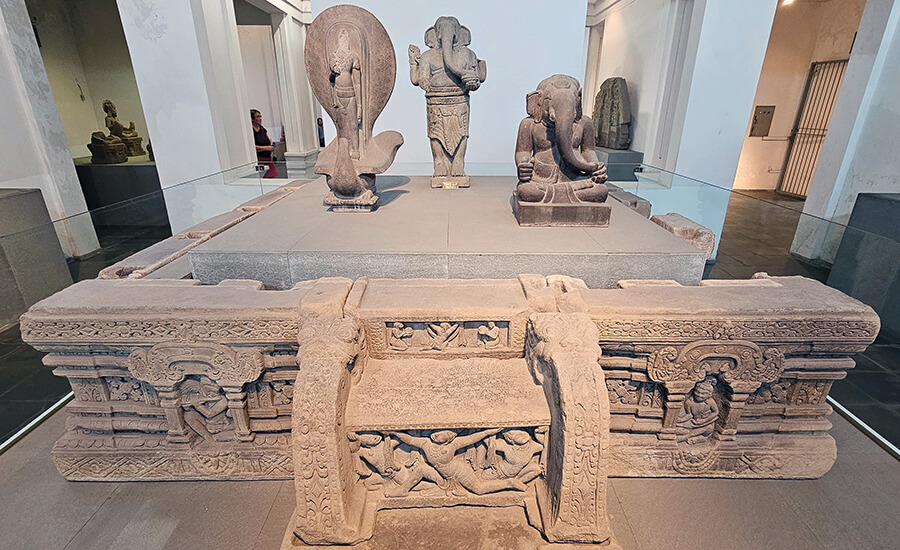
In particular, the image of Hindu monks cultivating in the forest, living in harmony with nature and animals. The front steps are decorated with images of six dancers performing the dance of offering scarves to the gods.
According to Indian mythology, Mount Meru is the residence of the gods, and Siva is the principal deity atop the mountain. The My Son E1 pedestal is the image of Meru mountain, and the Linga-Yoni worshiped above the pedestal is a symbol of the god Siva.
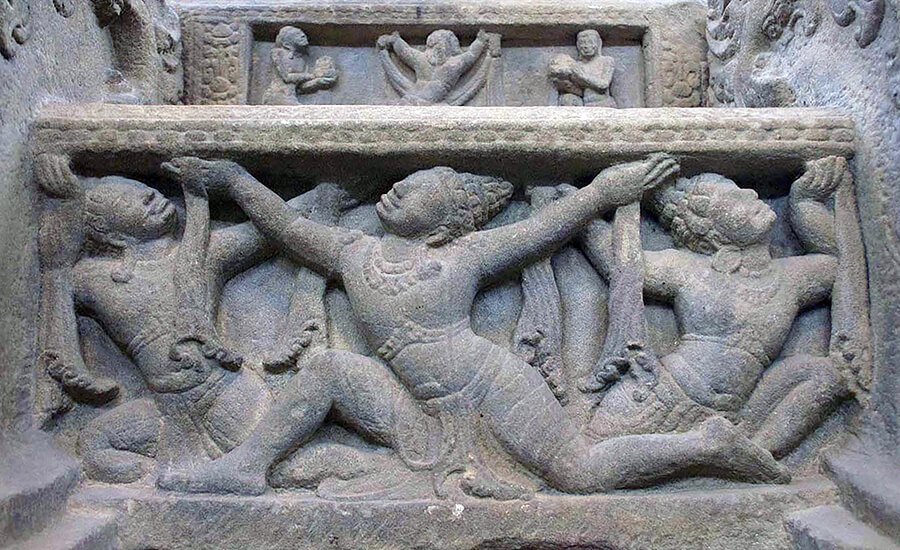
My Son E1 pedestal is a typical artifact of the altar type at the My Son Relic Area and is an important piece of evidence for research into the site’s cultural, religious, sculptural, and architectural issues. My Son ruins, in particular, and the ancient kingdom of Champa, in general.
4, Statue of Ganesha
According to Brahmanism, Ganesha is a respected god; his appearance is strange, with the head of an elephant and the body of a human. He is a symbol of intelligence, happiness, and success. Ganesha is one of the oldest gods of Hindu temples and also one of the most beloved gods, with the ability to remove difficulties and obstacles in life.
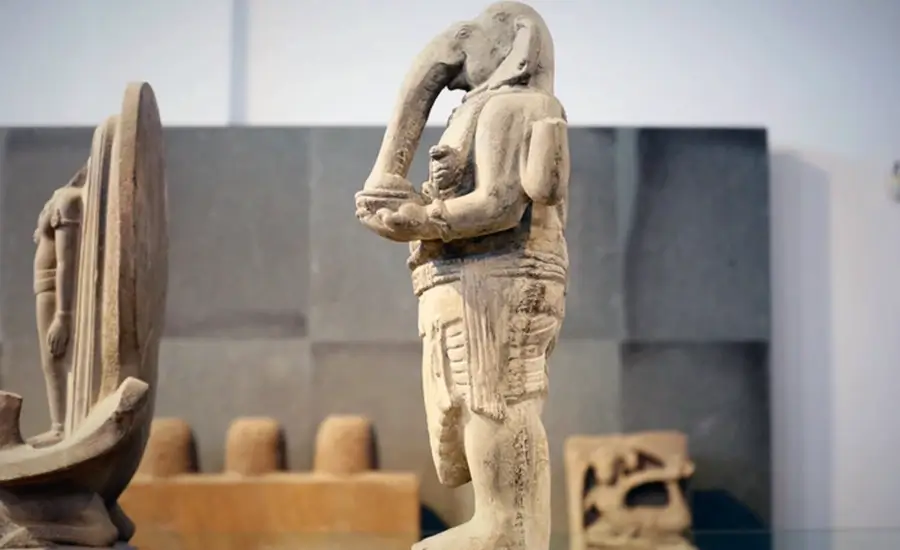
Ganesha statue, sandstone, dated 7th century, origin: My Son (Quang Nam). The statue was discovered in 1903 by the French Institute of Far East and Ancient France during archaeological work at temple-tower E5 of group E at the My Son relics in Quang Nam. After that, the statue has been kept and displayed at the Museum since 1918.
5, Apsara
Apsara – sandstone, originating from Tra Kieu, dated to the 10th century. Apsara is a fairy in Indian mythology. They are beautiful, elegant girls who sing well and dance well, are the wives of the musician Gandharva and the maidservants of the storm god Indra.
Apsaras were born from the churning of the milky sea of the Asura gods and demons to find the water of immortality. A corner of the pedestal currently displays sculptures of two Apsara dancers and two Gandharva musicians playing the instrument.
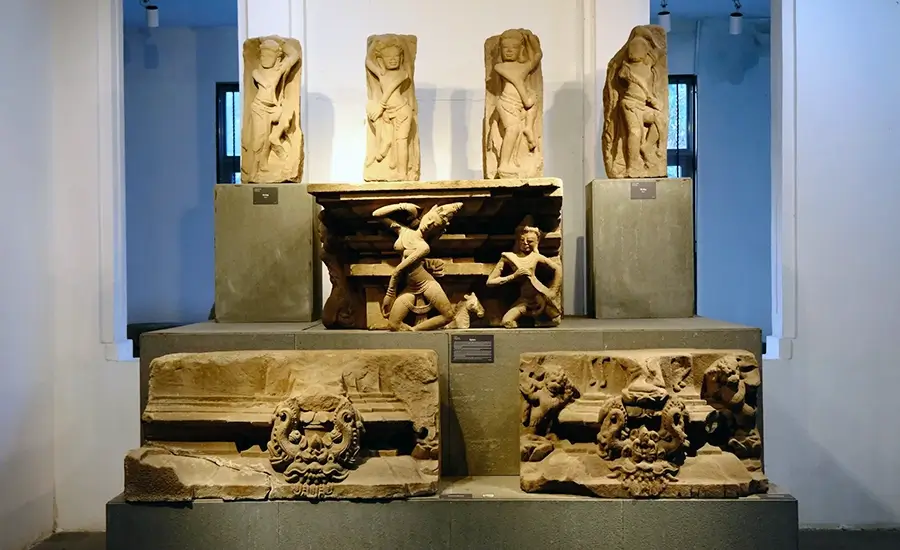
The Apsaras are shown dancing a dance that is still popular in Indian dance. The costume of Apsara dancers is also very special; it is a thin, tight-fitting dress, identified by a large bow tied on the back. 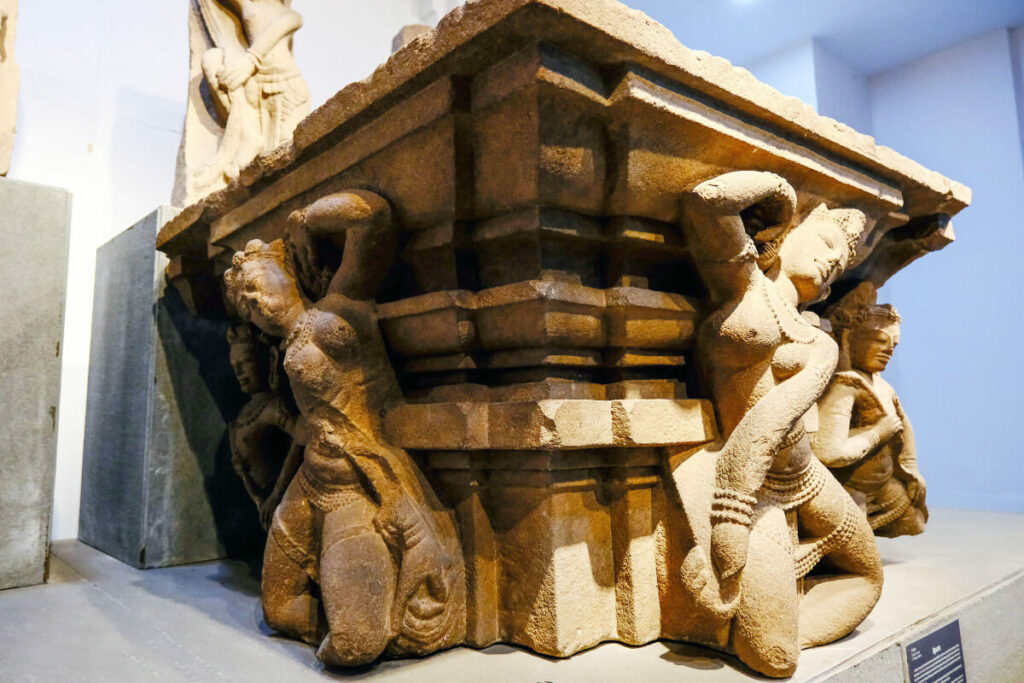
The dress is studded with many pearl strings, a characteristic of the Tra Kieu style. Outside the dress is a sampot made of small round pearls wrapped around the lower body and another layer loosely wrapped between the thighs, neck, ears, and hands, wearing many pieces of jewelry.
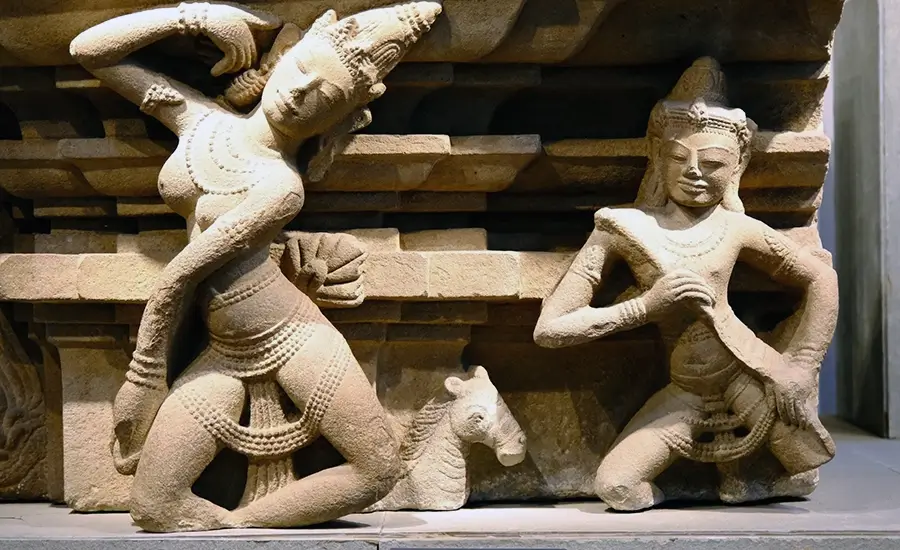
Apsara’s body curves softly, her face exudes pure, gentle beauty, and her lips seem to contain a secret smile. Next to the dancer is a Gandharva musician playing a Vina-shaped instrument.
6, Brahma’s birthplace
Brahma’s birthplace, sandstone, origin: My Son, dated 7th-8th centuries. This is a decorative carving on the arch of My Son E1 tower, brought to the museum in 1935. The carving depicts a familiar theme in Indian mythology: the legend of the creation of the human universe.
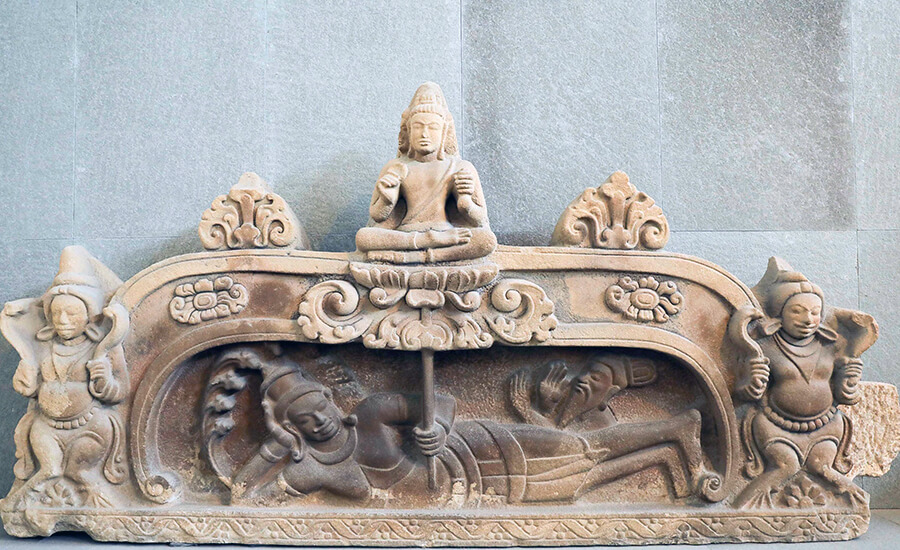
The carving illustrates the god Visnu lying on the vast, dark cosmic sea, supported by the 7-headed snake god Shesha, his right hand supporting his head, his left hand holding the lotus stem that grows from the navel. On the lotus stem, Brahma emerges in a meditative posture, and then Brahma created the world. On the side of the true god Visnu is the image of a Taoist blessing the birth.
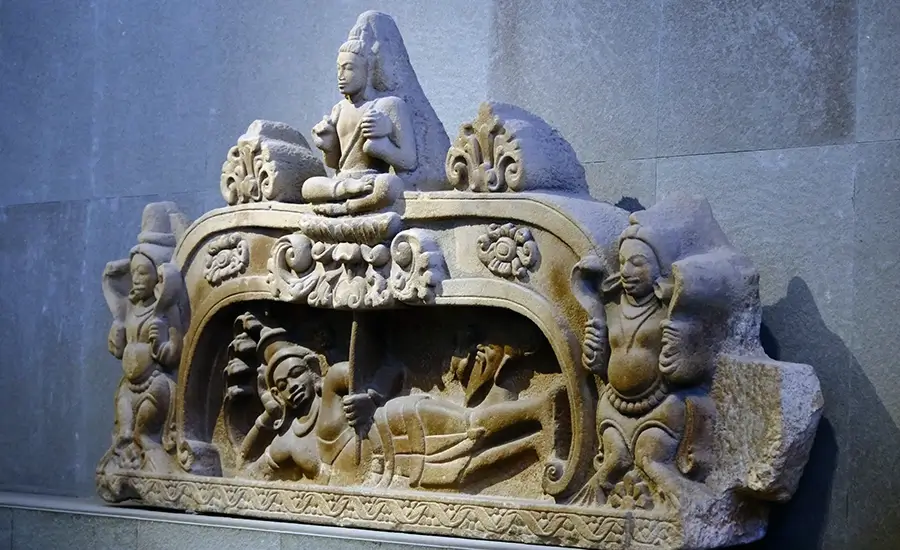
In Indian sculpture, this position often features the image of the goddess Lakshmi, Visnu’s wife. The two ends of the relief feature Garuda, god birds with human bodies and bird legs. This Garuda image is very popular in the Mon-Dvaravati art of Thailand. Currently, the Quang Ngai gallery is also displaying a work with the same theme.
7, Statue of Gajasimha
Gajasimha is a sacred beast in Indian mythology with the head of an elephant and the body of a lion. At temples and towers, the Gajasimha statue will be placed in front of the door to protect the building’s sanctity. Gajasimha statue, sandstone, origin: Thap Mam (Binh Dinh), dated 12th century. The statue was found during excavations at Thap Mam (Binh Dinh) in 1933-1934. After that, the statue was brought to the Museum in 1935.
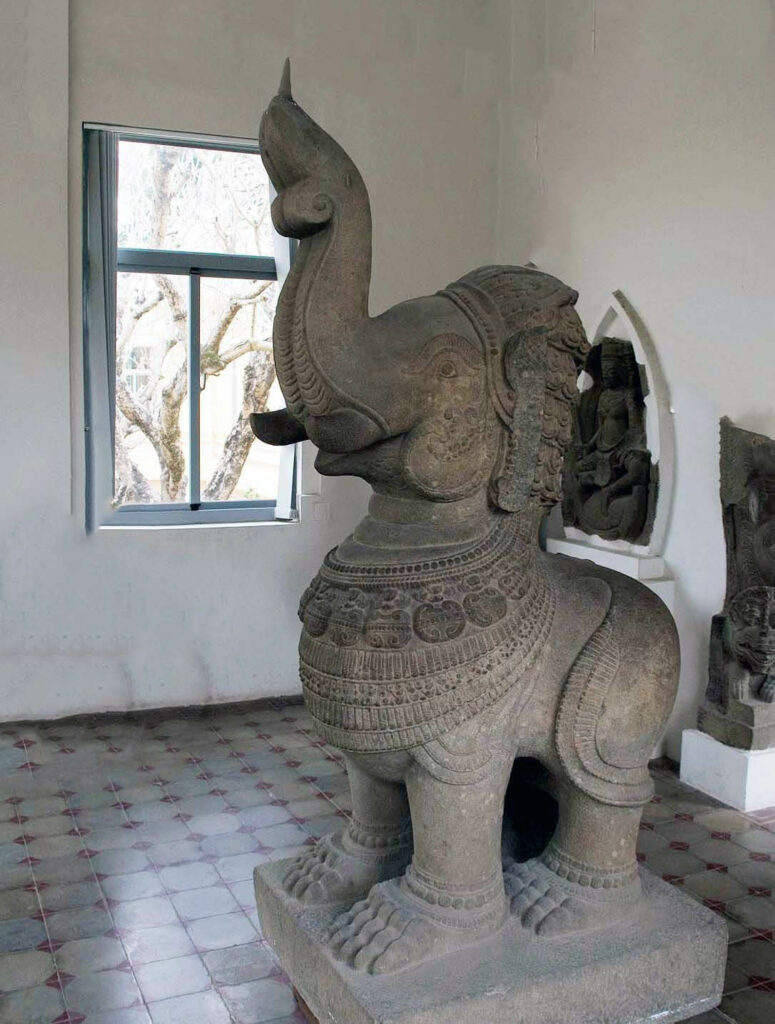
This is one of the rare round statues representing the deity in standing form, relatively intact, large in size, and bearing many unique stylistic features in the early period, around the 7th – 8th centuries.
8, Dong Duong Pedestal
The Dong Duong pedestal is a unique artifact with special and typical value, demonstrating a period of brilliant development of the ancient Champa kingdom with clear Buddhist influence. Dong Duong pedestal, sandstone material, origin Dong Duong, dated late 9th century – early 10th century.
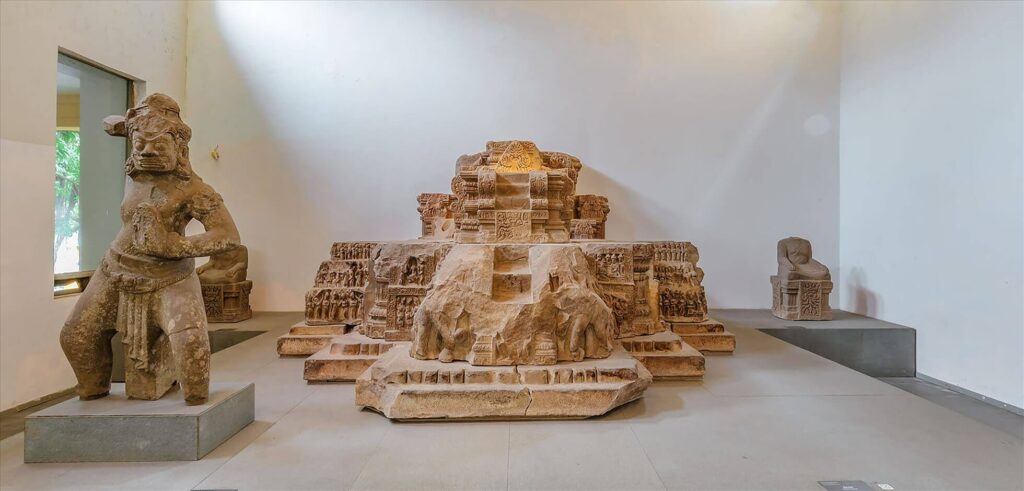
This is a pedestal found in the main western tower area where Bodhisattva is believed to be worshiped, slapping Laksmindra Lokesvara – the chief deity of the Buddhist monastery.
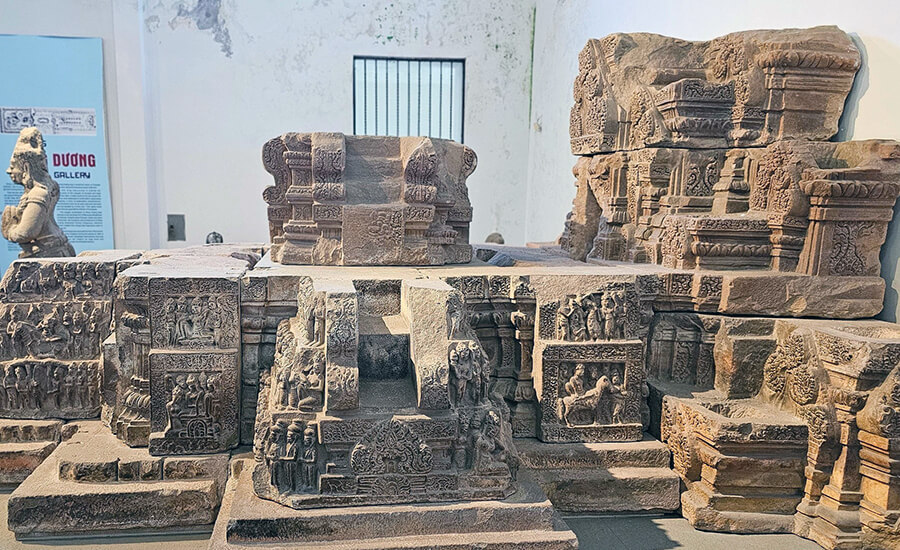
The Dong Duong pedestal is a unique material evidence of the Champa kingdom’s brilliant development in the 9th – 10th centuries. This was the period when Buddhism was most prevalent and developed in the kingdom’s history, marking a distinct stage of development compared to other periods.
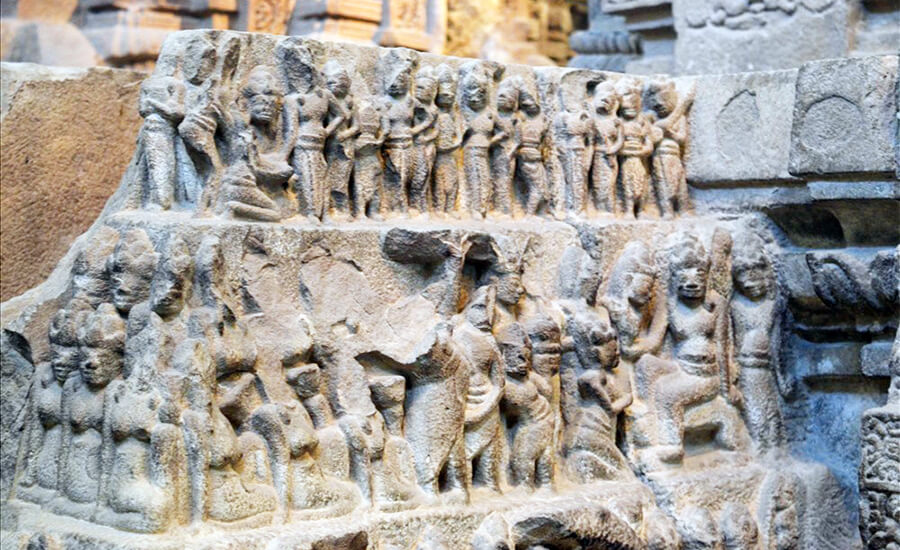
Although some parts and details are locally broken, this pedestal still retains the integrity of the elements that define the artifact’s typical value.
9, Statue of Bodhisattva Tara
The statue of Bodhisattva Tara, originating from Dong Duong, dates to the late 9th-early 10th centuries. The large bronze statue of Bodhisattva Tara (Laksmindra-Lokesvara), found at the Dong Duong relic, is a typical artifact of Bodhisattva worship at the Dong Duong Buddhist monastery.
This artifact was completely cast using a special casting technique, without any mold marks, particularly on the concave parts encrusted with gems and precious metals on the forehead. At international exhibitions, this statue is considered an important artifact and the highlight of the exhibition.
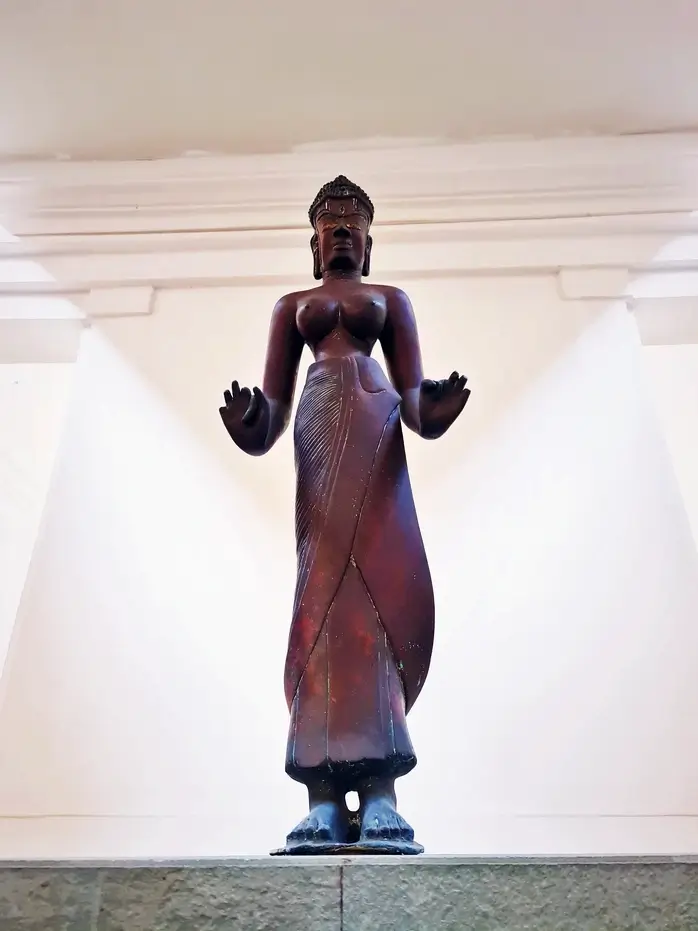
The entire upper body is exposed with full breasts. The lower outfit consists of a long skirt that reaches almost to the ankles and an outer layer of fabric. Square, serious face, big, curved, intersecting eyebrows, big nose, thick lips… reminiscent of the Dong Duong style. Her hair is tied up into a high bun with an image of Amitabha Buddha. Based on the stylistic characteristics and symbolic signs of the lotus in hand and the image of Amitabha Buddha in her hair, many researchers soon associated this statue with the chief deity Laksmindra Lokesvara mentioned in the literature stele found in Dong Duong.
Source: collected by An
Follow us for the best deals on Vietnam package tours and visa services!

Comment (0)