
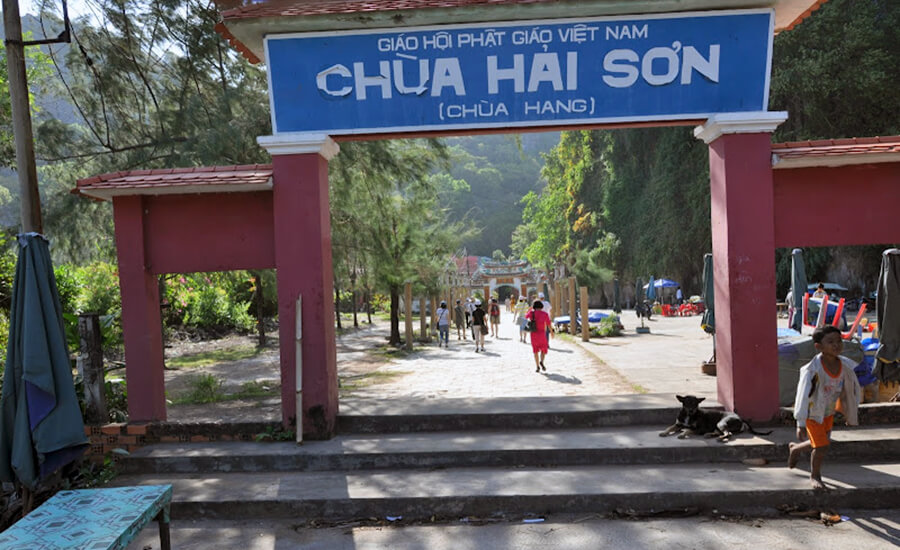
Hang Pagoda in Kien Giang attracts tourists with its unique architecture deep inside the cave. This place has a charming landscape that fascinates visitors.
Overview of Hang Pagoda in An Giang
Hang Pagoda, also known as Hai Son Pagoda, is located in a cave at the foot of An Hai Son Mountain, Kien Luong Commune, An Giang Province. The pagoda is located close to the coast of the Gulf of Thailand, where, year-round, waves crash against the limestone mountains that stand tall like a sea watchtower.
The Hang Pagoda was formed in the 18th century, when monks from Thailand and fishermen came to the An Hai Son mountain area to reclaim land, discovered this cave, and established a hermitage there (at that time, the pagoda did not have an official name). In 1771, the Siamese (Thai) invasion occurred, and the Thai monks had to leave this place.
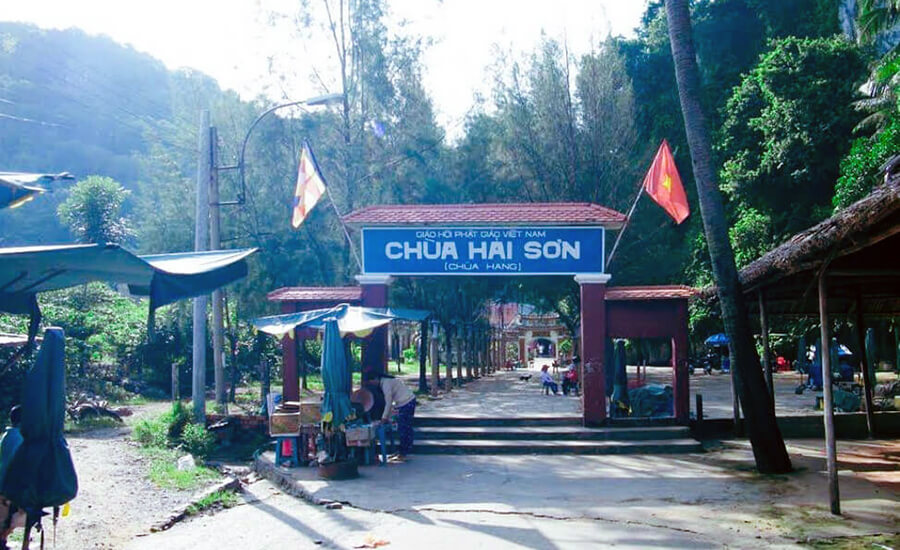
In 1800, two Vietnamese brothers, Vo Thuong Le and Vo Thuong Nghia, restored the cave pagoda and officially named it Hang Pagoda. Since then, many generations of abbots have succeeded each other in preserving and developing the pagoda. Especially the major 1962 renovation by Venerable Thien Hoa, which gave the pagoda its current appearance. Hang Pagoda was ranked as a national historical and scenic relic by the Ministry of Culture and Information in 1989. Currently, the area has become the Hang Pagoda – Phu Tu islet tourist area and has been attracting a lot of tourists to visit.
How to get here?
Hang Pagoda is located midway between Rach Gia and Ha Tien, making it quite convenient to reach by road.
- From Rach Gia Ward, it is about 70km northwest of the pagoda. Visitors follow National Highway 80 towards Ha Tien for about 50km. When reaching Kien Luong town, turn left onto provincial road DT11 (the road to Chong islet) and continue for about 18-20km to reach the Phu Tu – Hang Pagoda tourist area. This route has clear signs, the roads are relatively easy to travel on, and it can be traveled by car or motorbike.
- From Ha Tien Ward, Hang Pagoda is about 38km to the southeast. From the center of Ha Tien, visitors follow National Highway 80 back to Rach Gia, through Kien Luong district, turn right towards Chong islet – Binh An to reach Phu Tu islet scenic area. This route runs along limestone mountains and fields, with beautiful scenery and signs to the tourist area. Visitors without their own vehicles can take a coach or bus from Rach Gia/Ha Tien to Kien Luong and then take a motorbike taxi/taxi to Hang Pagoda.
Currently, upon arriving at the gate of the Phu Tu islet Tourist Area, visitors will be taken by electric car to Hang Pagoda instead of walking as before, making the sightseeing journey lighter and more convenient.
Opening hours and entrance fee
Hang Pagoda – Phu Tu islet tourist area is now open to visitors every day of the week. Visitors can visit Hang Pagoda during the day (early morning to before sunset) to ensure sufficient natural light in the cave and to clearly see the scenery. Morning is considered the ideal time to visit Hang Pagoda – Hon Phu Tu, when the weather is cool, and the gentle sunlight makes the sea and mountain landscape appear clear and fresh.
Currently, to enter the Hang Pagoda – Hon Phu Tu tourist area, visitors need to buy a ticket for about 20,000 VND/person to visit Hang Pagoda, Phu Tu islet, and the neighboring Bai Duong beach. In addition, parking motorbikes or cars at the parking lot has a small fee (per day). Note that the entrance fee may be adjusted according to local regulations; visitors should update the latest ticket price before going. In addition, there is no separate entrance fee for Hang Pagoda; visitors may freely worship Buddha and make merit as they wish.
Characteristic architecture of Hang Pagoda
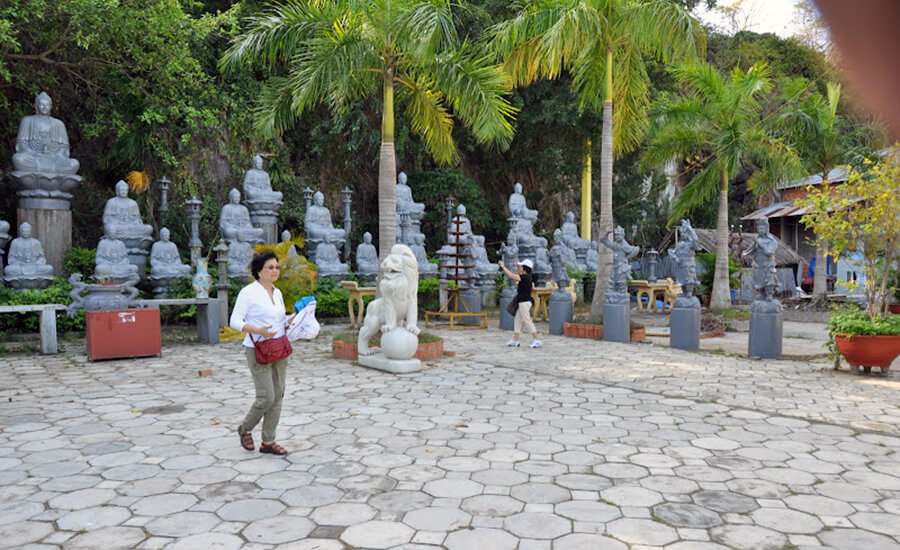
Hang Pagoda in An Giang is located right under a limestone cliff, and in front of it is the pagoda yard overlooking the sea. Right in the pagoda yard is a white stone Maitreya Buddha statue weighing about 22 tons, imported from Non Nuoc (Da Nang) – a large statue standing out in the natural landscape.
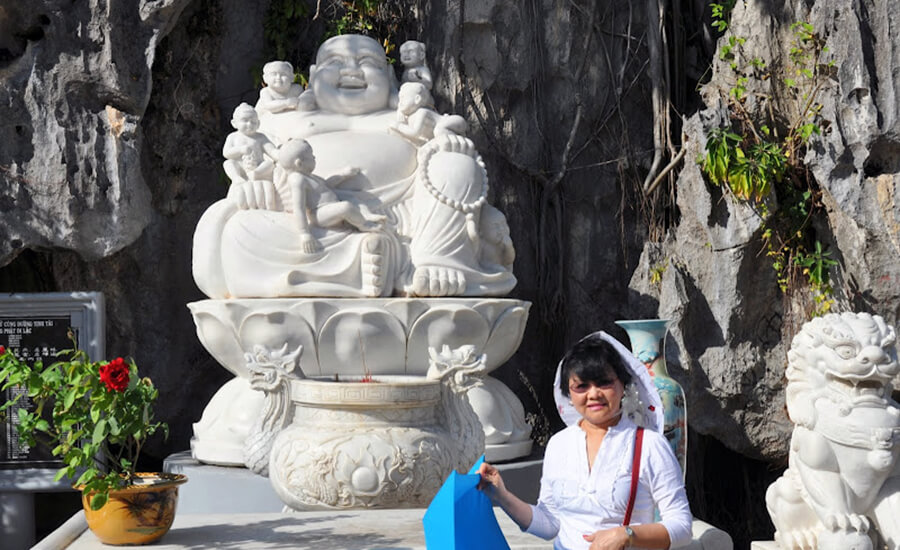
Above the cliff around the cave mouth are ancient trees clinging to the rocks, letting their long roots hang down, creating a scene that is both wild and sacred. The entrance to the pagoda is through an ancient-style triple gate, with a signboard bearing the name “Hai Son Tu”.
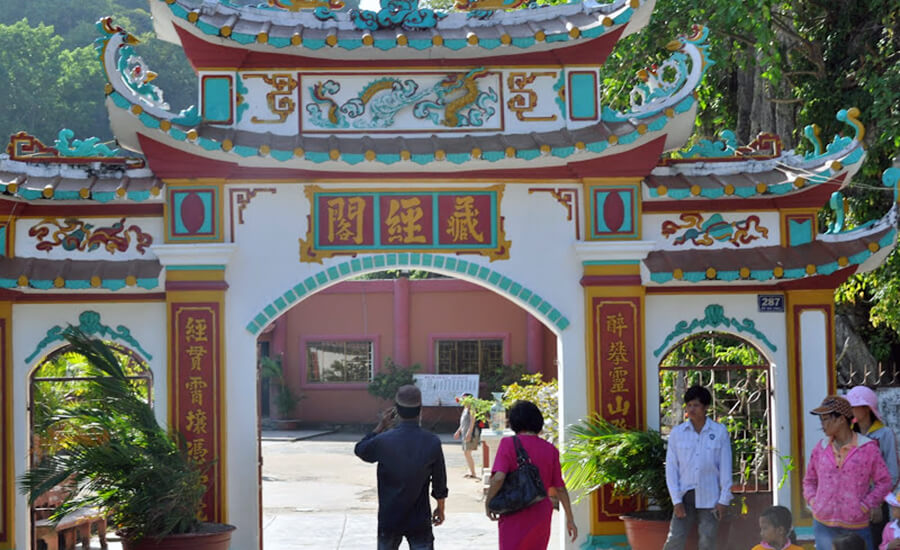
The entire pagoda is hidden in the heart of the rocky mountain, so from the outside, you can only see the green cliff and the ancient pagoda gate.
Passing through the gate, visitors will enter a natural limestone cave running through the mountain along the Northeast – Southwest axis, more than 50 m long. The cave is quite high but very deep, so the inside lacks light, the middle part is as dark as night. The cave is only wide enough for 3-4 people to pass through at its narrowest point, and the cave floor has been used as a path for visitors.
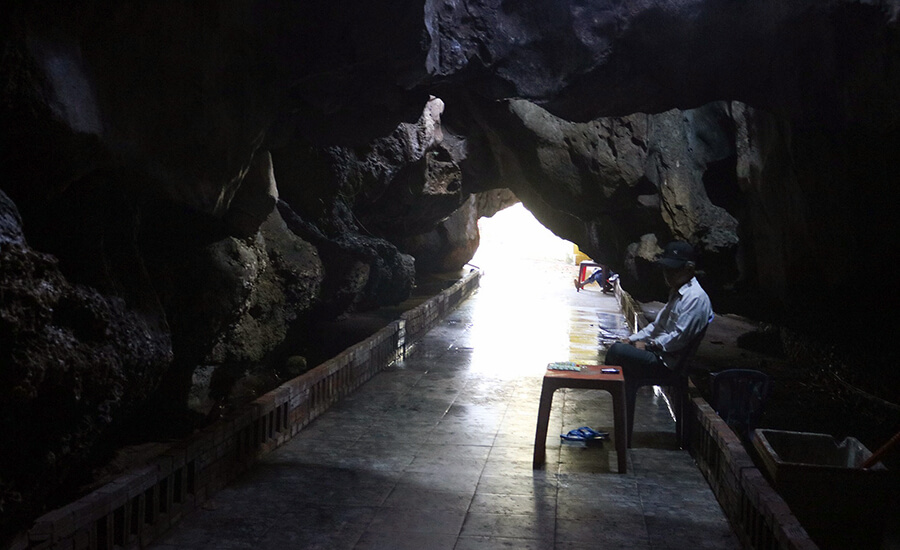
Inside the cave, there are many stalactites with many strange shapes formed by seawater erosion. In particular, when tapped lightly, the large stalactites resonate like bells, so people call them “bell stone”. In the main cave, there is the main hall of Hang Pagoda with many Buddha statues, notably the rare statue of the Thousand Hands and Eyes Bodhisattva Guanyin of the Southern sect.
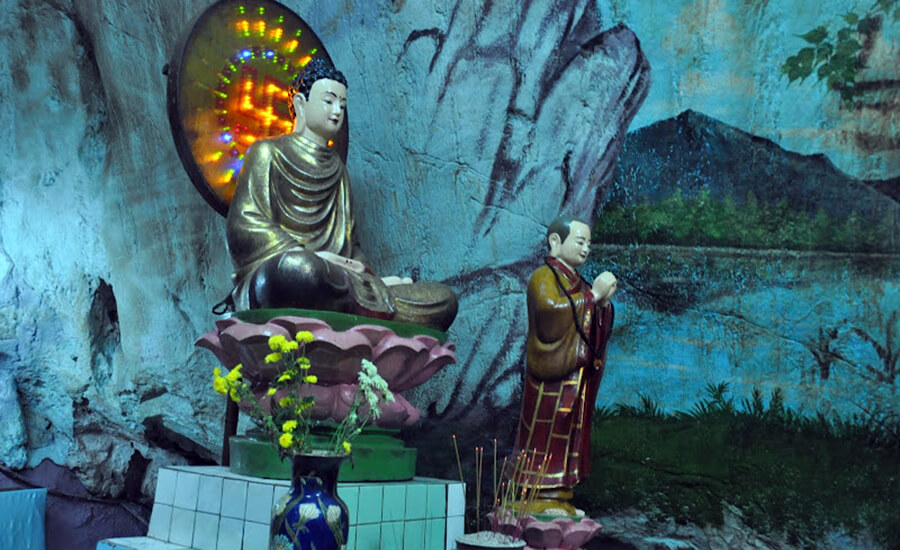
In addition, the cave has famous niches, such as the “path to heaven” on the wall, and is called “Kim Cuong cave” or “Phat Ngu cave”, where a natural rock shaped as a Buddha lies peacefully in the dim light and dark. All of these create a mysterious, sacred space typical of Hang Pagoda.
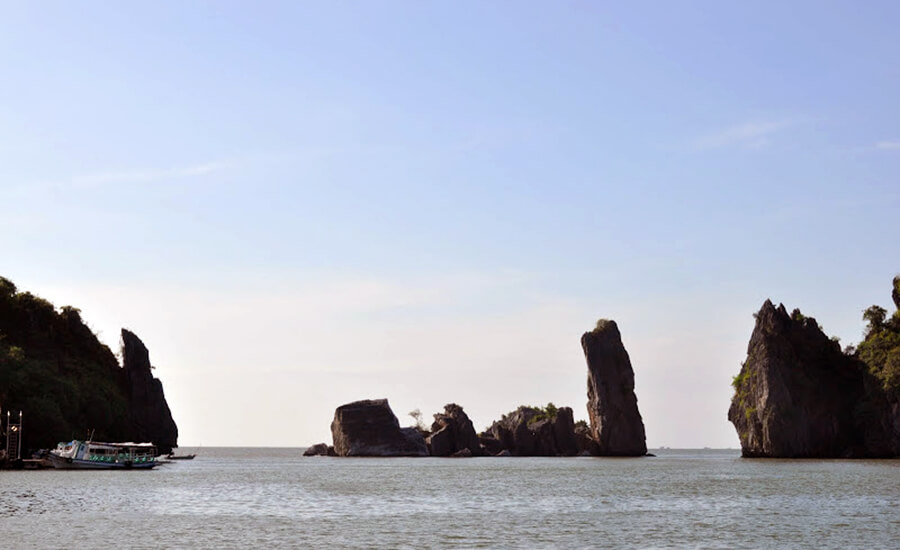
From the main hall, a cave path leads to the coast; visitors follow the winding path for about 10-15 minutes to feel the cool sea breeze and see the brilliant blue light at the end of the cave. This exit opens onto a rocky beach near the sea, where visitors can enjoy a panoramic view of Phu Tu islet and the vast sea and sky beyond.
Religious activities and festivals at Hang Pagoda
Hang Pagoda is a long-standing Southern Buddhist institution, both a place for monks to practice and a pilgrimage site for Buddhists and tourists. Every day, the pagoda still holds chanting and incense-burning ceremonies like other pagodas. In particular, every year the pagoda organizes a grand festival in the spring, lasting from the 8th to the 15th of the 4th lunar month (on the occasion of Buddha’s birthday).
During this time, the pagoda attracts a large number of Buddhists and tourists from all over to offer incense to Buddha and pray for peace. Unlike many other pagoda festivals, the Hang Pagoda festival takes place solemnly, simply, and quietly – no ostentatious offerings, no colorful lanterns – maintaining the pure space of the Zen monastery.
In addition to major festivals, Hang Pagoda also attracts many locals on the full moon and the first day of each month (lunar calendar) to worship and pray for luck and peace. Visitors from all over the world often prepare offerings (incense, flowers, fruits, etc.) to present to the Buddha as a sign of respect before visiting the pagoda.
With its sacred status and unique scenery, Hang Pagoda is both a place for worship and a typical cultural and spiritual tourist destination in Kien Giang province.
Notes and tips when visiting Hang Pagoda in An Giang
- Dress politely, keep quiet: Because Hang Pagoda is a spiritual tourist destination, visitors should dress elegantly and behave discreetly when entering the pagoda. Avoid talking and laughing loudly to keep the sacred space of the Buddha’s door. Especially in the main hall in the cave, which is quite small and quiet, visitors should walk lightly and speak softly.
- Choose the right time: The best time to visit Hang Pagoda – Phu Tu islet is the dry season (from about December to April of the following year) when the weather is sunny, the sea is calm, and the scenery is clear. Avoid going in the rainy season (May-October) because the cave path can be slippery and the sea is rough. Morning is the ideal time of day to visit and take photos because of the good light and cool air.
- Avoid crowds: During festivals (April 8-15 of the lunar calendar) or on the 1st and 15th of the lunar month, Hang Pagoda attracts many pilgrims. If you don’t like crowds, you should avoid these peak days or go early. On the contrary, if you want to immerse yourself in the festival atmosphere, be prepared to park your car further away and queue to enter the cave. Weekends are also crowded with tourists, so going on weekdays will be more comfortable.
- Prepare offerings and flashlights: Visitors can bring some incense and fruit to offer to Buddha at the temple, showing respect before visiting. The cave is quite dark inside, although there is electricity, you can bring a small flashlight to better illuminate the stalactites and paths if needed. You should wear sneakers or sandals with a good grip because the wet cave floor can be slippery.
- Services and security: Hang Pagoda – Phu Tu islet tourist area now has an electric shuttle from the gate to the temple, a spacious parking lot, public toilets, and a tourist information station. The area’s security is guaranteed by the local government, and there is almost no solicitation of tourists. Visitors should still take care of their personal belongings.
Source: collected by An
Follow us for the best deals on Vietnam package tours and visa services

Comment (0)