
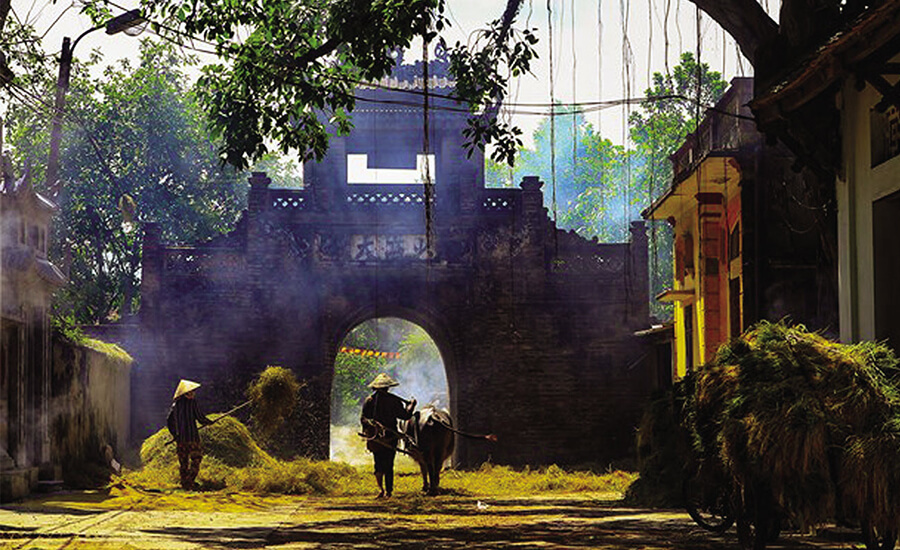
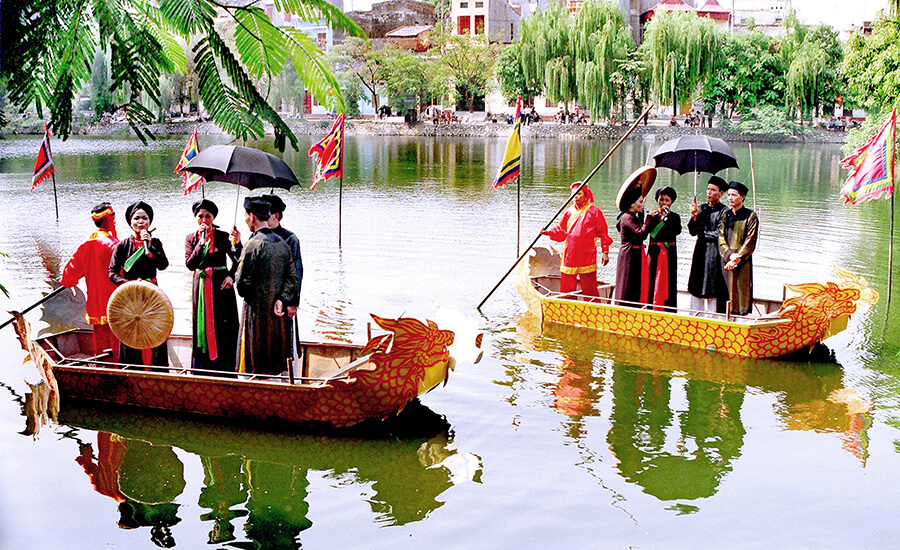
Occupying most of the area of the ancient capital region, Bac Ninh has a rich culture, one of the cradles of Quan Ho folk songs with 49 ancient Quan Ho villages, the cradle of Quan Ho folk songs recognized as a representative intangible cultural heritage of humanity by UNESCO. This place is also famous for the Tay Yen Tu scenic area, many beautiful pagodas, festivals, preserved traditional craft villages, and rich nature. In particular, Luc Ngan litchi is a specialty loved by many people.
General information about Bac Ninh
Bac Ninh borders the Northern midlands. The administrative center of the province is located in Bac Giang ward, about 50 km northeast of the center of Hanoi, with the following geographical location:
- Bordering Quang Ninh province to the east
- Bordering Hanoi to the west
- Bordering Hai Phong city and Hung Yen province to the south
- Bordering Lang Son province and Thai Nguyen province to the north.
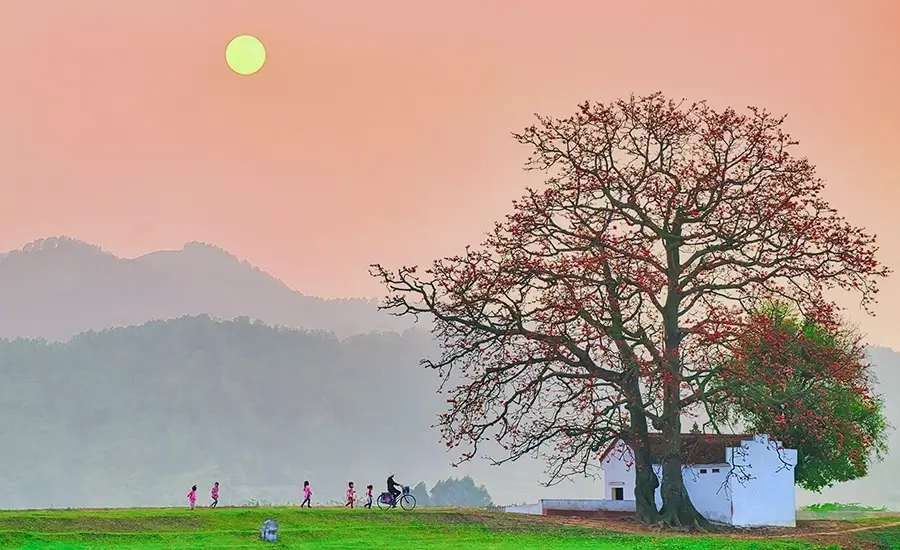
After the 2025 merger, Bac Giang province and the former Bac Ninh province formed a new administrative unit, Bac Ninh province, with a natural area of 4,718.60 km².
What’s the best time to visit Bac Ninh?
Bac Ninh is located in the tropical monsoon climate zone, with four distinct seasons. The average annual temperature is about 23-24 degrees Celsius. From January to March is the festival season of Dau pagoda, Lim festival, Do temple… suitable for those who like to learn about culture and customs.
In the summer and autumn months, there are not many special things to do in Bac Ninh, but you can visit spiritual spaces, craft villages… At the end of the year, the canola fields along the Duong River bloom in bright yellow, making for great photo opportunities.
How to get here?
Bac Ninh is near Hanoi; travel time is about an hour. This is a suitable destination for weekend cultural tourism. For those who live far away, you can combine Hanoi and Bac Ninh into a single trip. Transportation from Hanoi is quite convenient; you can go by motorbike, private car, taxi, bus, or boat.
Accommodation in Bac Ninh
Accommodation areas are mainly concentrated in Bac Giang ward, with many options from budget to mid-range and high-end.
4-star hotels include Muong Thanh, Kinh Bac Palace, Mandala Hotel and Suites, Ravatel Luxury Hotel, Sojo Hotel Bac Giang, and Linn Hotel, with double-room prices ranging from 700,000 VND to 1 million VND per night. Other hotels cost 200,000 VND per night or more.
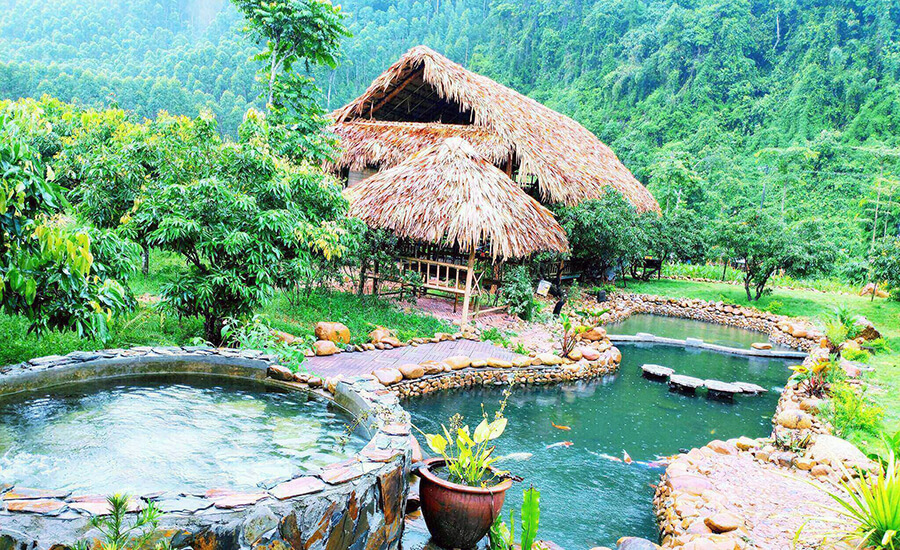
In addition, visitors can also stay in Viet Yen, Luc Nam, and Son Dong wards. The Tay Yen Tu tourist area has homestays, priced from 200,000 VND per person.
Tourist attractions in Bac Ninh
Sacred temples and pagodas
Tieu Pagoda
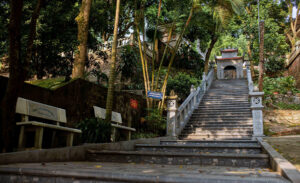 The pagoda in Tam Son ward is a famous ancient temple in Bac Ninh province, located halfway up the mountain, surrounded by quiet trees year-round. The pagoda consists of the patriarch house, the stele house, and auxiliary works.
The pagoda was a large Buddhist center during the Ly Dynasty. Currently, this place preserves many ancient documents and anecdotes reflecting the life and background of Emperor Ly Thai To.
Coming to Tieu Pagoda, visitors can also admire the mysterious and precious statue of Zen Master Nhu Tri in Vietnam. In addition, this is a rare pagoda in the North that does not have a donation box, the altars only have fruits, candies, incense, etc.
Dau Pagoda
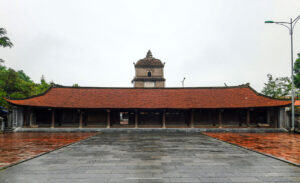 Dau Pagoda is located in Tri Qua ward, in the center of the typical historical and cultural relic area of the north. It was built at the beginning of the 3rd century, in a region that later became a center for Buddhism. Visitors to Dau Pagoda not only pray for peace but also to see with their own eyes the unique architecture of “the oldest pagoda in Vietnam”.
In Buddha’s main sanctuary, there is a large statue of the female genie Phap Van, seated on a lotus flower, which is why the pagoda is also called Phap Van Pagoda.
Near the pagoda is a famous tower, Hoa Phong, built in the 6th century. This stone tower was built to protect against evil winds. Inside the tower hangs a bronze bell and a cast gong.
Phat Tich Pagoda
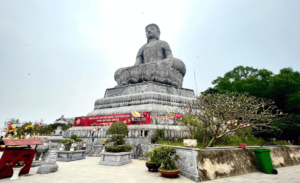 Phat Tich pagoda was built between the 7th and 10th centuries on the mountainside of Phat Tich in Phat Tich Commune. Under the Ly Dynasty, the pagoda underwent a large-scale restoration. In 1057, Emperor Ly Thanh Tong ordered the building of a tower for valuables.
There are some ancient relics preserved in the pagoda, such as a blue stone statue of Amitayus Buddha meditating on a lotus pedestal. The statue is 1.86 m high; with the pedestal, it reaches 2.69 m. On the pedestal and in the lotus petals are images of dragons and flowers, a typical feature of the Ly Dynasty art. It was recognized as a national treasure of Vietnam in 2013.
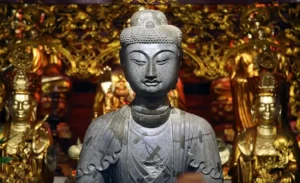 Besides the Amitayus Buddha statue, Phat Tich Pagoda also has another national treasure: a set of 10 sacred animal statues from the Ly Dynasty. These 10 statues include 5 pairs of horses, rhinoceroses, buffaloes, elephants, and lions, arranged symmetrically in front of the Tam Bao corridor.
In the pagoda, there are also other Ly Dynasty relics such as stone wall panels, fighting cocks… on which are carved images of Kim Cuong, Dharma protectors, divine birds, musicians, dancers, etc.
Cung Temple – Ngoc Well
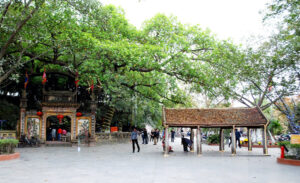 Cung Temple is located in Viem Xa area, Kinh Bac ward (also known as Diem village). The miracle of Cung Temple has been famous among the people for a long time, since the Tien Ly and Tien Le dynasties. During the Ly dynasty, the court’s mandarins and soldiers fought along the Cau River and came to this place to pray for help, and all were answered, leading to the defeat of the invaders.
In the middle of Cung Temple’s yard is Ngoc Well. Ngoc Well is semicircular, about 20 m² in area, with 11 brick steps, 4 stone steps, and 1 ironwood step near the edge of the well.
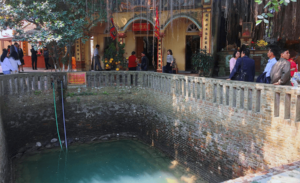 At the bottom of the well is a layer of natural laterite about 10m deep. The water in the jade well is clear blue, and you can see all the way to the bottom. The water drawn from the well can be drunk directly without filtering or boiling, and will taste cool and naturally sweet like no other.
Nowadays, Cung Temple – Ngoc Well is a tourist attraction that draws many visitors from all over to visit and pray for love, career, and a good family. Cung Temple worships two princesses, Tien Dung and Thuy Tien, daughters of Emperor Ly Thanh Tong, who had the merit of founding the village and passing on the profession to the people.
Do Temple
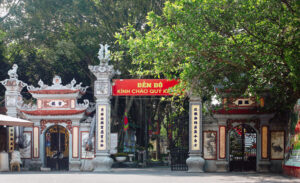 Dong Temple was built during the reign of the Le King in Dinh Bang Village, Tu Son ward, and it has been altered several times since. The major reconstruction took place under the reign of Le Trung Hung in the 17th century. At that time, a high wall of ancient architectural style was built to surround the temple.
The interior residence contains a sanctuary where the sacred throne and ancestral tablets of the eight Ly Kings are kept. It is surrounded by a 3m high, 1m wide brick wall. The outer building consists of a square chamber with eight roofs. It houses the worshipping house, the storehouse, the guesthouse, and the Queen’s Temple, which is dedicated to Princess Ly Chieu Hoang. A five-dragon entrance leads to the square house, a paved stone path.
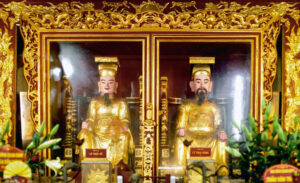
The outer wall, next to the brick wall at the end of the guesthouse, has four palanquins on each side. On the way from the five-dragon entrance to the lakeside, visitors will see a water puppet stage with eight roofs and curved corners. By the semi-circle-shaped lake is the house of stelae.
Many valuable ancient relics and important historical documents are preserved in the Do Temple. In particular, there is an old stela with the writing of Phung Khac Khoan, the winner of a feudal literature contest in 1602.
But Thap Pagoda
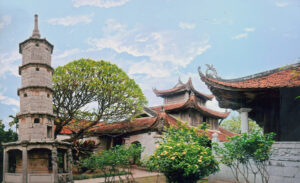 But Thap pagoda is located west of But Thap village, in Tri Qua ward. Thap But pagoda is one of the most famous pagodas in Vietnam. The architectural complex still retains many relics of the 17th century. The temple’s Buddha hall is almost the same as that of an ancient Vietnamese temple, consisting of 10 houses located on a long axis of more than 100 meters
Inside, there are various valuable ancient objects and statues considered Vietnamese masterpieces of 17th-century wood carving. Among them are the They Tien Dong Do Lich Dai statue and the Guanyin statue with one thousand eyes and one thousand arms, made in 1656 and symbolizing the reverence of both religion and beauty.
Vinh Nghiem Pagoda
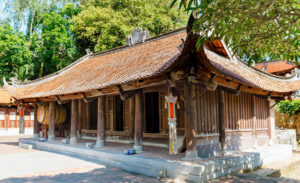 Vinh Nghiem Pagoda, also known as Duc La Pagoda, is an ancient pagoda in Duc La village, Tan An ward, Bac Ninh province, Vietnam. Vinh Nghiem Pagoda dates back to the beginning of the Ly Thai To period (1010-1028). The pagoda was built along a southeast axis, comprising 4 blocks: Thien Duong Palace, Thuong Dien Palace, the first Patriarch’s house, the bell tower, the second Patriarch’s house, and a number of other structures.
In the pagoda, there are many statues of the Dharma, including Buddha statues, statues of the Truc Lam lineage’s ancestors, statues of later ancestors, Dharma protectors, and Arhat statues…The pagoda is recognized as a Buddhist center, a place to train monks for the whole country, and the birthplace of the Three Patriarchs of the Truc Lam Zen sect of Vietnamese Buddhism. This is a place to store ancient wooden scriptures dating back 700 years, an extremely valuable ancient bookstore. In 2015, the pagoda was recognized as a special national monument
Bo Da Pagoda
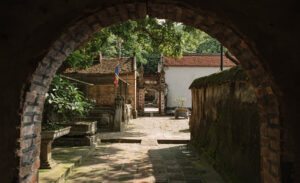 Bo Da Pagoda is located on Phuong Hoang Mountain (Bo Da Son), north of the Cau River, in Van Ha ward. Bo Da Pagoda is one of the most unique pagodas in the region, a major Buddhist center of the Truc Lam Yen Tu Zen sect. The pagoda was designated a special national monument in 2016, and the Buddhist scriptures carved on wood and preserved in the pagoda are considered the oldest of the Lam Te Zen sect. Bo Pagoda is one of the places that still preserves traditional Vietnamese architecture.
The pagoda has a unique architecture compared to traditional pagodas in Northern Vietnam, the most beautiful and largest tower garden in Vietnam, many valuable antiques, and a rich treasure of Han-Nom heritage. Nearly 100 interconnected rooms were built with folk materials such as baked bricks, tiles, and ceramic coffins, and the surrounding walls were made of earth. The walls, gates, and some structures were built with rammed earth, creating a quiet, close-to-the-Northern-countryside feel.
Eco-tourism areas
Suoi Mo
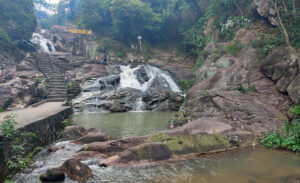 Suoi Mo is located in Nghia Phuong commune, nearly 30 km from Bac Giang ward. Flowing along the foot of Huyen Dinh – Yen Tu mountain, under the dense forest canopy and undulating rocks, the scenery here is very majestic. In this area, there is also a cluster of temples (Ha temple, Trung temple, Thuong temple) worshiping Princess Que Mi Nuong, daughter of the 16th Hung King, who opened the stream to bring water to the region.
Going further upstream is the temple dedicated to worshiping Duc Thanh Tran and some vestiges of the Tran Dynasty army that fought against the feudal invaders. Suoi Mo is an eco-tourism destination combined with cultural beliefs, suitable for many types of visitors. From the stream bank, visitors will explore Rong Khe peak, Thum Thum waterfall, Ngam Trang watchtower, Thuong Ngan peak… Stopping to explore Suoi Mo, visitors will enjoy many local dishes, such as wild bamboo shoots, grilled stream fish, five-color sticky rice, crab rice noodles, and rice cakes.
Cam Son Lake
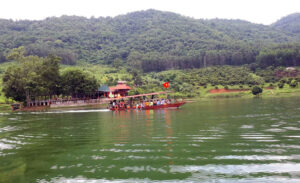 A natural freshwater lake stretching across many communes in Son Hai commune and Lang Son province, about 2,600 hectares wide, can reach 3,000 hectares during the rainy season. The lake is nearly 30 km long, 7 km wide at its widest point, 200 m at its narrowest point, and about 20 m deep. The lake is surrounded by high mountain ranges; in other words, the lake’s shore is the overlapping mountains and tall trees. In addition, the lake’s vicinity is home to the Tay and Nung ethnic communities.
From National Highway 1A to Lang Son, about 50 km, turn in about 4 km, visitors will reach the main dam of Cam Son Lake. This place is suitable for picnics, boating, mountain climbing, and fishing as well as visiting ethnic minority hamlets.
Typical architectural works
Tho Ha Village and Communal House
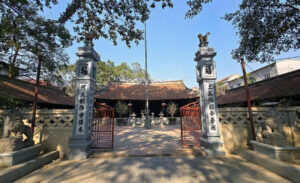 Tho Ha Village, located in Hiep Hoa Commune, is a pure Vietnamese Northern countryside village. The village still retains its typical features such as gates, communal houses, banyan trees, and wells. Tho Ha land cannot grow rice, so people here make a living by handicrafts and trade.
The Tho Ha Communal House is a national relic, built in 1692 during the reign of King Le Hy Tong, representing the spiritual and cultural space of the Vietnamese people. The carvings are clearly in the style of the Le Dynasty, expressed on the architectural structures as stylized “four sacred animals, four seasons”, birds, animals, and humans. The Ha Communal House currently consists of three houses: the front hall, the main hall, and the rear palace.
Dinh Bang Communal House and Dinh Bang village
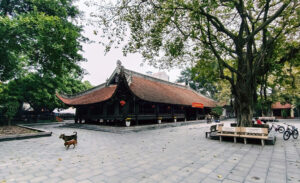 Dinh Bang Communal House, located in Tu Son ward, is very famous in northern Vietnam. Its construction started in 1700 and ended in 1736. The house is a place of worship for three tutelary spirits: Cao Son Dai Vuong (God of land), Thuy Ba Dai Vuong (God of water), and Bach Le Dai Vuong (God of harvest).
The main part of the communal house is rectangular, 20m long and 14 wide, and it is divided into seven rooms. It is very imposing due to its large roof and its 60 or so ironwood pillars, which range in diameter from 55 to 65 cm.
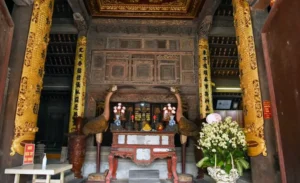 The components’ design is highly complex, and the structure is very sturdy. There is a panel inscribed with Chinese characters that is read in Vietnamese as Bat Ma Quan Phi, meaning “Eight Running Horses”.
To get to Dinh Bang village from Hanoi, cross the Red River on the Chuong Duong Bridge and then take National Highway 1 for 20km. Dinh Bang, rich in historical sites, is one of Bac Ninh’s 20 traditional handicraft villages.
In Dinh Bang, people are experts in lacquerware. Moreover, almost everyone in the village sings quan ho folk music. People of all ages and both genders express their feelings through lyrics that bear a deep national character.
Craft villages
Dong Ho Painting Village
Dong Ho Village is located on the banks of the Duong River in Thuan Thanh District, and has long been a part of the spiritual life of Vietnamese people with folk paintings imbued with national identity. Dong Ho paintings are not drawn based on inspiration but are printed using wood engravings.
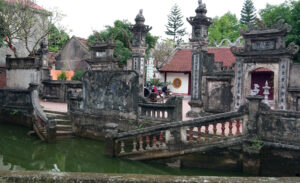
To have sophisticated engravings, there must be a model painter with high technical skills. The painting must be printed on fine Do papers. Colors for painting are obtained from natural materials such as half-baked bricks and ashes of certain leaves and roots.
To create the glittering background for Do papers, the artisan burns scallop shells into a powder, which is refined and mixed with resin, and then the mixture is applied to the paper sheet, which will be used for painting.
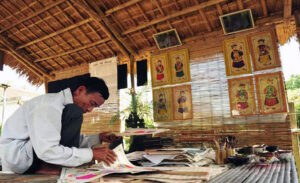
Dong Ho’s paintings have conventional layouts, contents, and colors. For a large part, the painting reflects wishes for peace, happiness, and prosperity. Some paintings focus on animals such as cows, pigs, dogs, and cats, which are familiar to Vietnamese farmers. Particularly, such topics as “catching coconuts”, “mice’s wedding”, and “jealousy” always attract tourists at home and abroad.
In the past, the villagers just made paintings before the Tet Holiday (Lunar New Year’s Day). Nowadays, tourists can buy paintings at any time of the year.
Phu Lang Pottery Village
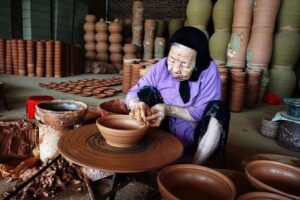 Phu Lang Pottery Village, located in Phu Lang Commune, was recognized as a National Intangible Cultural Heritage in 2016. In Phu Lang, it is easy to see pottery lining the village roads, alleys, and hamlets. In addition to household products such as jars, pots, and vats, Phu Lang pottery is also used for interior and exterior decoration…
The pottery here has brown, black, and light yellow glazes. Each finished product goes through many stages, from spreading the clay, shaping, cutting, drying, firing, and assembling…
The highlight of Phu Lang pottery is the use of the embossed carving method, with natural, durable, and unique glaze colors. The shape of the pottery is rustic but strong, containing the pristine beauty of earth and fire.
Tho Ha rice paper
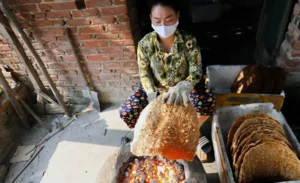 Tho Ha village is located in Van Ha ward, about 45 km from the Hanoi capital. Tho Ha village was formerly famous for its pottery. This was one of the most famous pottery centers of the Vietnamese people in the 14th century. However, the pottery profession gradually faded away; only the rice paper-making profession is still passed down from generation to generation. Upon entering the village, visitors’ first impression will be of rice paper trays lining small alleys, roofs, and tree branches, and the air is filled with the aroma of rice paper. Tho Ha mainly produces two types of rice paper: coconut and spring roll.
To have delicious rice paper, people are careful right from the stage of choosing ingredients. Rice paper is made from pure rice that is soaked overnight. Every day at 3 am, the small village by the Cau River wakes up to start a working day. Every kitchen is red hot. Nowadays, while coconut rice paper is still made by hand on the stove, the process of making rice paper is supported by machines. The grilled coconut rice paper is crispy and fragrant, with notes of coconut, sesame, and peanuts. The rice paper has a moderate thickness, is flexible, easy to roll, and is still chewy when soaked in water without breaking, so it is popular with many people. Currently, Tho Ha is also a destination for tourists and researchers of culture and craft villages.
Specialty of Bac Ninh
Dinh Bang Phu The Cake
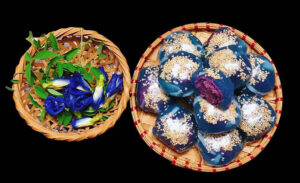 This is a characteristic of the North culture. Phu The Cake is wrapped in Dong leaves and boiled, so its aroma doesn’t show, but beneath the transparent yellow crust, the filling looks inviting. In addition to green beans that are shelled, steamed, and fluffed, the maker adds white sugar, coconut pulp, lotus seeds, and five-spice powder.
The cake dough is made from sticky rice, ground in a water mill, then filtered to extract the essence, pressed through a sieve, and dried. When eating the cake, we will feel the stickiness of the sticky rice, the crispiness of the papaya, the richness of the green beans, the fatness of the coconut pulp, the richness of the lotus seeds, and the sweetness of the sugar, all blending together to create a unique flavor.
Te Cake in Cho Village
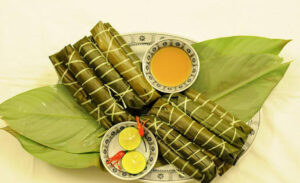 Te Cake is a specialty of Yen Phong land. To make this type of Te cake with a characteristic flavor, the people of Cho village often choose fragrant, moderately sticky rice as the raw material.
Besides rice, the filling includes pork butt or shoulder, dried onion, seasoning powder, fish sauce, pepper… Te Cake in Cho village is best eaten hot. Gently peel off the leaves by hand; the fragrant aroma of the cake crust will spread, mingling with the refreshing aroma of Dong leaves. The crust is naturally both soft and chewy.
Bui pork roll
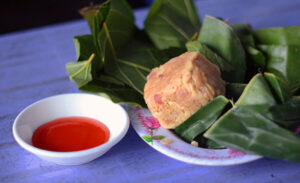 You should not miss Bui pork roll (Vietnamese: nem Bui), one of the famous dishes in north region. Local people call the dish nem thinh (finely ground roasted rice). Depending on personal taste, nem is eaten rolled in fig leaves and dipped in chili sauce or fish sauce.
You will feel the astringent taste of fig leaves, the sweetness of meat and the fragrant smell of thinh. Nem Bui originates from Bui village, Ninh Xa Ward, Bac Ninh province. After many ups and downs, in recent years Nem Bui has become more and more known to many people and has become a delicious and cheap culinary dish.
Yen The Hill Chicken
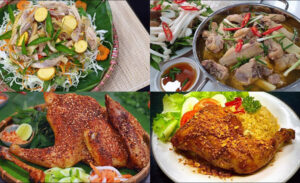 Yen The region, Bac Ninh province, has a mountainous midland terrain, a large area, creating favorable conditions for the development of free-range livestock and poultry farming. Among them, hill chicken is one of the strong livestock. Because it grows in a natural mountainous environment, Yen The chicken has a sweet, rich taste.
Delicious dishes from Yen The hill chicken are boiled chicken with lemon salt, grilled chicken, chicken patties, chicken cooked in ginger wine soup, and steamed chicken with salt. Yen The hill chicken is famous for its firm, sweet meat and crispy skin, so boiled dishes are the most authentic way to enjoy it, while other dishes help enhance the chicken’s flavor.
Van Village Wine
An indispensable gift when you come to Bac Ninh, the wine is brewed with delicious sticky rice and traditional yeast made from 35 rare medicinal herbs, making it smooth to drink and rich in flavor.
With the list of places suggested by Vietdreamtravel.vn, you will not worry about missing the opportunity to visit famous architectural works and relics when explore Bac Ninh or spiritual places that play an important role in the formation and development of this land.
Source: collected by An
Follow us for the best deals on Vietnam package tours and visa services!
Comment (0)