
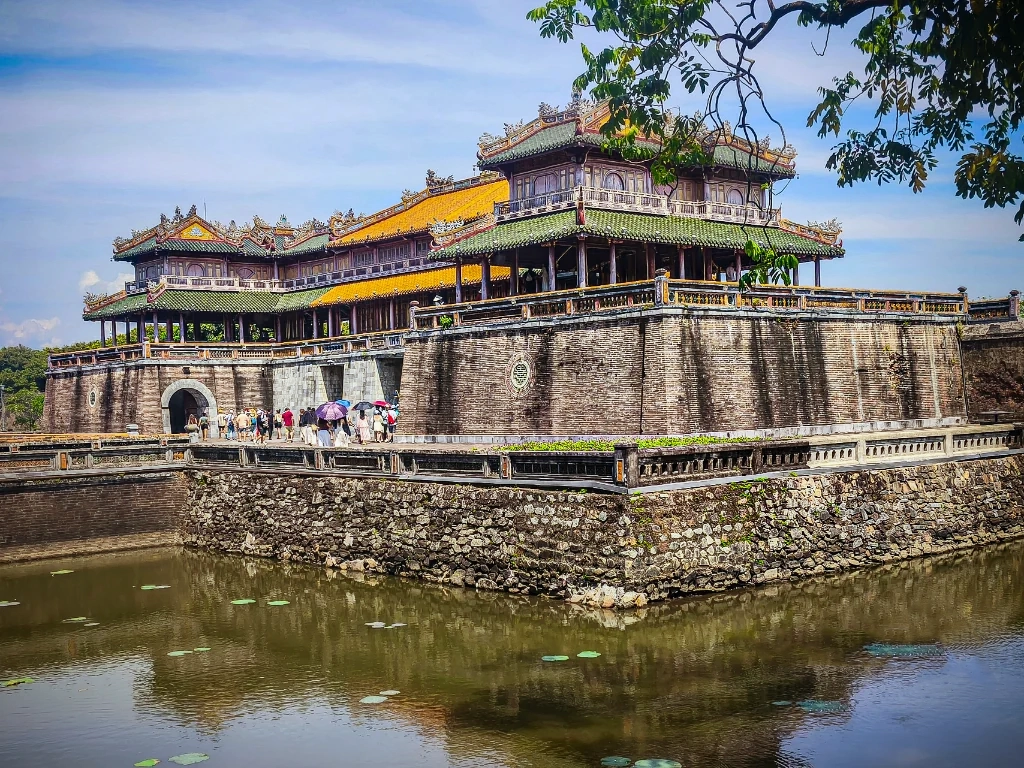
The Hue Imperial Citadel, Ancient Capital of Hue (Vietnamese: Kinh Thành Huế), is one of Vietnam’s most significant and monumental historical architectural complexes, constructed under the Nguyen Dynasty in the early 19th century. Situated on the northern bank of the Perfume River, the Citadel served as the nation’s political, administrative, and military hub while Hue functioned as the imperial capital, from 1802 to 1945.
As the core component of the Complex of Hue Monuments, the Hue Imperial Citadel was designated a UNESCO World Heritage Site in 1993. It remains a compelling destination for visitors eager to explore the history of the Nguyen Dynasty, its architectural artistry, and the character of a traditional Vietnamese imperial capital.
Overview of Hue Imperial Citadel
The Hue Imperial Citadel was built following the Vauban architectural style. It consists of three concentric enclosures: the Citadel (outermost), the Imperial City, and the Forbidden Purple City (innermost).
Emperor Gia Long personally selected the site and marked its boundaries; surveys began in 1803, construction commenced in 1805, and the project was completed in 1832 during the reign of Emperor Minh Mang. In the modern history of Vietnam, the construction of the Hue Imperial Citadel stands out as perhaps the most massive and ambitious undertaking. It involved tens of thousands of laborers, the movement of millions of cubic meters of earth and stone, and an enormous volume of work, including the digging of moats, the diversion of rivers, the relocation of residents and graves, and the construction of ramparts, spanning 30 years across the reigns of two emperors.

The Hue Imperial Citadel sits on the north bank of the Perfume River, facing south, and covers 520 hectares. Its perimeter stretches nearly 10 kilometers, with walls 6.6 meters high and 21 meters thick, designed in a zigzag pattern and punctuated by evenly spaced bastions. A system of moats encircles the outer perimeter.
Within the Citadel, there are residences for commoners and officials, as well as its most significant component: the Imperial City, the living and working quarters of the Emperor and the royal family.
The Imperial City
This second, inner enclosure of the Hue Imperial Citadel served as the residence of the Emperor and the royal family and as the seat of the imperial court. The Imperial City also houses shrines dedicated to the ancestors and emperors of the Nguyen Dynasty.
Construction of the Imperial City began in 1804, but it was not until 1833, during the reign of Emperor Minh Mang, that the entire complex, comprising over 100 structures, was fully completed. The Imperial City features four gates, one on each side; the main entrance (on the south) is the Ngo Mon Gate.
Inside the Imperial City lie the Thai Hoa Palace (Palace of Supreme Harmony), where formal court audiences were held; various ancestral shrines; and the Forbidden Purple City, the private living quarters of the Emperor and the royal family. Collectively, the Imperial City and the Forbidden Purple City are often referred to as the “Dai Noi” (the Inner Palace complex).
The Forbidden Purple City
This is the innermost enclosure, located within the Imperial City. The Forbidden Purple City was originally known as the Palace Citadel. Construction began in the second year of Emperor Gia Long’s reign (1803), and it was renamed the Forbidden Purple City in the second year of Emperor Minh Mạng’s reign (1821).
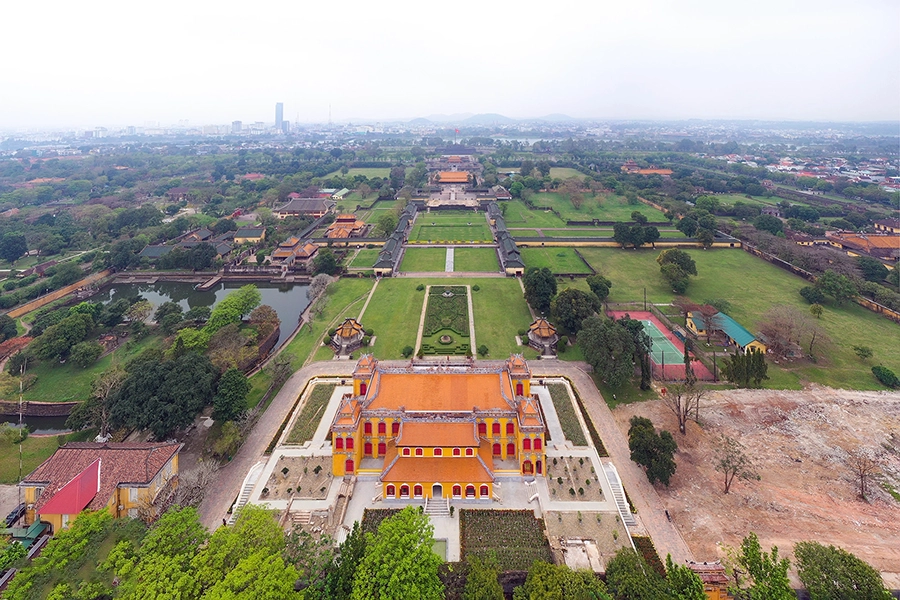
The citadel is rectangular, measuring 341 meters along the north and south sides and 308 meters along the east and west sides, with a total perimeter of 1,298 meters. Within the Forbidden Purple City, dozens of architectural structures of varying scales were organized into several distinct zones.
Today, most of these structures have either deteriorated over time or were destroyed during wartime; these include the Kien Trung Palace, Can Chanh Palace, Can Thanh Palace, and numerous other residences and buildings.
Monuments in the capital
Ky Dai
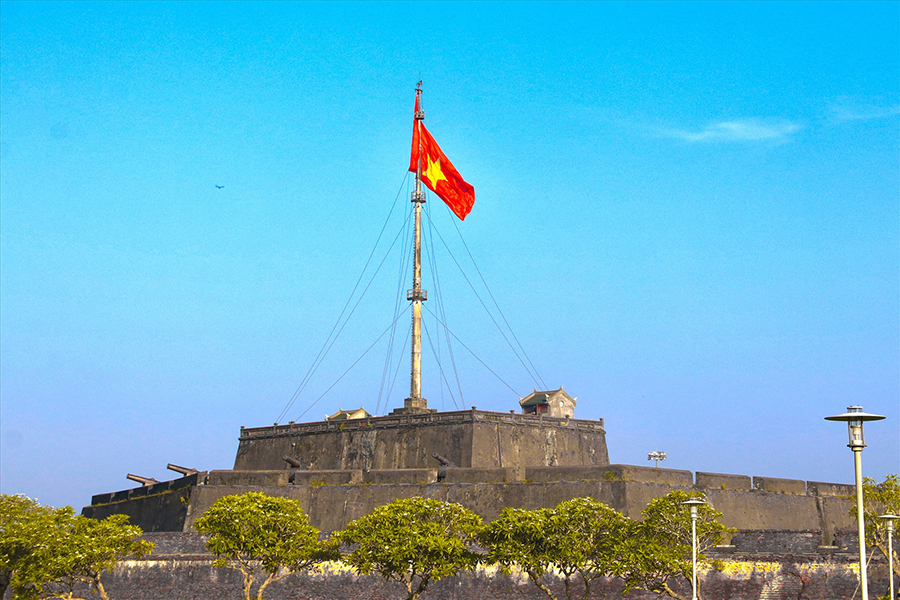 The Flag Tower (Ky Dai) is a prominent architectural landmark of the Hue Imperial Citadel, situated on the southern side of the complex, directly opposite the Ngo Mon Gate. Constructed in 1807 during the reign of Emperor Gia Long, the Flag Tower served not only as the site for hoisting the Nguyen Dynasty’s flag but also as a symbol of the dynasty’s authority and national sovereignty.
The structure consists of three stacked, trapezoidal tiers of brick and stone, reaching a total height of about 17.5 meters. At the summit stands a flagpole approximately 37 meters tall, creating a striking focal point within the Imperial Citadel. The tiers decrease in size from bottom to top, providing both structural stability and an air of imposing majesty to the overall design.
During the Nguyen Dynasty, the Flag Tower played a significant role in court ceremonies. The raising and lowering of the flag followed strict imperial protocols and served as a visible manifestation of royal power. The structure is also linked to various historical upheavals, most notably the event on August 21, 1945, when the red flag with a yellow star was hoisted atop the Hue Flag Tower during the August Revolution.
Long An Palace
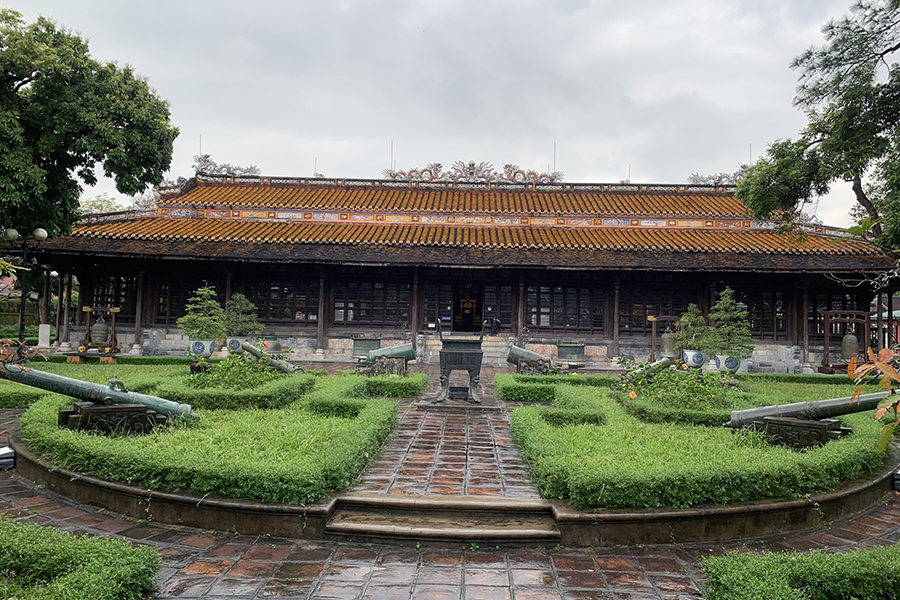 Located at 3 Le Truc Street, within the Hue Imperial Citadel complex, this structure currently serves as the primary exhibition space for the Hue Museum of Royal Antiquities, housing a collection of precious artifacts associated with the royal life of the Nguyen Dynasty.
Long An Palace was built in 1845 during the reign of Emperor Thieu Tri. It was originally situated within the Bao Dinh Palace grounds and served as the king’s resting place after he conducted the Tich Dien (field plowing) ceremony every early spring. King Thieu Tri also often rested here, read books, wrote poetry, and recited poems. Following various historical upheavals, the structure was dismantled and relocated to its present site in 1909.
A notable feature of Long An Palace is its traditional wooden architecture, characterized by an interconnected, multi-roofed design with two adjoining building sections. The system of columns, beams, and other wooden components is intricately carved, showcasing the exceptional artistry of Nguyen Dynasty craftsmen. The palace is particularly renowned for the Classical Chinese poems adorning its decorative panels, including works by Emperor Thieu Tri, which are rendered using the technique of mother-of-pearl inlay.
Hue Museum of Royal Fine Arts
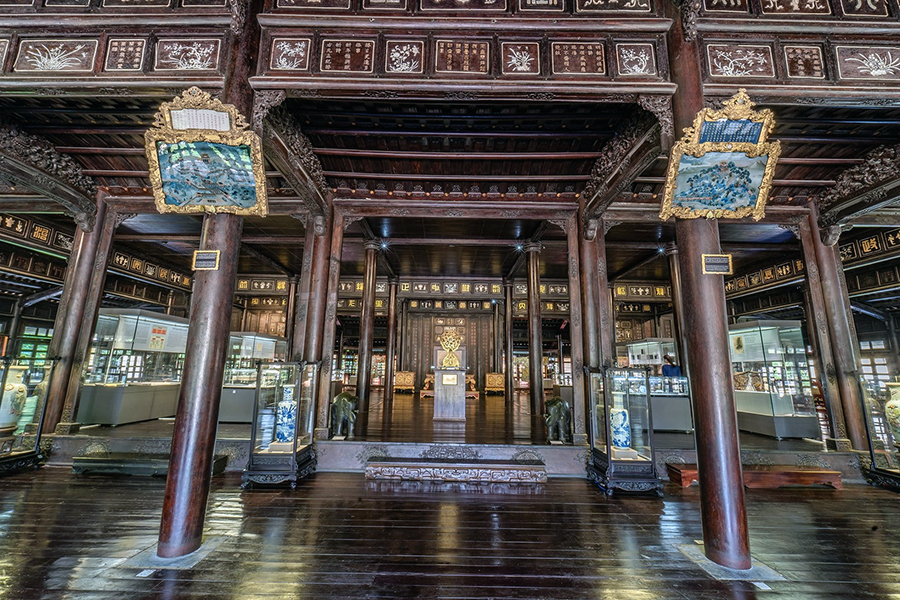 At No. 3, Le Truc, Hue. The museum’s main building is Long An Palace, formerly known as the Hue Royal Fine Arts Museum, and is one of Vietnam’s oldest museums. Established in 1923 during the reign of Emperor Khải Định under the name “Musée Khải Định”.
The museum preserves and showcases precious material heritage from the Nguyen Dynasty (1802–1945), offering visitors insight into royal life, court rituals, and traditional craftsmanship. Its exhibition spaces feature a wide array of artifacts made of gold, silver, bronze, and jade, alongside ceramics and other items once used in the imperial palace.
In particular, visitors can admire exquisite handicrafts, such as custom-commissioned porcelain, decorative court objects, and intricately carved artifacts. Each piece not only demonstrates the exceptional skill of past artisans but also reflects the aesthetic values, spiritual life, and cultural influences that shaped society during the Nguyen Dynasty.
Phu Xuan Communal House
Phu Xuan Communal House is a unique example of vernacular architecture within the Hue Imperial Citadel. It is intrinsically linked to the formation and development of the Phu Xuan region, which served as a vital political hub under the Nguyen Lords, the Tay Son dynasty, and the Nguyen dynasty.
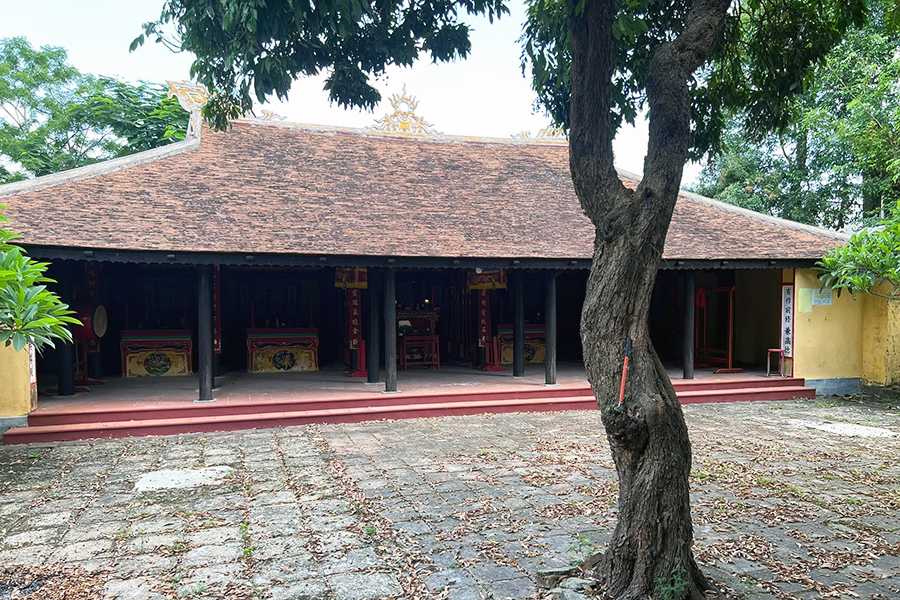 Unlike the magnificent palaces reserved for royalty, the Phu Xuan Communal House embodies the traditional architecture of a village communal house, reflecting local residents’ spiritual life and communal activities. It serves as a place of worship for village guardian deities, as well as a venue for rituals, ancestor commemoration, and preserving traditional customs.
The significance of Phu Xuan Communal House lies in the connection it represents between village culture and the imperial capital. Even as Hue became the seat of power for the Nguyen dynasty, folk religious institutions, such as the village communal house, persisted, helping to sustain the cultural identity of the local community.
Phu Xuan Communal House also offers visitors insight into a lesser-known aspect of the history of the ancient capital: alongside the grand royal structures, the region possesses a network of communal houses, pagodas, and shrines that remain deeply intertwined with the daily lives of the people.
Tinh Tam Lake
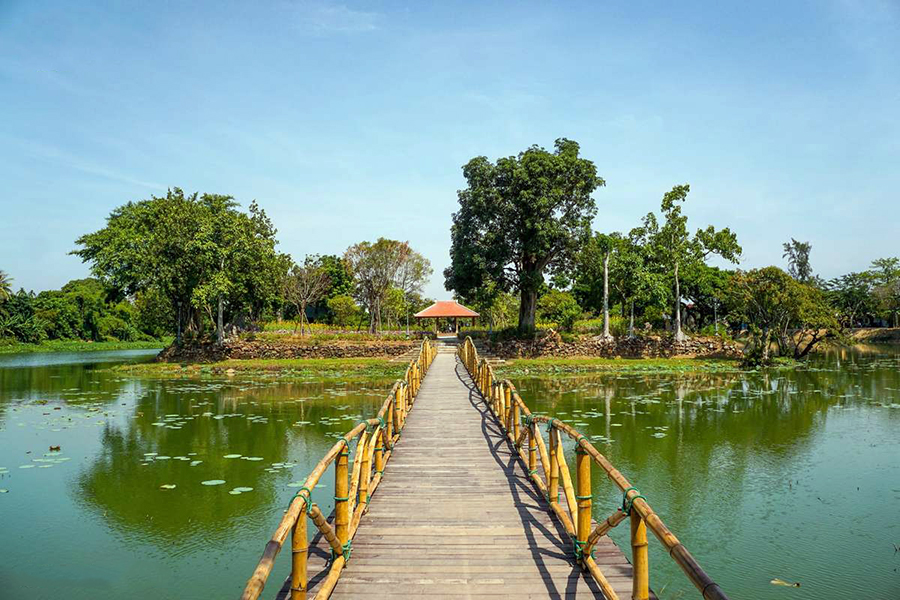 Tinh Tam Lake is a relic created during the Nguyen Dynasty. Previously, the lake was originally a trace of the Kim Long River flowing through Hue. At the beginning of Gia Long’s reign, the court renovated sections of the river and diverted the stream to form Ngu Ha and Ky Te Lake. Two floating beaches in the lake were used to build warehouses to store gunpowder and saltpeter.
In the 3rd year of Minh Mang’s reign (1822), the Nguyen Dynasty mobilized up to 8,000 soldiers to renovate the lake.
In 1838, King Minh Mang moved two warehouses to the east, rebuilt the area for leisure and entertainment, and called it Tinh Tam Lake. During the reign of King Thieu Tri, this was considered one of the 20 beautiful landscapes of the citadel.
Library
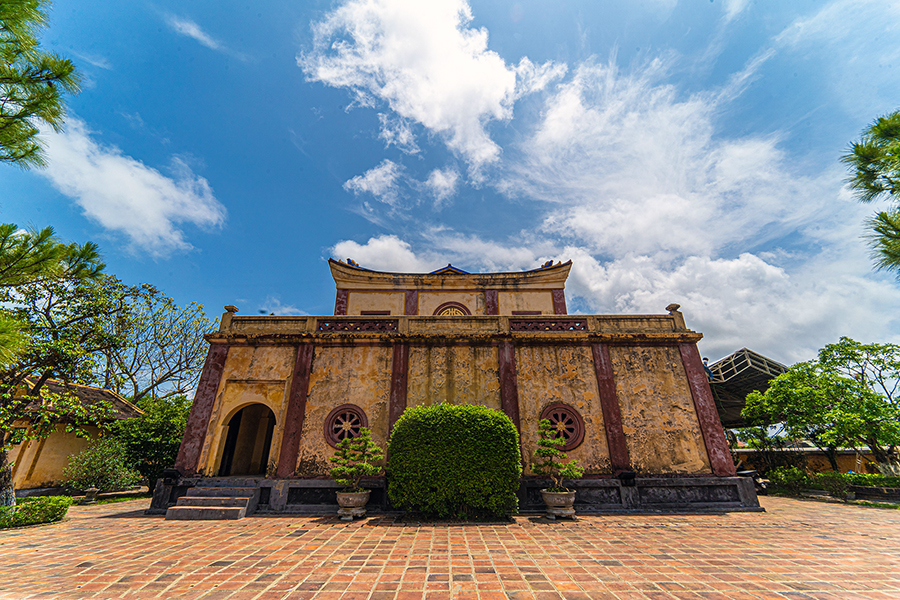 The library building was built in 1825 on Hoc Hai Lake in Hue Citadel and used as a place to store old official documents of the Nguyen Dynasty’s agencies and ministries. This can be considered a Vietnamese Museum under the Nguyen Dynasty, storing rare documents related to the royal court’s activities and the country’s changes.
Just the number of directories from the Gia Long and Minh Mang periods stored here is up to 12,000 volumes. This was a key place for storing important documents, contacts, and papers at the time.
Privy Council – Tam Toa
It was the king’s advisory body, consisting of four mandarins from Tam Pham or higher, who were Grand Scholars of the Dong Cac, Van Minh, Vo Hien, and Can Chanh palaces. The institute was initially located at Ta Vu’s house. After the capital fell in 1885, they moved to the Ministry of Rites, then the Ministry of Infantry, and finally to Giac Hoang Pagoda, along with the Surveillance court (of the French) and the Office of the ministries, so it became known as Tam Toa. Today, Tam Toa is located at 23 Tong Duy Tan, Dong Ba ward, in the southeast corner of Hue Citadel, and is the headquarters of the Hue Monuments Conservation Center.
Xa Tac Ceremonial site
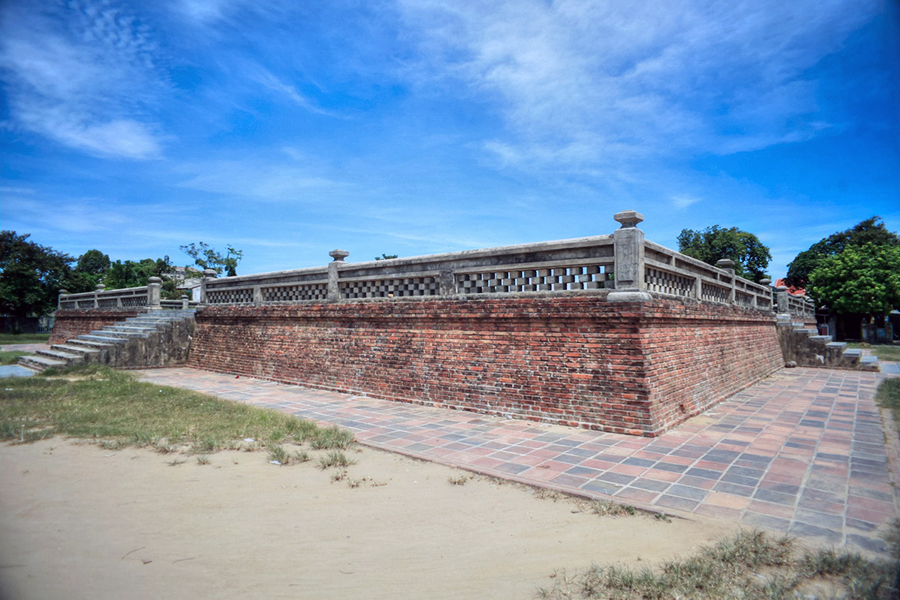 This is one of the significant ceremonial sites of the Nguyen Dynasty, located within the Hue Imperial Citadel. Constructed in 1806 during the reign of Emperor Gia Long, the altar served as the venue for the imperial court to conduct rituals honoring the deities of Earth (Xa) and Agriculture/Grain (Tac), a practice reflecting the aspiration for national peace, abundant harvests, and a prosperous life for the people.
In traditional Eastern philosophy, land and agriculture are considered the foundations for the existence and development of a nation. Consequently, the Xa Tac ritual was among the most important state ceremonies, embodying the Emperor’s responsibility to the nation and his subjects. Notably, during the altar’s construction, the Nguyen Dynasty gathered soil from various regions across the country and brought it to Hue, a symbolic gesture representing territorial unification.
Architecturally, the Xa Tac ceremonial site is an open-air ceremonial platform with two square tiers, with the upper tier serving as the site for key rituals. This structure reflects traditional cosmological concepts and the ceremonial protocols inherent in imperial court culture.
The Nine Holy Cannons
The famous set of nine bronze cannons from the Nguyen Dynasty is currently housed in two locations near The Nhon and the Quang Duc Gates within the Hue Imperial Citadel. These are not merely massive military artifacts; they are also masterpieces of early 19th-century Vietnamese bronze-casting art.
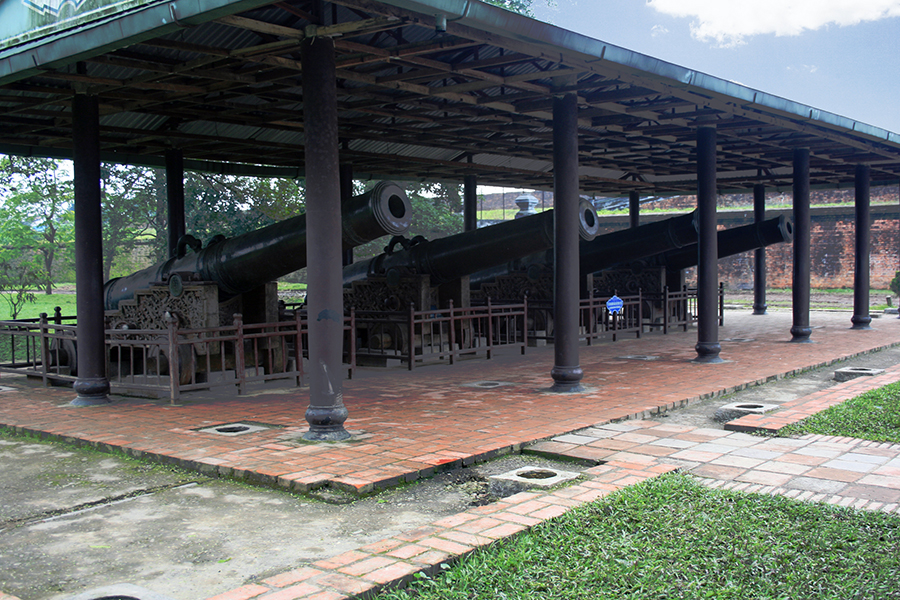 After the country’s unification and the establishment of the Nguyen Dynasty, Emperor Gia Long commissioned the casting of these nine cannons between 1803 and 1804, using bronze obtained from spoils of war. Each cannon measures about 5.1 meters long and weighs over 10 tons, a testament to the era’s remarkable metal-casting expertise.
A unique feature of these Nine Holy Cannons lies in their symbolic names. They are divided into two groups: the “Four Seasons” (Spring, Summer, Autumn, and Winter) and the “Five Elements” (Metal, Wood, Water, Fire, and Earth). This naming convention reflects a worldview centered on the workings of the universe, while also embodying the aspiration for an enduring dynasty.
Each cannon’s surface is adorned with intricate decorative patterns and inscriptions in Chinese characters detailing its name, weight, and creation. Although they take the form of weaponry, the Nine Holy Cannons served primarily as symbolic treasures representing the Emperor’s military might and authority, rather than as functional artillery for actual combat.
In 2012, the Nine Holy Cannons were designated a National Treasure, recognizing their exceptional historical, artistic, and technical significance.
The forts
The forts were built on the convex waist along the wall. They are evenly spaced and accompanied by a system of shooting walls, artillery emplacements, gun workshops, ammunition depots, and guard posts, totaling more than 11 km. The fortress’s inner wall is made of earth; the inside and outside are covered with bricks.
The citadel has 24 fortresses in total: 5 on each side and 4 at the four corners. Each fortress has its own name; the first letter of each name comes from one of the four directions: South, North, East, West. In addition, the Northeast corner has Tran Binh Dai, considered the 25th fortress of the Imperial City, connected to the Imperial City through a gate called Thai Binh Gate.
Source: collected by Thien An
Follow us for the best deals on Vietnam package tours and visa services!
Comment (0)