
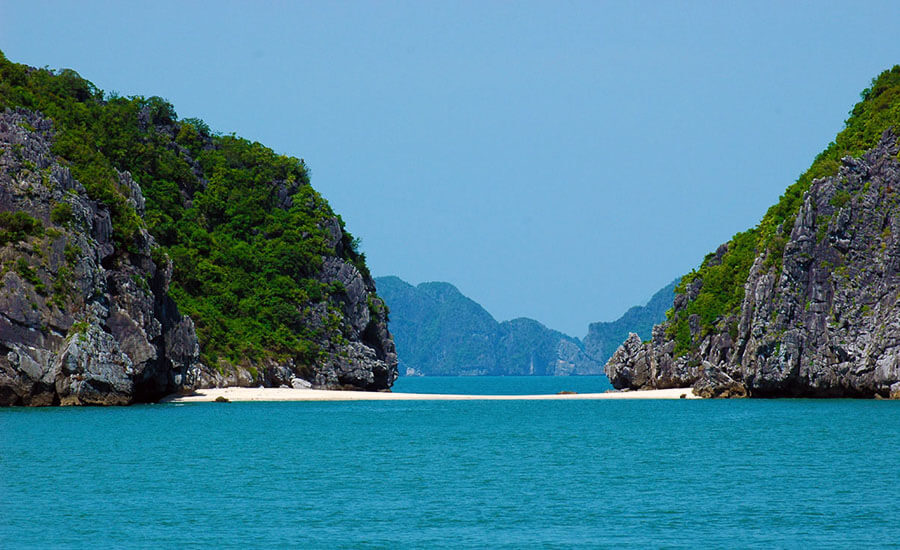
Hai Phong is a large port located near a major international maritime line. For hundreds of years, the Chinese, Japanese, French, Spanish, and Portuguese have been coming here for trade. Nowadays, it remains a center for trade and industry, an important transportation hub, and a famous tourist destination. Let’s explore Hai Phong with Vietdreamtravel in this post.
General information about Hai Phong
Hai Phong is also known as the Port City. After merging provinces and cities of Vietnam 2025 (Hai Duong province merged with Hai Phong City), the new Hai Phong has an area of 3,194.72 km². The widespread planting of red phoenix flowers here, and the characteristic color of the flowers on the streets, also makes Hai Phong known as the “Red Phoenix Flower City”.
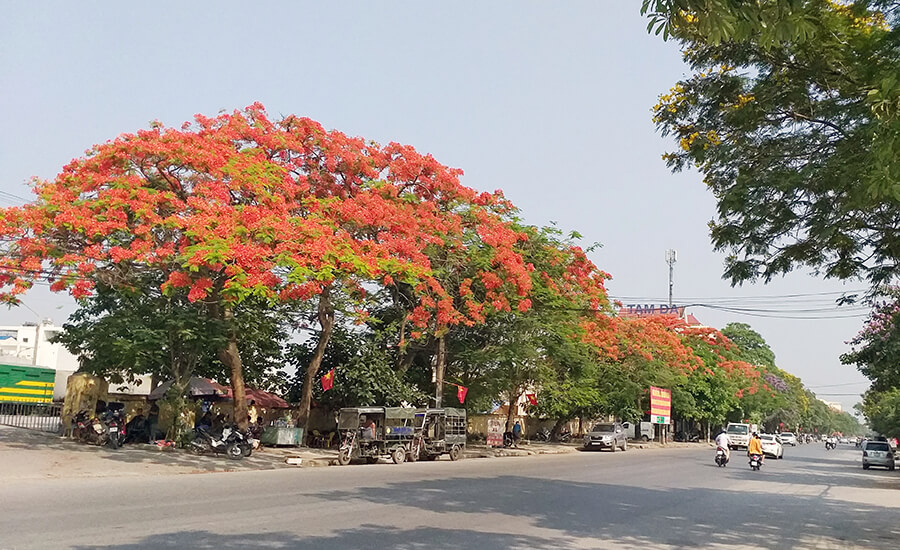
Not only is Hai Phong an industrial port city, but it is also one of the places with great tourism potential. Hai Phong currently retains many attractive architectural features, including traditional architecture with ancient pagodas, temples, and shrines, as well as French neoclassical architecture in the old neighborhoods. At the same time, Hai Phong currently owns a world biosphere reserve, located in the Cat Ba Archipelago, along with beaches and resorts in Do Son. The city also has cultural characteristics, especially cuisine and traditional festivals.
When is the best time to explore Hai Phong?
Hai Phong is suitable for tourism in all four seasons. It has an average temperature of 23-24 °C. When visiting Hai Phong in the spring, visitors can attend festivals and visit important historical sites.
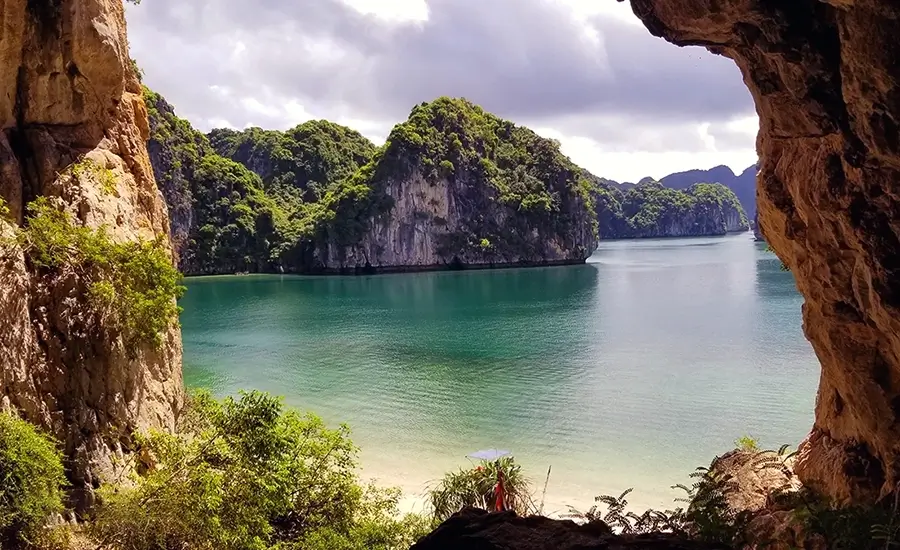
In the summer, Cat Ba Island, Bai Tu Long Bay, and Ha Long Bay are popular destinations. Visitors can go to the beach or enjoy the famous coconut ice cream at restaurants in the city. In addition, summer is when red poinciana flowers bloom along the central streets and the road to Do Son.
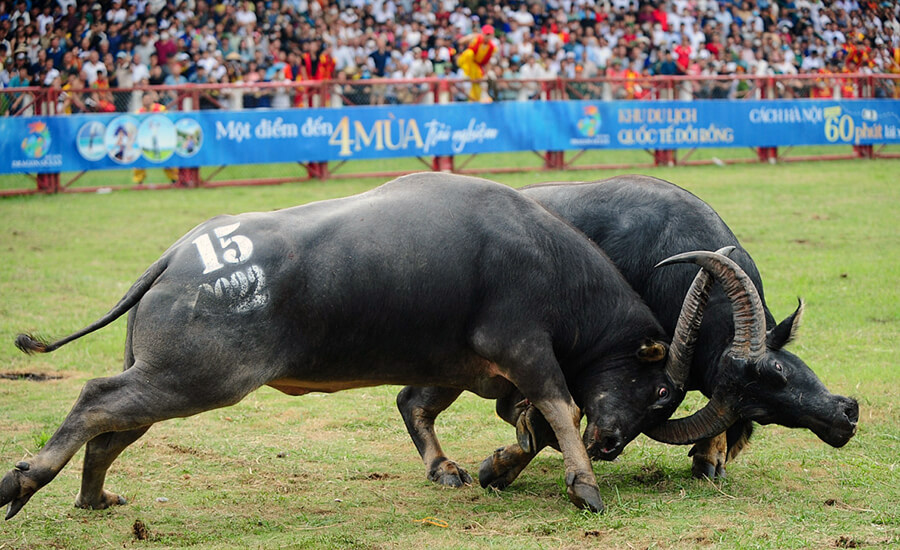
In autumn, the famous Do Son buffalo-fighting festival is a major attraction.
How to get here?
From Hanoi, you can get to Hai Phong by many means.
By road
This is the most convenient way to travel: via the Hanoi-Hai Phong expressway. Time is about 1.5 hours. The road is only for cars. Other vehicles travel along the old QL5. By bus, you can choose Hai Phong Travel or Hoang Phuong, both priced at 230,000-250,000 VND and including pick-up and drop-off services within the city.
The limousine, with 9 to 11 seats, is the most popular, with fares starting at 230,000 VND/person and home pick-up service. Other standard tourist buses from Hoang Long, Hai Au, Hoang Phuong, Hai Phong Travel, Cat Ba Limousine, and Hai Nguyen cost from 180,000 VND/person.
By train
Trains are also a popular means of transport, especially for tourists on day food tours. Train pairs HP1/2, LP5/6, and LP7/8 run daily, departing from Long Bien and Hai Phong stations at 6 am, 9 am, 3 pm, and 6 pm. Tourists can also get off the train at Phu Thai, Hai Duong, and Cam Giang stations.
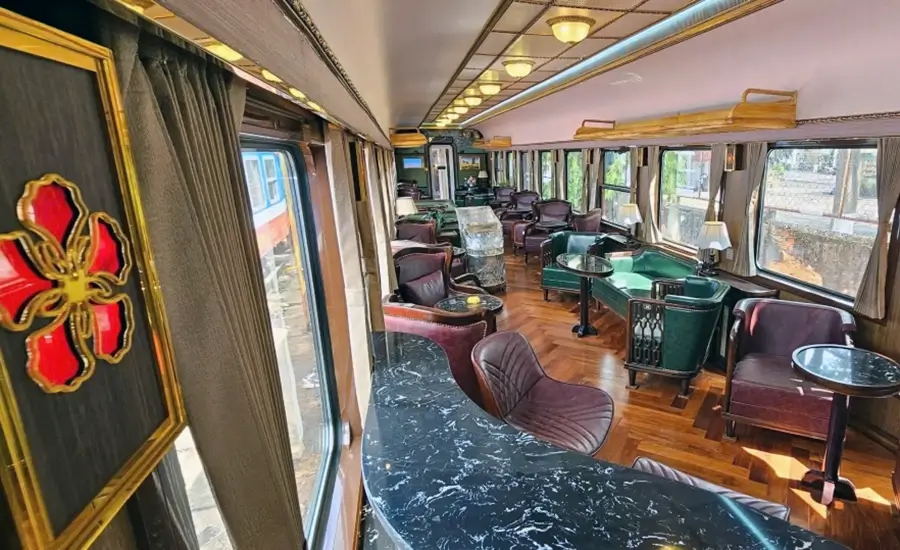
Trains have hard, soft, air-conditioned or special seats, priced from 120,000 to 300,000 VND. Tourists traveling by train can park their motorbikes to proactively choose their own means of transport in Hai Phong.
By airplane
Hai Phong has Cat Bi airport, located about 12 km from the city center. Vietjet Air and Vietnam Airlines have daily flights from Ho Chi Minh City to Hai Phong. Round-trip fares start at 2 million VND.
Accommodation in Hai Phong
There are many accommodation options in the center of Hai Phong city, such as hotels from budget to luxury, homestays, serviced apartments…
Hai Phong has the tourist island of Cat Ba, with famous resorts such as Flamingo Cat Ba Beach Resort, Hôtel Perle d’Orient Cat Ba – MGallery, Nam Cat Island Resort CatbaBay, with average prices from 1.5 million VND per night. Staying overnight on a cruise in Lan Ha Bay is also an option, from 3 to 6 million VND per person per night.
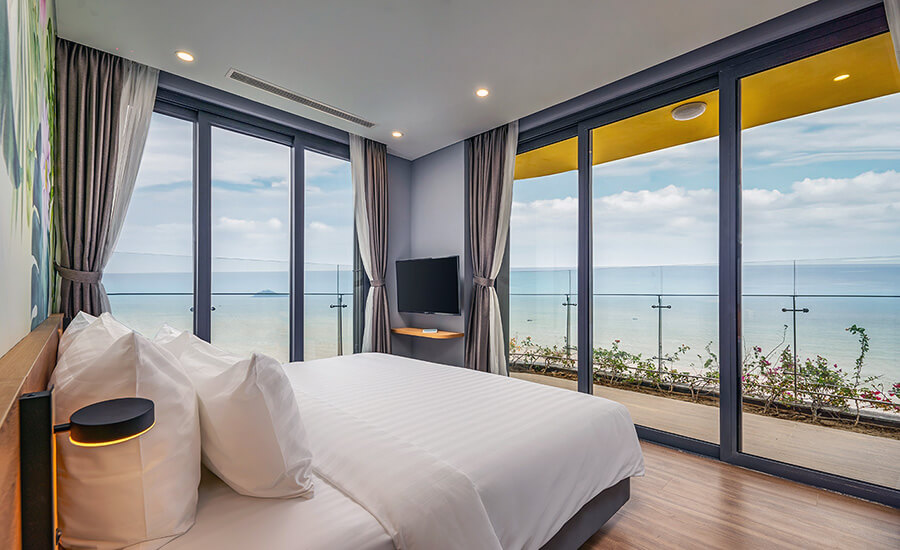
In the areas of Hong Bang, Ngo Quyen, Le Chan wards…, visitors can choose high-end hotels with prime locations and convenient access, such as Sheraton Hai Phong, Melia Vinpearl Hai Phong Rivera, Pullman Hai Phong Grand Hotel, Mercure Hai Phong, Nikko Hai Phong. Room rates range from 2 million VND per night.
More affordable options include rooms in Vinhomes and Hoang Huy townhouses, or homestays such as Dreamland – Chihouse and Vancao Green Homestay, with prices from 300,000 VND per night.
In Do Son and Nam Do Son wards, the most high-end resort is Dream Dragon Resort, with prices from 2.5 million VND per night. Hon Dau Resort, Do Son Resort, Ruby Tree Golf Villa, Ocean Senses Hotel, Hai Anh Hotel… are priced around 1 million VND per night. Hotels from 300,000 VND to 700,000 VND include Hai Au Hotel, Hai Quan Guesthouse, BIDV Hotel Do Son…
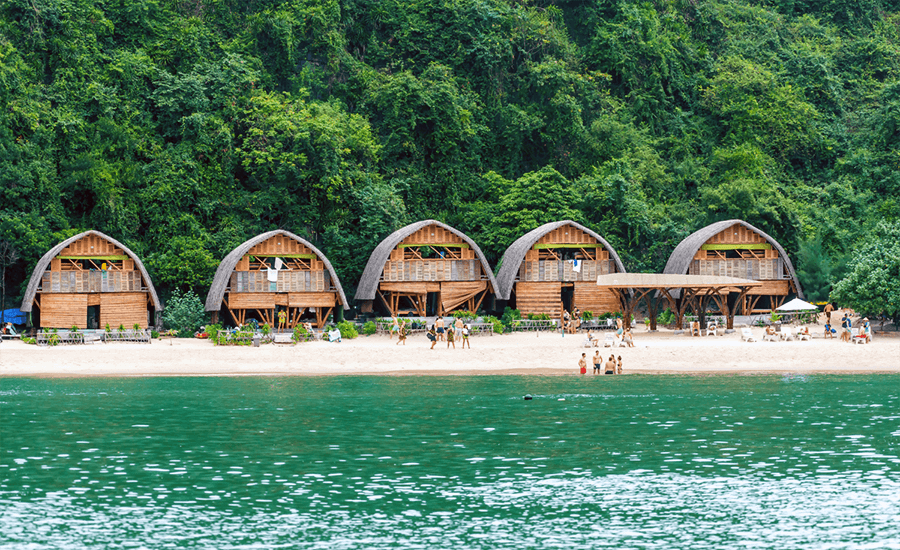
In Hai Duong ward, high-end hotels include Nam Cuong, Sen Tim, Kim Bao, Apec Mandala Wyndham Hai Duong, Hai Duong Garden Apartment… with prices around 1 million VND. Budget hotels range from 200,000 VND to 500,000 VND.
Tourist attractions in Hai Phong
Since the addition of the old Hai Duong province, Hai Phong has become not only a famous destination for its pristine beaches and culinary paradise, but also a festival destination, with many temples and historical relics.
Scenic spots
Do Son tourist area
 Do Son is divided into 3 areas: area 2 is for swimming, and areas 1 and 3 are for eating and walking. Along the coastal road, visitors can visit Hang Pagoda, said to be the first place where Buddhism was introduced to Vietnam; Ngoc Hoang Temple; and Van Ngang Temple. Thap Tuong Long Pagoda is located on the highest mountain in Do Son; from here, you can see the whole beautiful sea. Ba De Temple, on the way to Do Son, is also very famous for worshiping the Trinh Lord’s wife.
Do Son has entertainment and sightseeing areas, including Dragon Hill, Hon Dau, and a casino. Looking at the map, Dragon Hill tourist area is designed in the shape of a royal poinciana flower – the symbol of the city. The project includes a Son Tinh-Thuy Tinh-themed entertainment complex of nearly 25 hectares; a golf course complex with a full view of the sea; a Lagoon lake system filtered by modern water filtration technology; and fine white sand transported from Nha Trang.
Cat Ba Island & National Park
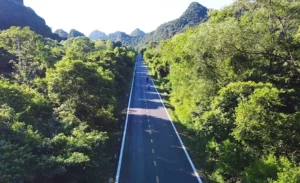 Cat Ba is an archipelago covering approximately 366 islands of different shapes and sizes. The main island is Cat Ba, located 30 nautical miles from Hai Phong, with an area of approximately 200km².
The topography of the park mainly consists of limestone mountains with many grottoes and caves, as well as beaches with white powdery sand. The limestone mountains have an average height of 150m, the highest of which is Cao Vong Peak, 322m above sea level.
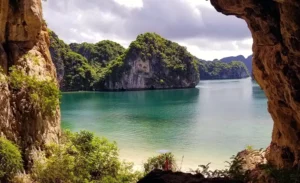 Cat Ba National Park has the largest area of tropical virgin forest in Vietnam. According to research, there are 620 plant species, 438 lines of descent, and 123 families, of which 350 are medicinal plants. More than 32 species of mammals, 69 species of birds, and 20 species of reptiles and amphibians can be found in Cat Ba National Park. The White-headed Vooc, an endangered bird species, is found on the cliffs separating the island from the sea. The yellow monkey, the chamois, and many beautiful birds also live on the island.
.Along with that is the sea area with near-shore coral reefs, cave systems, valleys… In 2004, the Cat Ba archipelago was recognized by UNESCO as a World Biosphere Reserve.
Voi (Elephant) Mountain
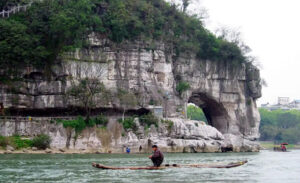 Voi Mountain, 20km southwest of the center of Hai Phong, along the Lach Tray River, is part of a diverse natural landscape. It is the highest peak to the north of Kien An.
At Voi Mountain, visitors can explore many beautiful caves, including Voi Cave, Chieng Cave, Be Cave, and Ca Chep. In the cave, there are many stalactites of various shapes, resembling kneeling dragons, tigers, and an elephant’s head.
On the top of the mountain, there is an even flat area which is called the “Fairy Chess Board”. There are also ruins of pagodas and citadels from the 16th-century Mac Dynasty on the mountain. Of particular note are the remains of the ancient Vietnamese civilization, such as stone axes and chisels, which date back more than 3,000 years.
Trang Kenh Landscape
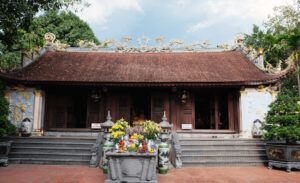 Trang Kenh is a poetic, natural area of hills, limestone mountains, caves, and rivers in Bach Dang ward, 20km north-east of Hai Phong.
U Bo is the name of a famous mountain peak. A myth tells that this mountain is where Tran Hung Dao commanded the naval battle against the Chinese Nguyen-Mong aggressors in the 13th century. At U Bo Peak, visitors can take in the full panorama of the Bach Dang River. The river’s silence, the sea’s immensity, and the presence of mythical stories all make this a fascinating area.
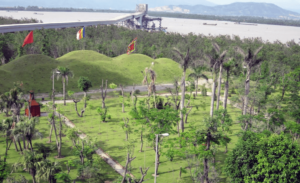 Archaeologists have concluded through investigation that Trang Kenh was a jewelry workshop of the ancient people who lived here 4000 years ago. In more recent times, it served as a revolutionary base for Hai Phong’s civil and military forces during the resistance struggle against the French.
Around Trang Kenh, there are some strange caves, including Hang Vua (King’s Cave). It is thus called due to a myth that Hung King the Eighteenth established a separate palace here. The altar of Hung King in the center of the cave is a lively-looking stone carved statue of him. There are many small tunnels criss-crossing the 18m-high cave, and freshwater streams running through it.
An Phu – Kinh Chu – Nham Duong Complex
 An Phu – Kinh Chu – Nham Duong Complex is a historical relic and special national scenic spot in Hai Phong. The relic includes An Phu: including An Phu Temple and Tuong Van Pagoda (Cao Pagoda); Kinh Chu: Kinh Chu Cave in Kinh Chu Mountain, with a cave leading to the sky called Duong Nham; Nham Duong: Nham Duong Pagoda.
An Phu Temple is also known as Cao Temple. The temple is located on the highest mountain peak of the An Phu range. According to legend, the temple was built during the Tran Dynasty (13th century) to honor Tran Lieu, the father of Tran Hung Dao, a Vietnamese national hero. The temple was built in the architectural style of the first and the second, including the front altar, the middle altar, and the rear palace. The harem worships the statues of Tran Lieu and his family members.
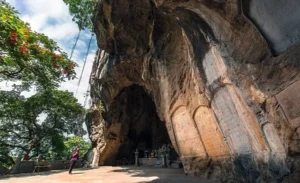 Kinh Chu Cave has many nooks and crannies. In the middle is the Buddha altar, on the right is the altar of Emperor Ly Than Tong and Ly Chieu Hoang, and inside is the altar of Duc Thanh Hien and Ban Co. On the left of the cave is the altar of Thanh Hoang and Duc Ong. Deeper inside is the statue of the Third Patriarch of the Truc Lam Zen sect, Huyen Quang.
Currently, in the cave, there are a total of 47 stelae, like a museum of stelae with skillful carvings, clearly reflecting the contemporary decorative art style from the Tran, Le So, Mac, and Le Trung Hung dynasties to the Nguyen Dynasty in the 19th century.
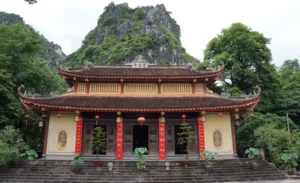 Nham Duong Pagoda, whose Chinese name is Thanh Quang Tu, is a large pagoda built in the Tran Dynasty, restored, and quite bustling during the Le and Nguyen Dynasties. The pagoda also preserves 2 stone towers from the Le Dynasty – precious treasures showing the history of the pagoda.
Nham Duong Pagoda also has archaeological sites such as Thanh Hoa Cave and Dark Cave, with 1,796 artifacts – mainly fossils of animals dating from 30,000 to 50,000 years old.
Sacred temples and pagodas
Du Hang Pagoda
Du Hang pagoda, named by scholar Phu Lam Tu, is located in Ho Nam ward in Le Chan ward, 2km south-west of the center of Hai Phong. The pagoda was built during the Early Le Dynasty (980 – 1009).
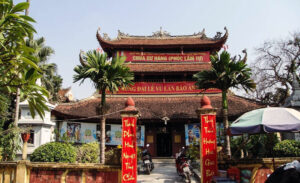 Emperor Tran Nhan Tong, a devout Buddhist, used to preach at the pagoda. The pagoda has undergone restoration on several occasions and is now listed as a historical site containing many relics, including Buddha statues, bronze urns, bells, gongs, and the prayer book of Trang A Ham, an ancient Buddhist script.
In addition, the inside of the Buddha hall is decorated with many puzzles, horizontal lacquered boards, and brilliant gold leaf… The temple’s space evokes a unique artistic style that impresses visitors at first sight.
Outside, many airy green trees are planted, creating a relaxing and peaceful atmosphere in the sacred place.
Hang Kenh Communal House
Located on Hang Kenh Street, Hang Kenh Communal House was built in 1717 and expanded in 1905, on a campus of about 6,000 square meters.
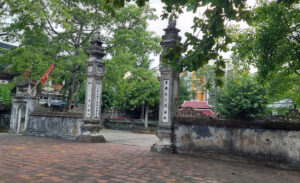 It is famous for its valuable wooden sculptures, of which there are 156 pieces featuring dragons as the main theme. Altogether, there are 308 dragons of different shapes and sizes. In addition, the communal house preserves two living turtle statues, dating from the late 17th century and early 18th century; many sacred swords and dragon knives listed as antiques, typically a pair of precious swords dating from around the 17th century; a pair of elephant and horse statues dating from around the 19th century, both carved from wood, standing on carts, placed in the central room….
The Communal House worships the “Restored National Founder” Ngo Quyen, who defeated the Southern Han army on the Bach Dang River in 938, opening a long-lasting era of independence and autonomy for the Vietnamese people.
Every year, from the 16th to the 18th of the 2nd lunar month, ritual ceremonies, festivals, traditional games, and folk song performances are held at the communal house, attracting large crowds.
Duoi Temple
Duoi Temple, also known as Quynh Hoa Temple, is located in Cam Cau village, Thong Nhat commune. This is an ancient temple built during the Ly Dynasty (11th century). In 1991, Duoi Temple was ranked as a national relic.
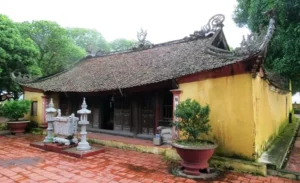 The temple worships Empress Dowager Y Lan (March 7, 1044 – July 25, 1117), concubine of Emperor Ly Thanh Tong, biological mother of Emperor Ly Nhan Tong. During the war, Duoi Temple served as a local revolutionary base and a communication center linking it to the Viet Bac resistance base.
The current architecture of Duoi Temple was shaped after the restoration at the end of the 17th century. In general, the temple has a layout shaped like the Chinese character “国”. From front to back, the first structure is the Tien Te building, consisting of 3 compartments, 2 wings, 17 meters long, 8.1 meters wide, with 4 main rafters and 2 rows of columns of 2 compartments. This is a typical construction of the Later Le Dynasty with a system of low columns and sophisticated carvings.
Every year, on the 12th day of the 2nd lunar month, which is Empress Dowager Y Lan’s birthday, and on the 25th day of the 7th lunar month, which is her death anniversary, the local people organize a festival to recall her merits and career. Her statue is carried on a palanquin around the commune for everyone to admire and deeply remember the person who contributed to the nation.
Thanh Mai Pagoda
 Thanh Mai Pagoda is located in Nguyen Trai ward. The pagoda was built on the slope of Phat Tich Mountain, now called Tam Bao Mountain. In front of the pagoda is Bai Vong Mountain, home to the tomb of Nguyen Phi Khanh, the father of the national hero and world cultural celebrity Nguyen Trai.
The pagoda was built in the 13th century. This is one of the centers of Vietnamese Buddhism, where the abbot Phap Loa – the second Patriarch of the Truc Lam Zen sect – presided. After years of rain and sun, war, the ancient pagoda collapsed. Recently, the pagoda has been partially restored on the foundations of several large works. The pagoda is located under a maple forest complex spread over an area of over 100 hectares, of which more than 50 hectares are entirely within the pagoda’s land.
Typical architectural works
Hai Phong Station
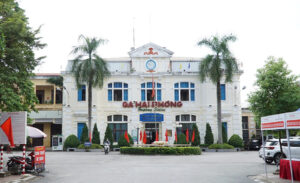 Hai Phong Station is the main train station in Hai Phong City. This is also the last passenger station on the Hanoi-Hai Phong railway line. In addition, Hai Phong Station has a railway line running to Hai Phong port, transporting goods from the port to other areas. Hai Phong Station was built by the French and opened in 1902.
This is one of the four main stations on the 99-km-long railway line connecting Hai Phong and Hanoi. Hai Phong Station bears the strong architectural imprint of the French. This is also considered one of the most beautiful train stations left by the French in Vietnam. In addition to the main building, which is almost completely preserved, Hai Phong Station also retains the iron pillars supporting the station’s interior porch and the blue stone foundation from the time of construction.
Hai Phong City Theater
 The Hai Phong City Theater was built in 1904 on the site of an old market in the ancient village of An Bien and completed in 1912. This project was modeled after the Paris Theater, with construction materials brought from France and construction carried out by Vietnamese workers and laborers under the direction of a French architect.
The theater’s architecture also impresses visitors with its elaborate decoration combined with curves. The stage area is not divided into levels but is open from the podium to the ceiling and roof.
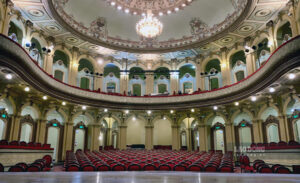 The space above the stage is equipped with electrical and air-conditioning systems. The theater’s Roman-style door system leads to the backstage, dressing rooms, restrooms, and technical rooms.
During the French colonial period, the Opera House was the political and cultural center of the French and wealthy locals. Only French troupes or famous domestic troupes were allowed to perform here, and only the wealthy could afford tickets. Today, this is a tourist symbol of the city, located in the city center, where cultural activities regularly take place and where groups of young people meet in the evening.
Hai Phong Museum
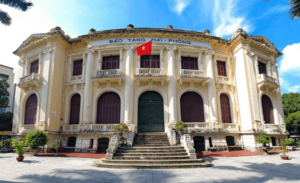 Hai Phong Museum is located at 65 Dien Bien Phu Street, Hong Bang Ward. This building was built in 1918 in the classical Gothic style of Europe, with the highlight being its pointed dome.
The building is about 16 m high (not including the two towers), has two floors and a basement, and a floor area of about 1,200 m². After many renovations, Hai Phong Museum still retains its original exterior architecture and basic interior structure as they were more than 100 years ago.
The two floors of Hai Phong Museum are divided into 16 exhibition rooms, with 12 rooms displaying content and 1 room for thematic exhibitions celebrating major holidays of the country and city, as well as related cultural events in the historical process. The museum has more than 22,000 artifacts and is currently displaying 1,736 artifacts, 840 images, and documents.
Bao Dai Palace
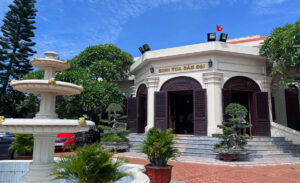 Bao Dai Palace, also known as Bao Dai Tower, is located on Vung Hill, Nam Do Son Ward. The palace is also famous as a resting place for many kings and their families on their way to the North. This place still preserves relics associated with the last king of Vietnam’s feudal dynasty.
Bao Dai Palace features French architecture, faces the sea, and is surrounded by a flower garden with many shady trees, with a basement and two upper floors. The entire palace is located in a campus of more than 3,700 square meters. The private area of the palace is 1,000 square meters, at an altitude of nearly 40 meters above sea level.
Long Chau Lighthouse
 The Long Chau archipelago is located 15 km southeast of Cat Ba town, Cat Hai special economic zone. It is famous for Long Chau lighthouse, built in 1894 at 109.5m above sea level. It is a means of lighting that helps ships move easily at sea. With a unique arched design. In the middle is a room. It is a combination of flat lampshades with small bulbs, called lamp hearts. On clear days, ships 25 nautical miles away from Long Chau island can still see the light from here.
This lighthouse is called “Archipen des Fai Tsi long” or Griffes du Dragon” (meaning dragon’s claws) by the French. Long Chau lighthouse is also one of the 3 oldest lighthouses in Vietnam, along with Hon Dau and Ke Ga lighthouses.
Historical and cultural relics
Bach Dang Giang relic site
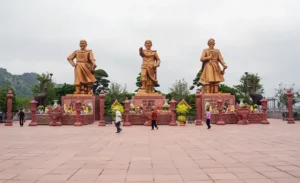 The Bach Dang Giang relic site, located in the Trang Kenh mountain range, covers 20 hectares and was recognized in 1962. The entrance to the relic is a pebble garden and a stone pillar about 5m high. All 4 sides are engraved with words; the middle side bears a poem, and the remaining 3 sides praise the achievements of the three predecessors in naval battles.
The complex has many other areas, such as Bach Dang Giang Temple, which worships King Ngo Quyen, who founded the Bach Dang stake battle, defeated the Southern Han army in 938, ended 1117 years of Chinese domination, and opened the Dai Viet civilization.
Doctoral Laureate Nguyen Binh Khiem relic site
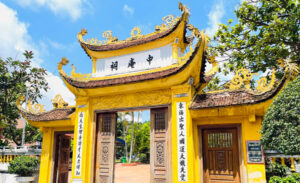 This site is located in Trung Am Hamlet, Nguyen Binh Khiem commune. It has nine separate structures: the Kinh Thien pen-shaped tower, the temple built after his death in 1585, with three front halls and two back sanctuaries. In front of the temple are two ponds, which represent the earth and the sky.
The horizontal lacquered board kept in the temple reads: “An Nam Ly Hoc” (Master of Philosophy in An Nam; the exhibition room with details on Nguyen Binh Khiem’s biography and career; a tomb of his father at the back of the temple; the stone statue of Nguyen Binh Khiem, 5.7m in height and 8.5 tons in weight, the semi-circular pond 1000m² in area; Song Mai Pagoda; the Ancestor Worshipping House with the statue of Minh Nguyet, Nguyen Binh Khiem’s wife and Trung Tan pavilion, whose names gives a new interpretation of the concept “trung” (loyalty); everyone tries to reach “chi trung chi thien” (absolute loyalty and goodness).
Nowadays, the upgraded site is a major tourist attraction in the region. It is also where a big festival commemorating Nguyen Binh Khiem as a cultural celebrity is held.
Nghe Temple
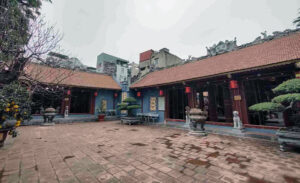 The temple is situated in the center of Hai Phong, approximately 600 meters southwest of the Municipal Theatre. Nghe Temple is devoted to the cult of Le Chan, a female general of the Trung Sisters’ insurrection in the first century (40 – 43). Le Chan founded An Bien Village, which later became Hai Phong.
Nghe Temple contains stone elephants and horses as well as stelae. The Nghe Temple is a work in the architectural style of the Nguyen Dynasty, early 20th century, including: three gates, a worship hall, an incense-burning area, a rear palace, a martial arts hall, a stele house, and a place for stone elephant and stone horse statues.
The architectural works of Nghe Temple form a closed architectural space, following the traditional national style.
Nghe Temple has been designated a National Historical and Cultural Relic by the State since 1975. Every year, on holidays, especially the birthday and death anniversary of female general Le Chan, the temple regularly organizes special and meaningful festival activities to commemorate the talented female general of Hai Phong.
Con Son – Kiep Bac
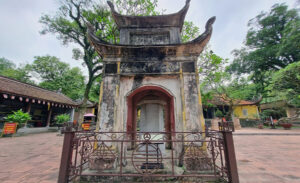 Con Son – Kiep Bac is a historical relic site associated with the heroes and cultural figures Tran Hung Dao and Nguyen Trai. Coming to Con Son, visitors climb Ky Lan Mountain, with Ban Co Tien Peak. On the right side of Ky Lan Mountain, where Nguyen Trai built a house to teach, there are still traces of the old house foundation and a stone slab that locals call Thach Ban, also known as the “five-room” stone (as wide as 5 rooms), where Nguyen Trai used to sit and read books.
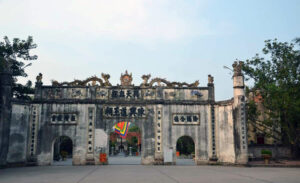
Kiep Bac is located on flat land in the middle of the Dragon Mountain valley. The three-door gate of Kiep Bac Temple looks like a majestic “Two dragons worshipping the moon” scroll. Kiep Bac Temple overlooks the Thuong River. During the Tran Dynasty, this was Binh Than Wharf.
Taking a boat on the Binh Than River, visitors will see a 200m long sandbank, called Con Kiem, where Tran Hung Dao left a precious sword for future generations. Behind the Kiep Bac temple are Tran Rong mountain, Bac Dau mountain on the left, and Nam Tao mountain on the right, all embracing the majestic Kiep Bac.
Mao Dien Temple of Literature
 Vietnam has the largest and oldest Temple of Literature in Hanoi, and the second is the Mao Dien Temple of Literature in Mao Dien commune, Hai Phong City. Mao Dien Temple of Literature was established to honor Confucius and great Confucian scholars, following the traditions of Vietnam, China, and other East Asian countries. The Temple of Literature (Hai Duong) is ranked as a special national monument.
The relic was established more than 500 years ago, during the early Le Dynasty. Mao Dien is the name of the locality; Mao means grass, and Dien means field. In the past, this place was a very large field with lots of fragrant grass, chosen as the Huong examination school of Hai Duong town. During the Tay Son Dynasty, the Temple of Literature was moved from Vinh Lai to merge with the Huong examination school. Since then, the relic has been known as the Mao Dien Temple of Literature.
Giam Pagoda
The national historical site of Giam Pagoda, located in Dinh Son Commune, has the Cuu Pham Lien Hoa Tower. The pagoda was built in 1336 to honor the great physician Tue Tinh.
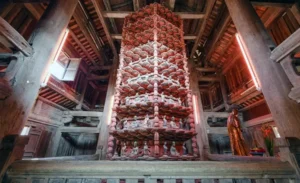 The Cuu Pham Lien Hoa tower is painted red and gilded with intricate, high-aesthetic-value patterns. On the lotus floors, there are 144 statues on 54 lotus petals; the top floor has a statue of Amitabha. The Cuu Pham Lien Hoa tower still retains its original ancient architecture and is one of three Cuu Pham Lien Hoa (But Thap Pagoda, Dong Ngo Pagoda) with special value in sculpture and decoration in our country.
The hexagonal prism-shaped tower is the most prominent structure of Giam Pagoda, made of ironwood, about 8 m high, weighing 4 tons, and featuring many elaborate carvings. In the middle of the tower is a rotating shaft that allows the entire structure to turn with the push of a single person. In 2016, Cuu Pham Lien Hoa of Giam Pagoda was recognized as a national treasure.
Nature and wildlife areas
Chi Lang Nam Stork Island
 The stork island is located in Nam Thanh Mien commune, covering an area of over 31,000 hectares, and is home to about 12,000 storks and 5,030 herons. The main species include white, black, fiery stocks, herons, and egrets. In addition, there are night herons and precious bird species such as pelicans and teal that also reside on this island….
Visitors have two options: pedaling or taking a boat around the small islands. It only takes about a day for visitors to visit the entire island. Many people choose to stay overnight at homestays to enjoy the peaceful surroundings and learn about storks’ lives. Thanks to that, they can observe more scenes such as flocks of storks and herons flying out to find food in the early morning and returning at dusk.
Traditional craft villages
Chu Dau Pottery Village
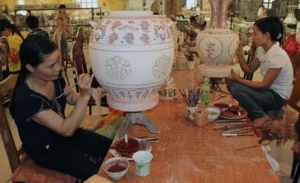 Chu Dau Pottery Village is located in Thai Tan Commune. Chu means boat, Dau means wharf, meaning the boat is moored at the river wharf. Chu Dau was originally a small village on the Thai Binh River; its reputation spread far and wide until traces of the pottery craft appeared, reaching the pinnacle of technique and art, the most famous in the world centuries ago.
The most typical products of ancient Chu Dau pottery are the Hoa Lam vase and the Ty Ba vase, also known as the father vase and the mother vase. The Ty Ba vase has the shape of a lute, representing the yin, the mother, the gentle and virtuous Vietnamese woman. The Hoa Lam vase represents the yang, the husband, the father, the pillar of the family.
Dong Giao Wood Carving Village
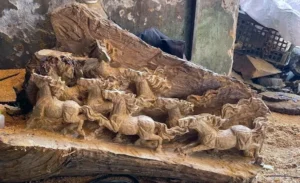 Dong Giao Wood Carving Village is located in Cam Giang commune, 20km west of Hai Duong ward. Dong Giao craftsmen mainly do the sculpting, usually the eight-piece altar, incense table, votive door… then hand over the goods to other villages to be painted, inlaid with mother-of-pearl or gilded. In addition to traditional products, the village also makes statues and decorative items, some of which are exported to China, Korea, Japan, and some European countries.
In recent years, many programs to support craft villages have been implemented to build brands and participate in domestic and international fairs. Dong Giao village is also oriented to develop in association with experiential tourism. Visitors coming here not only visit temples, pagodas, and historical sites, but also directly experience the carpentry process, using chisels to carve wood. This is considered a sustainable direction, both creating livelihoods and promoting culture..
Thanh Hai Water Puppetry Village
Hai Phong has 3 remaining puppetry troupes: Hong Phong, Thanh Hai, and Le Loi. All of them take advantage of the performance location, which is interspersed with houses and fields. Thanks to that, visitors have a sense of closeness when watching.
 In a small pond in the middle of the village, a water pavilion was built as a performance venue. The stories of the fields are skillfully evoked by the locals, who are often familiar with plowing and planting. The performances of the four sacred animals dance, the story of the frog fisherman… just happened naturally and were enthusiastically received by tourists.
Unlike in many other places, the puppetry here uses a different control system. While many other troupes use poles to bring out the puppets and then pull the strings, the people here drive stakes into the water and then connect the strings. At that time, each activity and gesture of the “character” will be controlled by their ingenuity and skill.
Hai Phong cuisine
Hai Phong is most famous for its street food. Tourists often choose a day food tour to enjoy Hai Phong’s delicious dishes. However, if you want to experience Hai Phong’s specialties firsthand, don’t forget the following dishes.
Crab noodle soup
The basic ingredients of a bowl of crab noodle soup include rice noodles (red rice noodles or white rice noodles) that have been blanched because this ingredient has been steamed before drying, the accompanying filling is a portion of soft, smooth field crab fat, thinly sliced lolot sausage, a few round, plump meatballs, sweet and chewy shrimp, and a little fatty pork fat.
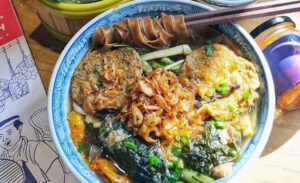 The crab noodle soup is served with seasonal vegetables such as water spinach, water mimosa, mustard greens, chrysanthemum greens, celery… Herbs include green onions, coriander, and Vietnamese coriander…After arranging the ingredients one by one like a work of art, the seller will pour in hot broth made from sweet, flavorful ground crab.
To make the dish more appealing, the seller does not forget to drizzle a little caramel sauce made from crab fat with shiny red fat. Sprinkle some fragrant, golden fried onions on top, and diners can start enjoying.
When eating crab noodles, you should definitely add a little bit of chi chuong – a typical chili sauce of Hai Phong to enhance the dish’s distinctive flavor.
Ha Lung cake
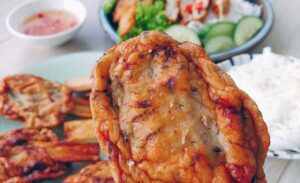 Ha Lung cake (cha chia Ha Lung) is one of the delicious dishes of Hai Phong that makes many diners “miss” them. The unique flavors that create Ha Lung cake come from dried squid, sugarcane, and lean pork. To choose delicious squid, people are picky about buying squid in Cat Ba, Cat Hai, then bring the squid back, cut it into small pieces, grind it with lean pork, marinate it with fish sauce, MSG, shiitake mushrooms, wood ear mushrooms, pepper… and roll it on a sugarcane stick.
Before eating, the cake is steamed and then deep-fried in oil. Ha Lung cake is served with raw vegetables and chi chuong (the way Hai Phong people call chili sauce). Biting into a piece of the cake, you will feel the sweetness of sugarcane, the rich aroma of meat, and especially the rich, authentic taste of the sea from the attractive dried squid pieces.
Green bean cake
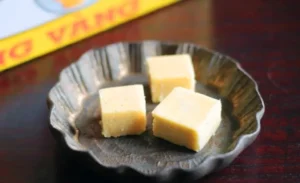 When mentioning Hai Phong, most thoughts about delicious gifts center on green bean cake. This dish originated in the early 20th century, and although it does not have an eye-catching appearance, its delicious flavor still attracts many travelers. The ingredients to make this dish include green beans, sugar, lard, and grapefruit oil.
Experienced cooks often choose thin green beans, dry them, roast them until golden brown, and then grind them into fine powder. The lard is fried over low heat to avoid burning, then filtered, and only the transparent part is taken. The sugar is mixed with water, also filtered, and grapefruit essential oil is added and mixed in the right proportion to create delicious cakes. Enjoy green bean cake, sip a cup of tea. The bitter, astringent taste will enhance the cake’s sweet, rich flavor.
Gai cake
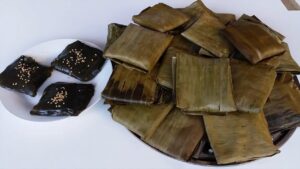 Appearing in Hai Phong since the 12th century, gai cake has quickly become famous far and wide and remains popular to this day. This is a simple cake made from garden ingredients, but it still leaves diners with a lasting memory. The ingredients of Gai cake are divided into two parts: the shell and the filling. In which the shell contains only sticky rice and Gai leaves, while the filling includes pork fat, green beans, coconut, and lotus seeds.
The most elaborate processing method is filling. In which pork fat is marinated with sugar to make it crispy like pumpkin jam. Lotus seeds and green beans are stewed, crushed, and mixed with pork fat, fresh coconut, and sugar. Gai cake is wrapped in dry banana leaves and steamed for 2 hours.
Thanh Ha Lychee
 In May and June, all over Hai Phong, especially in Thanh Ha land, there are many ripe lychee trees. The clusters of ripe lychees are bright red, set against the green foliage. Entering the gardens, you will enjoy the fresh air, pick ripe lychee clusters with your own hands, and feel the aroma and sweet taste linger on the tip of your tongue. Thanh Ha lychee’s characteristic is that the ripe skin is bright red, the surface is flat, the lychee pulp is thick, clear white, crispy, has a sweet taste, and a light aroma.
Rice paper
A characteristic of Hai Phong rice paper is that it is soft, chewy, and does not break when soaked in water for a long time. To make such rice paper, locals here revealed they use only Q5 rice. Customers who buy this specialty can process it into many delicious dishes, such as stir-fried pork, cooked with fish, chicken…
Ruoi cake
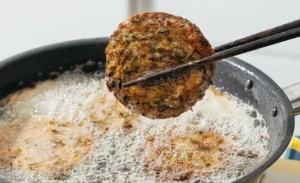 Ruoi, scientifically named Nereididae, are a family of polychaete worms. Ruoi cakes are found in the low-lying rice fields of Kinh Mon, Kim Thanh, Thanh Ha, and Tu Ky. Every “September 20th and October 5th” when the tide rises and floods the fields, Ruoi cakes emerge from underground in groups and swim out to the river.
Wash the Ruoi cakes, drain them, then put them in a bowl and mash them with chopsticks, mixing them with the above ingredients. Steam the Ruoi cakes, then fry them in oil until patty-like. Hot Ruoi cakes are rolled in lettuce leaves, eaten with herbs and vermicelli noodles, then dipped in fish sauce to savor their rich flavor.
Source: collected by An
Follow us for the best deals on Vietnam package tours and visa services!

Comment (0)