
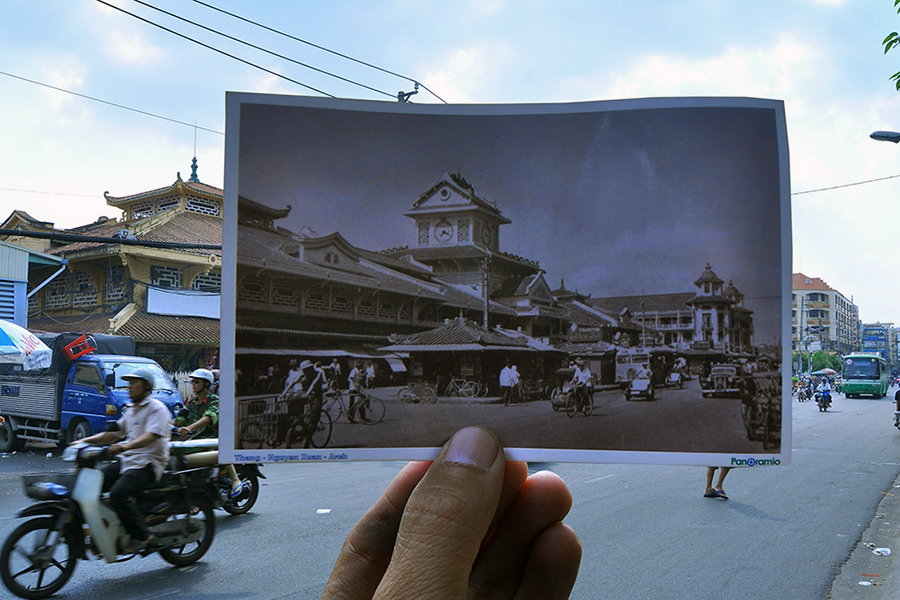
After more than 300 years of establishment and development, old Saigon and Ho Chi Minh City today have become a bustling commercial center, the largest in the country. Experiencing many ups and downs throughout history, yet in many places, streets, markets, and buildings still retain the beautiful image of the old days. Both domestic and foreign tourists want to come to see and learn about the development history, which once made it known as the “Pearl of the Far East” in Asia.
Ben Thanh Market
In the past, Ben Thanh Market was famous for its red-and-green billboards. The market existed very early (1922), before the French invaded Gia Dinh (one of the old names of Ho Chi Minh City). Over the decades, this place has always been a bustling shopping center in the heart of Saigon.
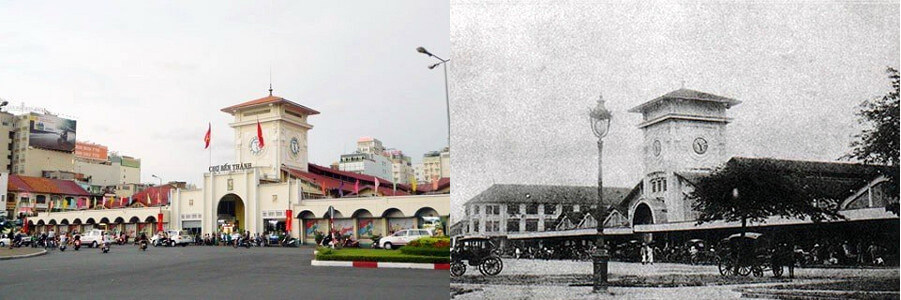
Maybe many people do not know, but the original Ben Thanh market was near the Saigon River. During the anti-French period, the market was located on the banks of the Ben Nghe River to serve visitors and soldiers. Therefore, the market is called Ben Thanh Market and is an indispensable symbol of Saigon’s past and present.
Notre Dame Cathedral Basilica of Saigon
Notre Dame Cathedral Saigon is located at 01 Paris Commune, Sai Gon Ward. Construction started in 1877 and was completed in 1880 by the French. The entire building features ancient elements and bold French architecture.
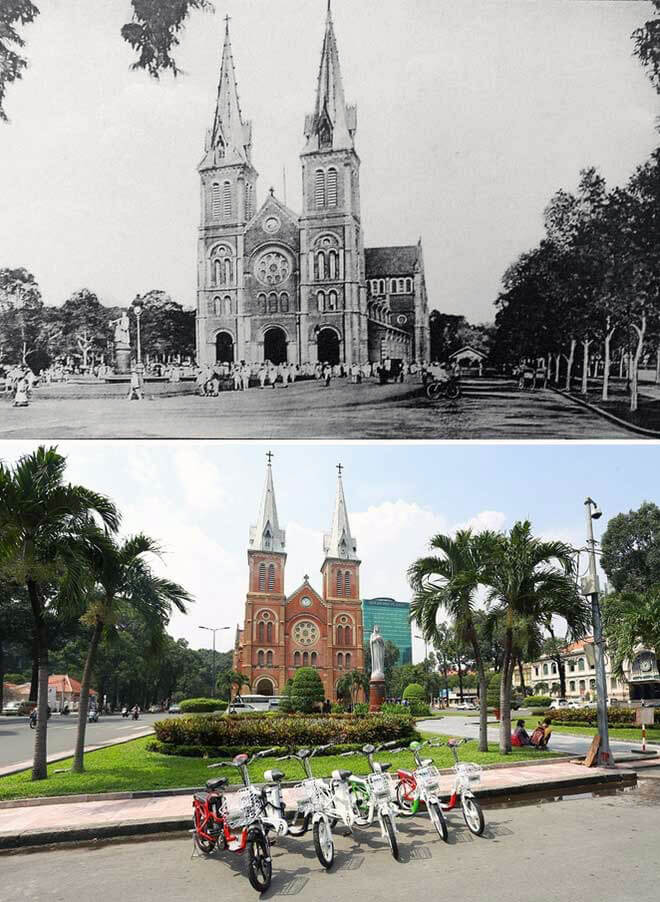
During construction, all building materials, from cement to screws, iron, and steel, are sourced directly from France. In front of Notre Dame Cathedral stands a 4.6 m-high statue of Our Lady of Peace, weighing 8 tons, carved from Italian white marble. In 1895, the church was built with two more bell towers, each tower 57.6m high, including six bronze bells weighing 25,850 tons. This is also the largest set of bells in Vietnam up to now.
Independence Palace
Another equally famous building in Saigon is the Independence Palace, also known as the Reunification Palace. This used to be the residence and working place of the President of the Republic of Vietnam. It is currently classified as a special national monument by the Vietnamese government.
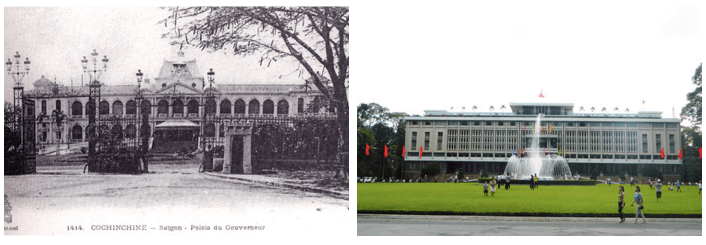
Built on a large piece of land with an area of 12 hectares, including an architectural building over 80m wide, a living room with a capacity of more than 800 people. The palace was designed and built by architect Ngô Viết Thụ on a 4,500 m² site, with a usable area of 20,000 m², and includes 3 main floors, 2 mezzanines, a ground floor, 2 basements, and a helicopter landing terrace. More than 100 rooms in the Palace are decorated in different styles depending on their purpose, including staterooms, cabinet meeting rooms, and the offices of the President and Vice President…
In the mid-1960s, this was the largest-scale project in South Vietnam. Today, the building still retains its distinctive architecture and is a popular tourist attraction for visitors to Saigon.
Central Post Office
Saigon Central Post Office is located at No.125 Hai Ba Trung, Sai Gon Ward. The French built this building between 1886 and 1891 according to the design project of architect Villedieu and his assistant Foulhoux. This is a European-style architecture combined with Asian decoration.
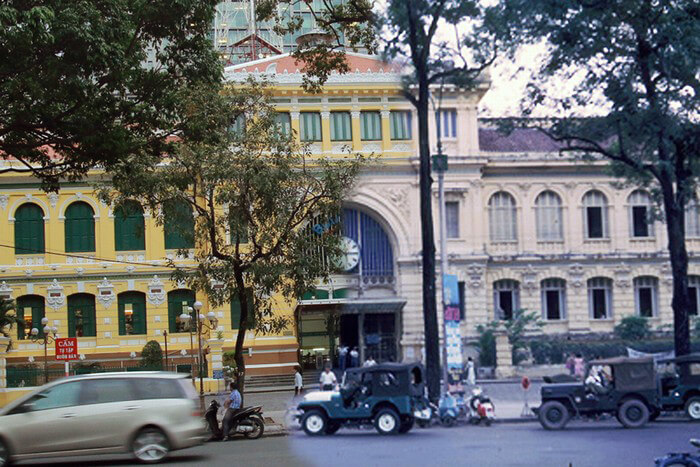
After more than 100 years of existence, the Saigon Central Post Office, together with Notre Dame Cathedral, has become a beautiful symbol of unique architecture, a place to store lasting values for Saigon – Ho Chi Minh City.
Saigon Opera House
This is also one of the oldest architectural works of Saigon, with the ancient Western European architectural style. The Opera House, also known as the Municipal Theatre, is a building facing Lam Son Square and Dong Khoi Street in Sai Gon Ward.
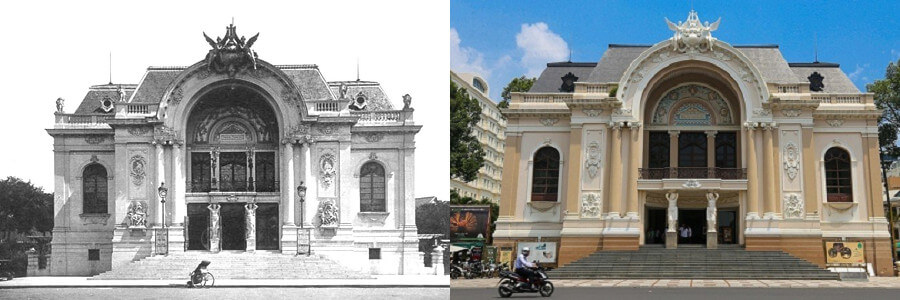
Completed on January 1, 1900, the theatre was initially built by the French with the intention of becoming an entertainment center dedicated to the luxurious. It is an ideal place for visitors to discover. The theatre is not only an architectural and cultural work, but it is also associated with the city’s history, contributing to the charm and elegance of Ho Chi Minh City.
People’s Committee
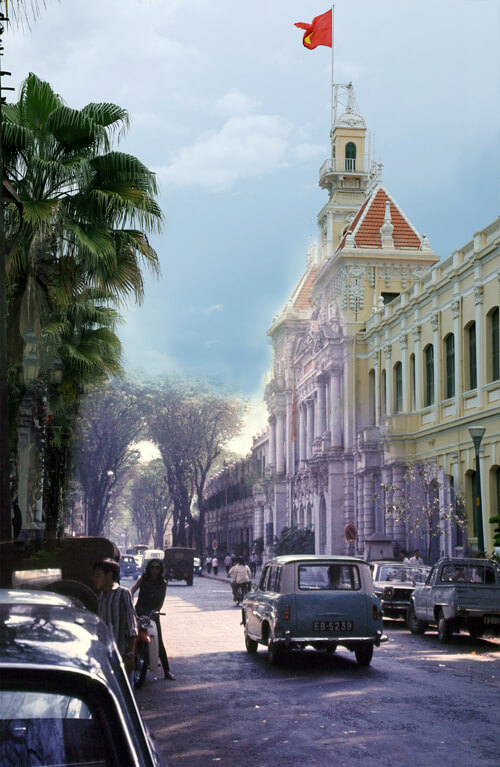
The People’s Committee of Ho Chi Minh City, currently HCMC Department of Home Affairs, formerly known as the City Hall, was built between 1898 and 1909. The photo, taken in 1960, shows that most of the building’s architecture is still intact. Only restored to be suitable for current use. However, anyone who has visited or will visit Saigon will not be able to forget the impressive sight of the building behind the great statue of President Ho Chi Minh.
Dragon Wharf
Dragon Wharf is located on 01 Nguyen Tat Thanh Street, Xom Chieu Ward. Here, on June 5, 1911, a young man named Nguyen Tat Thanh, using the name Van Ba, boarded the ship Admiral Latouche Tréville and began his journey to find a way to save the country.
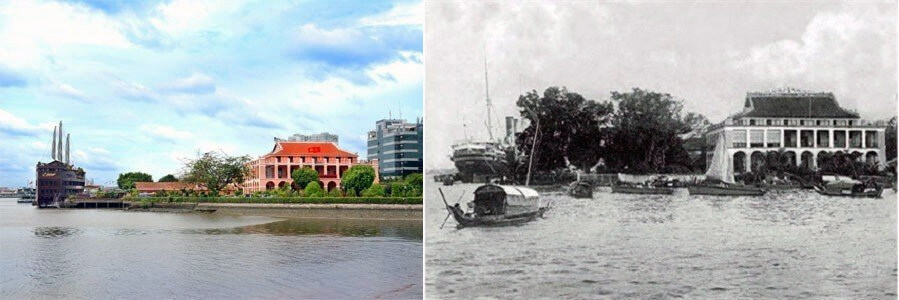
The wharf, built in the late 19th century, used to be the headquarters of the Unified Transport Company. After the liberation of the South, it became a memorial place for President Ho Chi Minh. Currently, the Ho Chi Minh Museum is a branch of Ho Chi Minh City. Every day, the museum welcomes thousands of visitors to visit, study, and learn about the life and career of President Ho Chi Minh.
Turtle Lake
Originally a water tower at Maréchal Joffre Square that provided drinking water to local residents, Turtle Lake (District 3) is now a tourist attraction for many young people and domestic and foreign tourists.
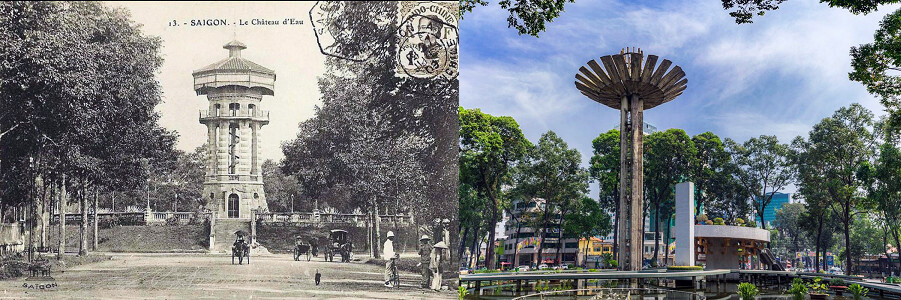
In the years 1965-1967, the government of the Republic of Vietnam built a traffic roundabout, decorated with trees and octagonal fountains, with 4 spiral walkways leading to the central area, where the monument and the image of an alloy tortoise are supported on the back of a large stone stele. Hence, the folk name is Turtle Lake. In 1976, the stele and the turtle were destroyed by an explosion, but people still know their names.
Grand Hotel
Located on Dong Khoi Street in Ben Nghe Ward, Grand-Hotel Saigon was built in 1929 during the Indochina period and has 68 rooms. Two years later, it was sold to French merchant Patrice Luciani and renamed Saigon Palace.
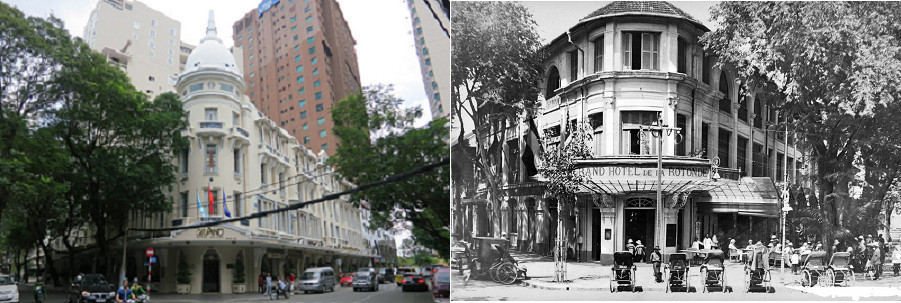
Regularly hosting entertainment events for the elite, Saigon Palace quickly became one of the busiest hotels in the city and was frequented by some of Indochina’s most high-profile figures during the 1930s.
Continental Hotel
Continental Hotel is Saigon’s oldest hotel, built in 1880, and is now more than 140 years old. This is also one of the few old buildings still standing on Dong Khoi Street.
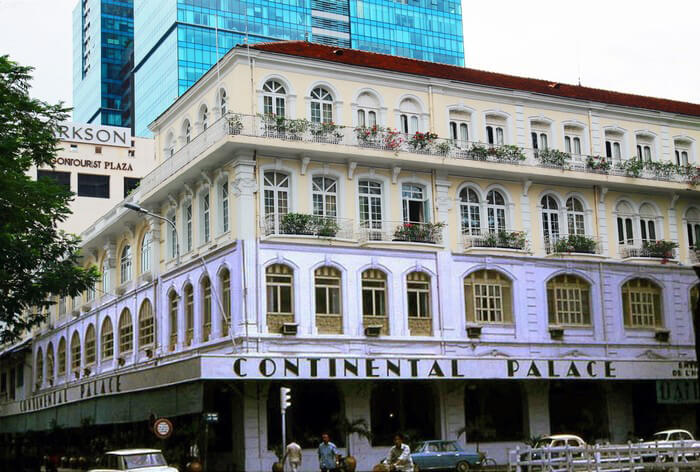
Despite its modest height with only three floors, Continental Saigon Hotel still stands out in the city center with its tiled roof, thick brick walls, and graceful windows. The bas-relief columns are in a boldly French architectural style.
Binh Tay Market
Binh Tay Market was built by a Chinese businessman, Quach Dam, and then donated to the city government in 1928. The market was built with an Asian architectural style but followed modern Western techniques and is considered one of the most beautiful markets in Saigon.
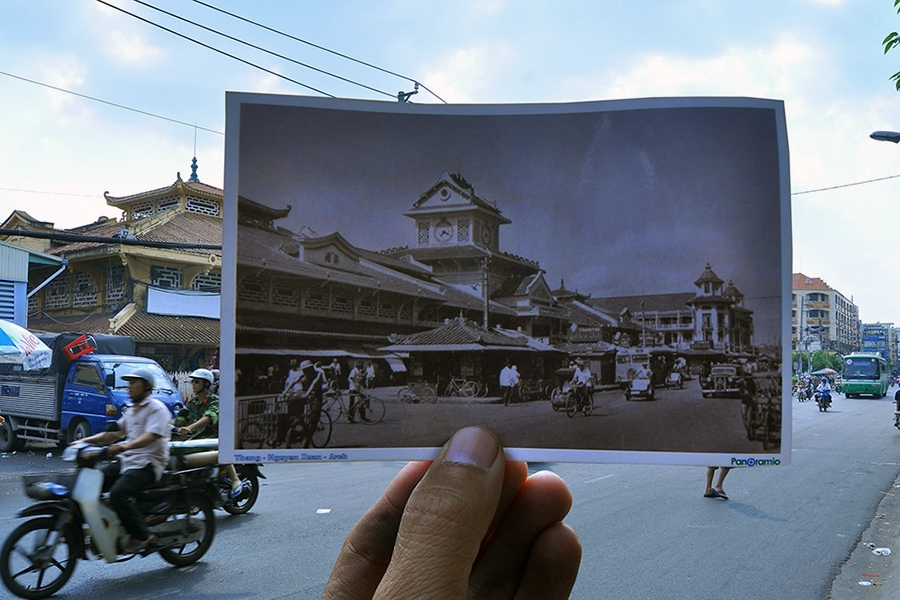
Over 80 years of establishment and development, the Binh Tay market today still retains its position as a large wholesale market for the city and District 6, despite fierce competition from supermarket chains. a modern commercial center in recent years. However, with China’s ancient architecture and long history, the market is opening a new development direction, positioning it as a potential shopping destination for domestic and foreign tourists.
Warmest Greetings To All from Viet Dream Travel! If you have any questions about Vietnam tours, including Cu Chi tunnels tours, Mekong Delta tours, package tours, visa services, or car/bus rental services, do not hesitate to contact us.
Source: collected by An
Follow us for the best deals on Vietnam package tours and visa services!

Comment (0)