
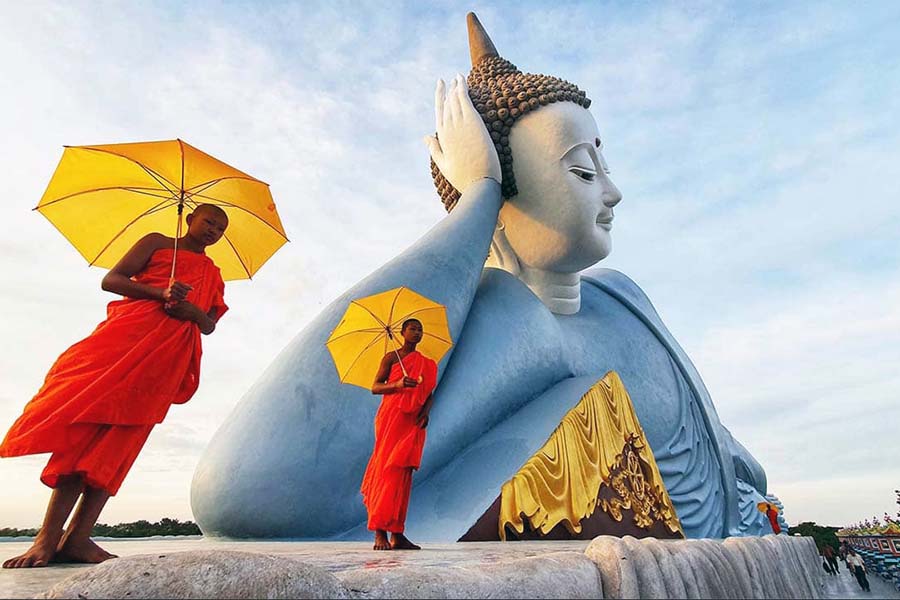
Soc Trang was a province (currently merged into Can Tho City) with many ethnic groups, creating a multicultural society. When exploring Soc Trang, visitors will come across many unique pagodas and attractive eco-tourism areas not to be missed.
General about Soc Trang
Soc Trang has a coastline of about 70 km, with three large river mouths, Dinh An, Tran De, and My Thanh, flowing into the sea.
Soc Trang is a convergence of culture, cuisine, destinations, and many typical experiences in the Mekong Delta.
What is the best time to visit Soc Trang?
Soc Trang is located in a tropical climate zone influenced by monsoons, with distinct dry and rainy seasons. The rainy season is from May to October, and the dry season is from November to April of the following year. The average annual temperature is about 27 degrees Celsius, and the region is rarely affected by storms and floods.
Tourists can visit Soc Trang in all seasons. However, the full moon day of the 10th lunar month each year is when two major festivals take place: Ok Om Bok and the traditional boat race.
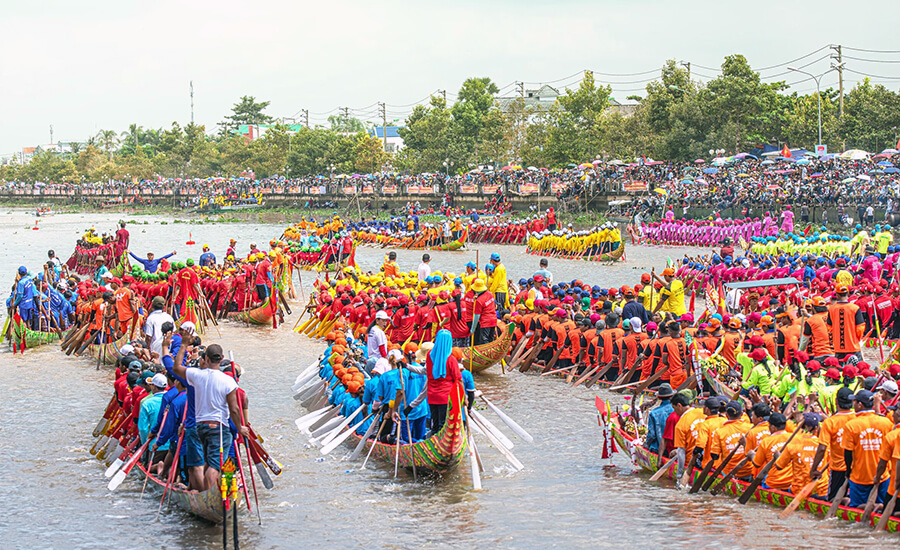
This could be the ideal time to travel to Soc Trang. Around April-May, the Tabebuia rosea is in full bloom in Soc Trang, with many beautiful scenes for photos.
How to get here?
The center of Soc Trang is about 230 km from Ho Chi Minh City and 60 km from Can Tho, on National Highway 1, which connects Can Tho and Ca Mau. The most convenient way to travel is by road, using means such as cars and personal motorbikes.
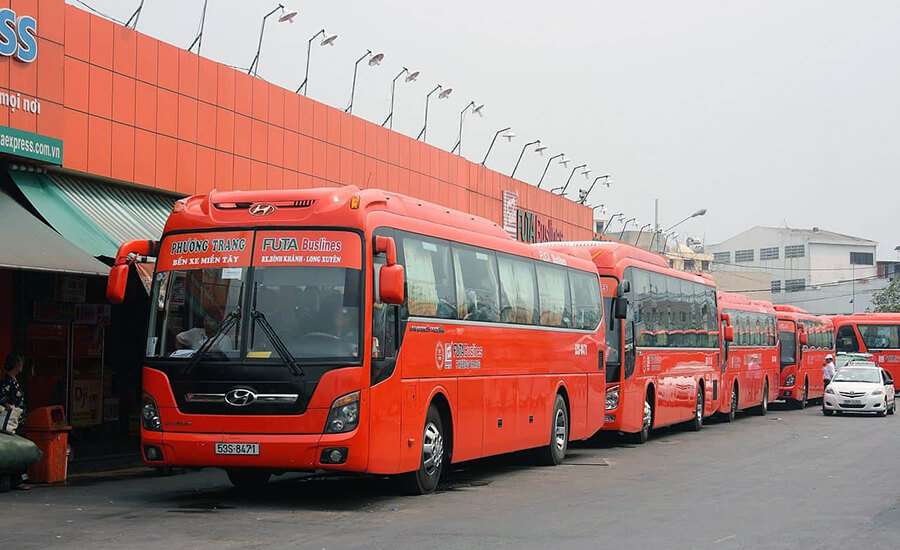
Passenger buses depart from Mien Tay (Western) Bus Station, travel time is about 4-5 hours. Bus companies include: Phuong Trang, Ha My, Ke Nghi, Tri Nhan, Lien Hung, Ngoc Anh, Le Hung, My Duyen… Ticket prices range from 160,000 VND to 300,000 VND.
Tourists from faraway places can fly to Can Tho and travel by road to Soc Trang. There are many limousine bus routes from Can Tho airport to Soc Trang. Tourists can register at the airport. Travel time is 1 hour and 15 minutes, ticket price is 120,000 VND.
Accommodation in Soc Trang
Soc Trang city has many 2-3 star hotels with prices ranging from 300,000 VND to 700,000 VND per night, such as Ngoc Thu Palace, Thuan Phat Hotel, Thien An Hotel, Que Toi Hotel, Net Viet Hotel, Xuan Huynh Hotel…
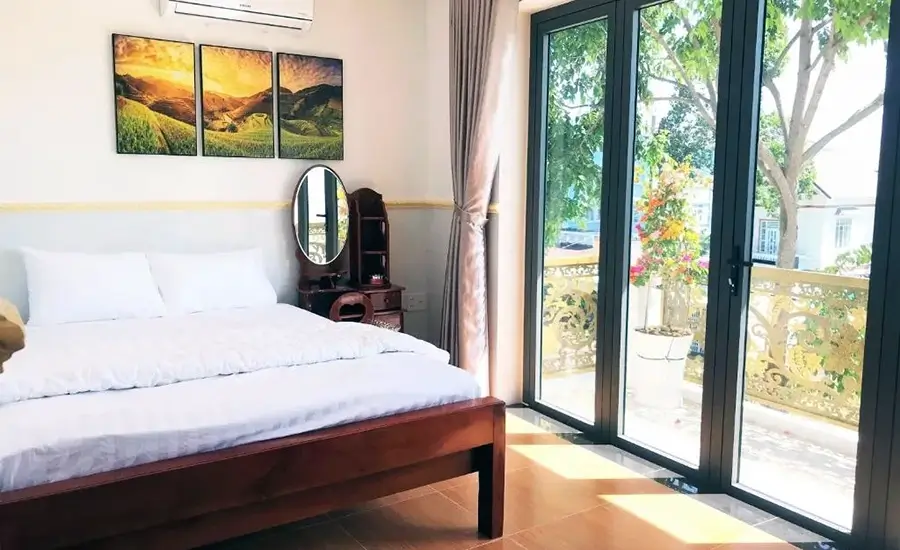
Tourist attractions in Soc Trang are not too far from the city center, so visitors can stay in hotels in the city, travel during the day to sightseeing sites, and return to stay overnight.
Where should you visit in Soc Trang?
Come to Soc Trang tourism if you do not know where to go. Do not forget to refer to the super nice Soc Trang tourist destinations below and enjoy your trip:
La Han Pagoda
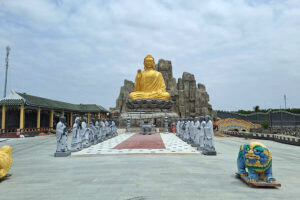
La Han Pagoda is a beautiful sightseeing destination that tourists should not miss when exploring Soc Trang. This Chinese pagoda has an ancient, majestic beauty, like a massive castle on the banks of the Mekong Delta, where indigenous people often come to make pilgrimages and pray for peace, luck, and fortune. Not only that, but La Han Pagoda also has a particularly striking feature in its wall design.
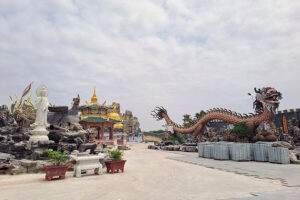 Most of the walls surrounding the pagoda are not made of wood or concrete and painted in the traditional yellow, but are built of stone, creating an impression of solidity and grandeur. In recent years, La Han Pagoda has become increasingly famous, attracting many young tourists from near and far to visit and take photos because of its impressive scenery.
The pagoda is located at 131 Dien Bien Phu Street, Cau Den Hamlet, Soc Trang Ward. This is one of the pagodas in Soc Trang that features unique architecture, with ample space and green grounds, very suitable for people to visit and make pilgrimages on full moon occasions and major holidays.
Kh’Leang Pagoda
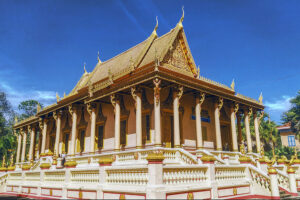
Kh’Leang Pagoda is one of the ancient Khmer pagodas in the Mekong Delta region with a history of nearly 500 years. Kh’Leang Pagoda bears the mark of highly sophisticated, sharp Khmer architecture, yet still blends Vietnamese and Chinese styles in its decoration.
Kh’Leang Pagoda is located on Ton Duc Thang Street, Group 5, Soc Trang Ward, in a large campus, shaded by ancient trees, most of which are palm trees, a tree species associated with life, culture of the Khmer ethnic people. Coming here, visitors can enjoy fresh air, learn about ancient Khmer documents, legends about the origin of Soc Trang and admire the unique architecture of the pagoda.
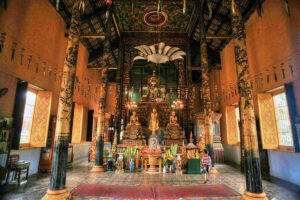
The name Kh’Leang Pagoda is associated with the legend of Soc Trang. According to the bibliography, the pagoda was built in 1533. At first, it was just a thatched pagoda, but after many restorations, it was rebuilt with bricks and tiles. The current pagoda architecture, including the main hall and Sala, was built in 1918.
Khleang Pagoda’s architectural complex is arranged harmoniously on high ground. Another notable point is that most of the works at Kh’leang Pagoda are built in the traditional stilt-house style of the ancient Khmer people of the South. Each work was sculpted and carved with patterns and exquisite motifs that reflect ancient Khmer architecture, creating a unique look that attracts many people to visit and admire.
With symmetrical and harmonious architectural lines and unique, diverse works of art, the main hall of Kh’Leang Pagoda is truly a work of special artistic value. In 1990, the Ministry of Culture, Sports and Tourism designated it a national historical and cultural relic, classified as an architectural and artistic relic. This is an interesting tourist destination you should not miss when exploring Soc Trang.
Nga Nam Floating Market
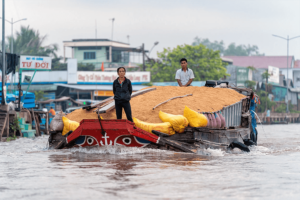
The Nga Nam floating market in Nga Nam town, about 60 km from the center of Soc Trang, is a place that attracts tourists to experience Western river life.
The name Nga Nam appeared when the French dug the canal around the Phung Hiep route. This canal and Xang canal cross Xeo Chinh canal to form five river branches flowing to 5 intersections: Ca Mau, Vinh Quoi, Long My, Thanh Tri, Phung Hiep.
Nga Nam floating market usually opens quite early and lasts until 8 o’clock, after which it gradually dissipates. The busiest time is usually from 5 am to 6 am, with hundreds of boats gathering, making a bustling noise all over the river wharf. This is the ideal time to experience the floating market.
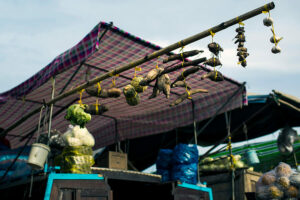
The goods at the Nga Nam floating market are very rich and diverse, ranging from famous, delicious rice from large rice granaries in the area to garden vegetables and fruits; from agricultural products and seafood to daily living and household items. To facilitate the transmission of information between sellers and buyers, the pole tree (cây bẹo) is an effective advertising medium in the floating market. This tool is usually made from old bamboo, bent straight, about 4-5 m long, with sharp corners for easy insertion and pliers when parked. The top is perforated to allow a rope to be skewered through to hang goods. Buyers just need to stand at a distance, look at the pole trees to observe, and find the goods they want to buy.
Currently, due to the increasingly improved road transportation system, some traders have switched to onshore market groups. However, the floating market remains quite bustling, retaining the typical soul of the Mekong floating market, a tourist destination not to be missed in Soc Trang.
Bat Pagoda
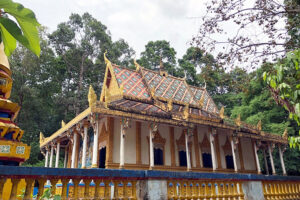
Bat pagoda is located on Van Ngoc Chinh Street in Phu Loi Ward. The pagoda features typical Khmer architectural motifs, with many small towers on its roof, and its gable end is carved with a delicately winding Naga snake. The entire roof of the pagoda is a great architectural work expressing the concept and philosophy of Buddha and the Heaven of the Khmer people.
At Bat Pagoda, there are also scriptures inscribed on palm tree leaves, artifacts, and history books, which are extremely rare and hold unique cultural values of the people of the Southwest that need to be preserved. The most interesting thing for visitors when coming to the pagoda is to admire the sight of thousands of bats hanging like fruit on branches and leaves. At peak times, the pagoda attracts more than a thousand bats.
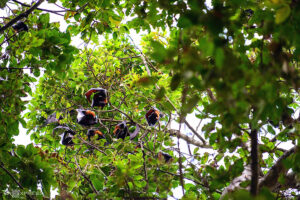
The bats at the pagoda are mainly the rare large flying fox, weighing 1 – 1.5 kg and with a wingspan of up to 1.5 m. They are fruit bats and live in lush fruit gardens, but they never eat fruit in the pagoda; they often fly far away to find food.
Therefore, when dusk falls, the scene at the pagoda is strangely bustling, with the noisy sound of bats flapping their wings, calling to search for food at night.
Bat Pagoda is the first pagoda to be ranked as a National Monument and Scenic Landscape. This is both a center for educational activities and for the organization of traditional religious festivals.
Khmer Museum
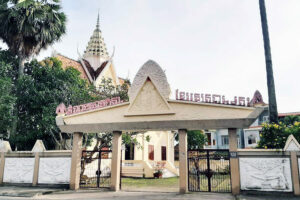
Khmer Museum, like many museums elsewhere, is a popular tourist destination here. The museum displays 730 valuable artifacts, including many donated by local people, many of them reflecting the life and culture of the Khmer people over many generations. This is a place specifically for tourists who want to learn about the beauty of culture, history, and patriotic traditions of fighting against foreign invaders of the Kinh, Khmer, and Chinese through the ages. In addition, the Museum is also a place to visit, learn and study history for students inside and outside the province.
Upon entering the Museum, visitors can see artifacts and weapons of our people and soldiers during the war, such as V100 armored vehicles, M48 tanks, and 122 mm long-barreled guns.
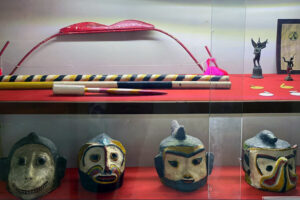 – The ground floor is designed to introduce: Overview of Soc Trang province; natural resources, history of land formation and ancient culture; peoples;,population ,and lifestyle, including agricultural artifacts, means of transportation, and house architecture of 03 ethnic groups; daily life clothes from everyday to funerals and weddings; religious beliefs. – Floor 01 is designed to introduce: the history of fighting against French colonialism and American imperialism through periods; the Soc Trang Party Committee, which formed and led the resistance; the period of innovation towards industrialization and modernization.
In addition, inside the Museum, there are stage models of Ro Hash and Du Ke to attract visitors and help them learn about the theater art of the Southern Khmer people. The image of the miniature Ngo boat also evokes more curiosity for tourists about the Oc Om Boc Festival and the Ngo Boat Race held annually in Soc Trang. There are quite a few new artifacts from the collection on display at the Museum that are highly appreciated by many visitors.
Address: 53 Ton Duc Thang, Soc Trang Ward.
Tan Long stork garden
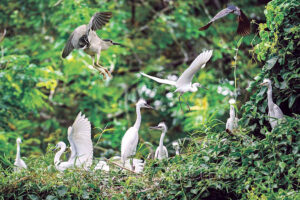
Tan Long stork garden is located in Nga Nam town, about 60km from Soc Trang city center. This place is not simply a bird sanctuary but also a stork conservation area, thanks to its highly favorable natural conditions for their growth and development.
Currently, in addition to individual storks, the stork garden also has several hundred individuals of moldy herons. This is a rare bird species, large in size, weighing over 3kg, with outstanding gray plumage.
When visitors come here, they will learn about storks and their very affectionate, faithful habits. They live in pairs, incubating eggs and raising young.
Chen Kieu Pagoda
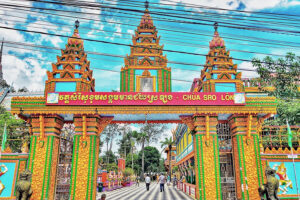
Located in the Southern Khmer pagoda system in Soc Trang, Chen Kieu Pagoda, known as Sa Lon Pagoda, is one of the pagodas with a “unique” architectural style that leaves a deep impression on the hearts of visitors. The outstanding feature of this pagoda is the walls. It is not evenly cemented, tiled, or painted like other pagodas, but is covered with pieces of cups, plates, and ceramics that are unique yet extremely beautiful and aesthetically pleasing.
In 1815, Chen Kieu Pagoda began construction using materials such as leaves, wood, and soil, like many other Khmer pagodas. During the war, under the devastation of bombs and bullets, the main hall of the pagoda was seriously damaged. In 1969, the pagoda was rebuilt in accordance with modern architecture, including a main hall, a sala (a type of meeting room), a stupa, and a place for prayer books.
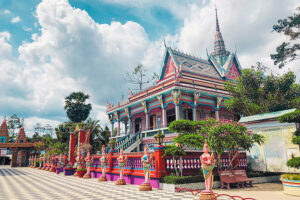
During construction, due to a lack of materials, the monks came up with the idea of using cups and plates donated by villagers to cover the wall. This idea not only saves construction costs but also creates impressive decorative motifs. Since then, the pagoda has also been known by its second name: “Chen Kieu Pagoda”. Khmer artisans cleverly used these cups and plates to decorate the walls and towers, creating a harmonious and impressive architectural work.
For tourists who love to explore or check in with ancient architectural works, this is an ideal place. Every corner of the pagoda can serve as an artistic backdrop for thousands of likes, guaranteed to surprise many when posted.
Chen Kieu Pagoda is located in Dai Tam commune, My Xuyen Ward.
My Phuoc Islet
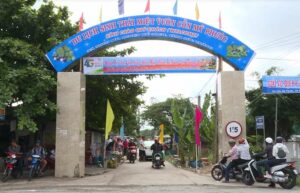
Address: My Phuoc hamlet, Nhon My commune. My Phuoc Islet is also known as Cong Dien Islet or Mud Islet. Since ancient times, this place has been famous for its fertile alluvial land, lush green trees, and fruit throughout the year. Surrounded by rivers typical of the West, this island’s landscape is also very poetic and charming. And more than that, the people of the Southwest region are always generous, gentle, and hospitable, which is also the reason why many tourists love this land.
My Phuoc Island has quickly become a famous green tourist destination in Soc Trang province, attracting a large number of domestic and foreign tourists to visit, experience, and relax.
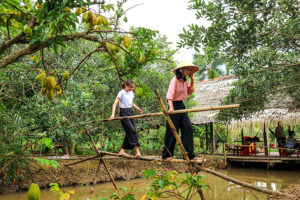
Upon arriving, visitors walk along the year-round roads lined with coconut trees and see for themselves the attractive fruit trees. And experience eating rambutan, mangosteen, durian, mango, longan, and tangerine right in the fruit-filled garden, enjoying their sweet flavors.
Besides, when checking in to My Phuoc island, visitors can also participate in garden-style entertainment activities such as casting nets, setting sails to catch fish, canoeing to collect cork, picking vegetables from the garden, and hiking. How do you know if a goby fish is a good one or a calendar fish? There are also many other exciting activities, such as fishing, river bathing, mud bathing, and the monkey bridge.
Equally interesting is that this green tourist area also organizes groups to teach how to make folk cakes such as pork skin cake, it cake, tet cake, coconut cake…
Som Rong Pagoda
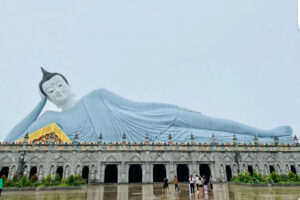
Botum Vong Sa Som Rong Pagoda, also known to locals as Som Rong Pagoda, is located at 367 Ton Duc Thang, Soc Trang Ward. The pagoda is decorated in the Khmer style, combined with modern architecture, to highlight it. Against the clear blue sky, the temple’s yellow tones look majestic and splendid.
The temple grounds are divided into many areas, the most prominent of which is the main tower. Wat Pătum Wongsa Som Rong Pagoda becomes more poetic in the late afternoon. Coming here at this time, visitors not only worship at the temple and pray for peace but can also take impressive, unique photos.
Bon Mat (Four-Faced) Pagoda
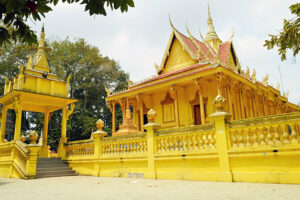
Built nearly 500 years ago, Bon Mat Pagoda, also known as Buôl Pres Phek Pagoda, is a typical aesthetic architectural work of the Khmer people in the South, a cultural and historical heritage. The pagoda covers an area of 6.5 hectares, located in Phuoc Thuan hamlet, Thuan Hoa Commune.
When mentioning the pagoda, people often talk about the legend of a Buddha statue with four faces, each facing a cardinal direction, and about 5 Buddhas found by the Khmer people during the process of reclaiming wasteland. This was a good omen, so people built the pagoda and brought the Buddha statue to worship in 1537.
What are the Soc Trang specialties?
Soc Trang is a place where the Kinh, Chinese, and Khmer ethnic groups have lived and interacted for many centuries, which has given it a unique culinary culture. Anyone who has once traveled to Soc Trang will certainly not forget the aftertaste of these rustic yet hard-to-find dishes. We would like to introduce visitors to delicious dishes and Soc Trang specialties that you must try.
Bun nuoc leo (Noodle soups)
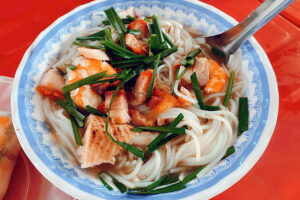
Noodle soup is a famous dish in Soc Trang, thanks to the combination of ingredients that gives it a flavor unlike that of any other region. People call Soc Trang noodle soup a solidarity dish, because the dish is a combination of the quintessence of the Kinh, Khmer, and Chinese ethnic groups, shown in each ingredient of the dish as a characteristic of the three ethnic groups.
In the bowl of noodle soup, people see the flavors of Khmer fish sauce (traditionally prahok), Chinese roasted pork and noodles, fish, and Kinh vegetables…. Each dish is a specialty, and the Soc Trang people combine them harmoniously and delicately to create a truly unique noodle soup. Currently, in the city area. In Soc Trang, many roads and streets have many shops selling noodle soup. There are some shops that sell from morning until night, to please diners who want to enjoy this unique noodle dish. Not only that, but this noodle dish is also included in the menu by restaurants for customers to choose from.
Addresses of some delicious restaurants:
- Ca Dong Restaurant – 655 National Highway 1A, Hamlet 3, Phu Loi Ward.
- Long Nhan Restaurant – Vo Dinh Sam Street, Soc Trang.
Cong cake
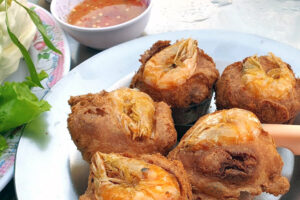
Coming to Soc Trang without enjoying Cong cake is truly a shortcoming for the trip. If you want to eat Cong cake properly, you must eat it at the market area in Dai Tam commune (My Xuyen) and eat it with available vegetables of the region, dipped in sweet and sour fish sauce prepared with your own secret to feel it. all the essence of the cake. Cong cake is crispy and moderately spongy, has a very fragrant aroma, and is bright yellow.
- Dai Tam Restaurant – 28 Dai Chi hamlet, My Xuyen Ward.
- Soc Trang Cong cake – 158 Tan Tho hamlet, Soc Trang
- Banh Tre – No. 101 Phu Loi Street, Soc Trang
Pia cake
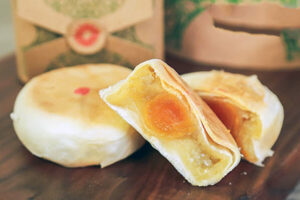
The cake has a distinct durian aroma; each thin layer of cake encases the sweet, flexible green bean filling. When you put a piece of pia cake in your mouth, you immediately feel the unique flavor of durian filling, the fatty taste of salted eggs combined with green beans, all blending together as it slowly melts in your mouth. On the outside are thin layers of skin stacked on top of each other and can be peeled off piece by piece, so it is also called skin cake. A delicious cake is a cake with a soft crust. With a round, flat, small shape wrapped in yellow and red, symbolizing luck, fullness, and prosperity, at the end of a trip to explore Soc Trang, visitors from far away often choose Pia cake as a gift. In addition to durian flavor, the cake also has many flavors such as taro, lotus seeds… and many different fillings.
Mi Sua (sua noodles)
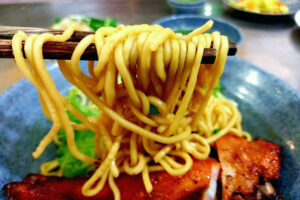
Sua noodles is a traditional dish of the Chinese community in Soc Trang. It is made with soybeans as the main ingredient, so the noodles are golden and usually larger than other types. There are two types of noodles: salty and non-salty. Each type is processed into different dishes, such as salty noodles (best when stir-fried) and sweet noodles, which are used to make sweet soup. When eating fried-sua-noodles, you will feel the chewy, crunchy taste of the noodles mixed with the fatty, sweet taste of the meat. A bowl of stir-fried noodles is often eaten with a bowl of broth to reduce boredom. The broth can be stewed with pork trotters, along with the aromas of coriander leaves, green onions, fried onions, and ground pepper, making the eater feel sweeter and more refreshed with each spoonful. Sua noodles are not salty; they are often cooked with boiled eggs and have a very sweet taste. They are used in parties and birthday celebrations. In meaning, the red color from egg yolk is a wish for a luckier and more fulfilling life.
Sua noodles are sold at restaurants in the center of Soc Trang, such as:
- Thuy noodle shop – 11 Cach Mang Thang Tam, Phu Loi Ward.
- Tinh Chau noodle shop – 26 Phu Loi, Ward 2, Soc Trang
Sour soup with catfish
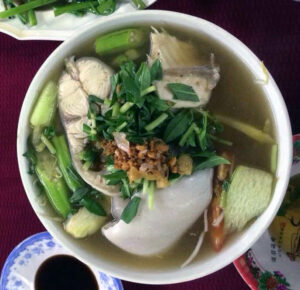
For a long time, dishes made from catfish – one of the specialty fish species of the Hau River- have created a very unique culinary flavor at restaurants and eateries in Soc Trang.
Catfish meat is white, fragrant, not fishy, and healthy, so it can be used to make many delicious dishes. In particular, catfish cooked in sour soup is a delicious, refreshing, and nutritious dish popular with many people, especially on hot days.
To get fresh, live catfish, you can go to restaurants in Dai Ngai, Dung Islet, and Tran De to enjoy the most delicious food.
Source: collected by An
Follow us for the best deals on Vietnam package tours and visa advice!

Comment (0)