
For those who have been to Saigon (Ho Chi Minh City) for the first time, when talking about the center, what people think of right in their mind will be District 1 with Ben Thanh Market, Notre Dame Cathedral, War Museum, Independence Palace, Bitexco Tower, or streets with sparkling lights at night.
But for those who have lived a lifetime in Saigon, besides Ben Thanh Ward – a magnificent center, there is another center, which is busy, prosperous, but friendly and close, containing a huge heritage for everyone named Cholon – the place has been keeping Saigon’s soul for over 300 years.
History of Cholon area
Cholon is the name of the area with a large Hoa population living along the Tau Hu canal. The Vietnamese called “Chợ Lớn” literally means “big” (lớn) “market” (chợ) and is usually anglicized as “Cholon” in English sources. This area was formerly a separate city from Saigon; in the years 1930-1950, due to urbanization, Saigon and Cholon gradually merged.

Cholon was established by Chinese in 1778, lying neatly in the area from Tan Da to Kim Bien and from Nguyen Trai down to Tau Hu canal. In 1782, after the fighting between Nguyen Anh and Tay Son ended, this area was destroyed. The idea of Cholon would go into the past, but shortly after, the Chinese people from Cu Lao (Bien Hoa) had migrated down to rebuild a more prosperous and bustling Cholon. When Cholon was born, the side of District 1 (Saigon city, belonging to Gia Dinh citadel was not yet formed.

When the French occupied South Vietnam on 6/6/1865, Admiral Roze signed the decision to establish the city of Cholon. The noun Cholon is used to refer to the City. On July 1, 1882, the first tram line in Vietnam, 5 kilometers long and 1 meter wide, was opened, connecting Saigon and Cholon.
By 1930, the two cities of Saigon and Cholon were bordered by what are now Nguyen Van Cu and Nguyen Thien Thuat Street. On April 27, 1931, the French government signed a decree unifying Saigon and Cholon into a new administrative unit called the Saigon-Cholon Area.

In 1951, the Saigon – Cholon Area was renamed Saigon – Cholon City, and in 1956, it was renamed Saigon City. Since then, the name “Cho Lon” has only been used to refer to the entire area of District 5, District 6, and a part of District 11 of Saigon. In which Cho Lon Ward is the main living area of the Vietnamese-Chinese community in Ho Chi Minh City today.
The large market with massive legacies
Cholon is the only place in Saigon that still preserves the intact cultural, architectural, and religious values of hundreds of years ago. If cultural values, history, and time have been lost more or less, but with this place, it seems that the destructive power of time has slowed down a lot? The tube-roofed roofs in here, along with the typical architecture, stand out with a very classic beauty. Visitors feel like they are present in some old Chinese quarter of centuries ago.
When hearing the name Cholon, people will think of bustling handicraft factories and many restaurants and local food shops. During the day, Cholon is noisy and bustling with buyers and sellers. There is almost no item that Cholon does not have.
Cholòn is unique; in addition to sightseeing and shopping, tourists can also witness the vibrant life of the Hoa, who immigrated here decades ago, as well as those who were born and grew up on this land.
Some interesting activities at Cholon
Visit Binh Tay Market
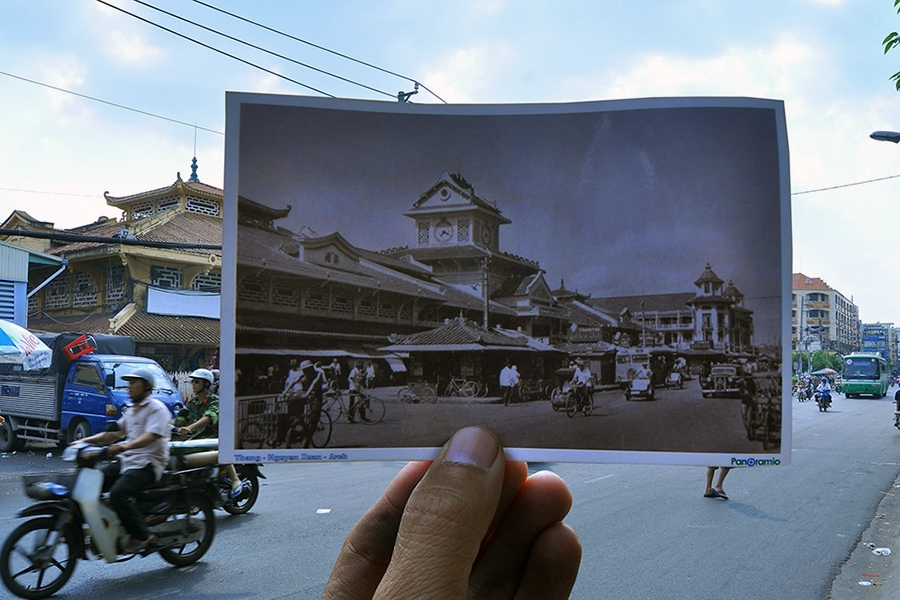
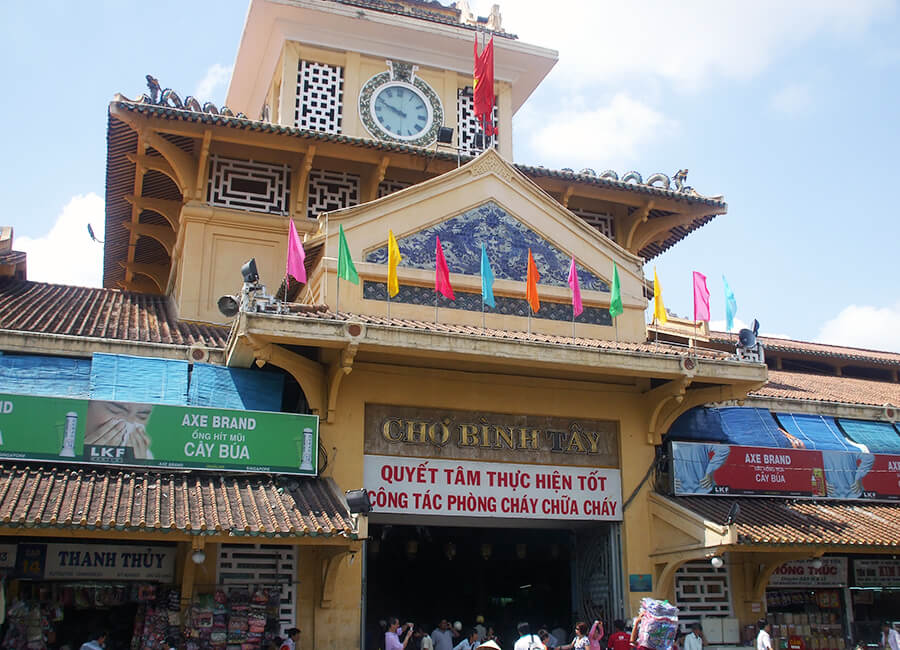
Binh Tay Market was built in 1928, located at the front of Thap Muoi Street in Binh Tay Ward, with an area of about 26,000 square meters, with more than 2,500 stalls, providing mainly wholesale goods, foodstuffs, handcrafted goods, and textiles. It also attracts visitors with its distinctive architecture and its exciting, lively atmosphere.
Explore Thien Hau Temple
Located at 710 Nguyen Trai, Cho Lon Ward, the temple was built in the 18th century by the Hoa group. This is the most sacred place you should not miss when coming to Saigon.

It has existed for over 250 years, but it still retains the characteristics of Chinese architecture. Many engraved lines, sculptures, and artifacts still retain historical and artistic value, making this place increasingly attractive to domestic and foreign tourists.
Although there are many other temples and pagodas around the city, this place consistently attracts a large number of visitors from all over the country to perform charitable work. In addition, Thien Hau Temple is a favorite place for photographers to take photos during traditional holidays such as Tet or March 23rd (lunar calendar).
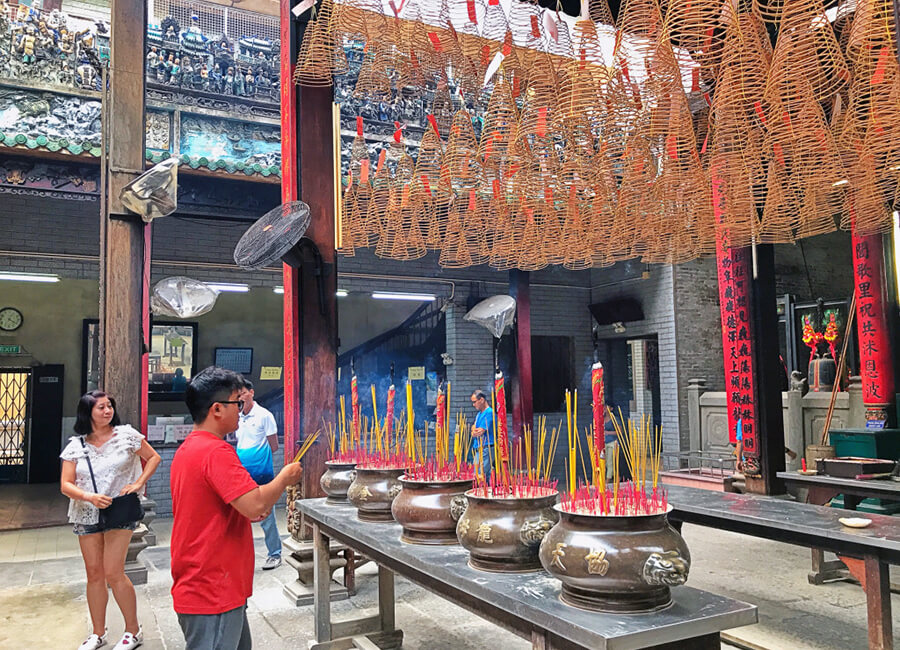
When people in Cholon come to the temple, they often ask for fortune-telling or write down their wishes and stick them on the merit wall. Each red paper for peace is glued next to the others in long rows, adding a unique feature to the temple.

Besides worshiping and burning incense, we believe this is also an ideal place for tourists to learn about the history of Thien Hau Pagoda amid a solemn setting and a peaceful, smoky atmosphere.
On Lang Pagoda
On Lang Pagoda, also known as On Lang Assembly Hall or Bodhisattva Avalokiteśvara Pagoda, is located about 600m from Thien Hau Temple, in the Cho Lon area of District 5. This religious building has a striking appearance with yellow and red tones and is often crowded every weekend morning. Just passing by Lao Tu Street, you can see from afar the shops selling offerings in front of the pagoda’s gate and the stream of people coming and going to burn incense, creating a lively atmosphere.

Built in 1740, the pagoda is a place of worship for Mazu and the Bodhisattva Avalokiteśvara. Before becoming a spiritual place in the Saigon Cho Lon area, this place was once the headquarters of Chinese people from Quanzhou.
The architecture of On Lang Pagoda has many similarities to the traditional pagoda style of the Chinese community, with a curved roof system, a base bordered with green tiles, and decorated with many sophisticated ceramic motifs.

Every year, On Lang Pagoda attracts a large number of locals and tourists to visit and participate in interesting activities such as beating the bad people to ward off bad luck. People also often visit this place on the first days of the year to offer incense to pray for fortune and buy red thread to pray for love.
Address: 12 Lao Tzu, Cho Lon Ward.
Hao Sy Phuong
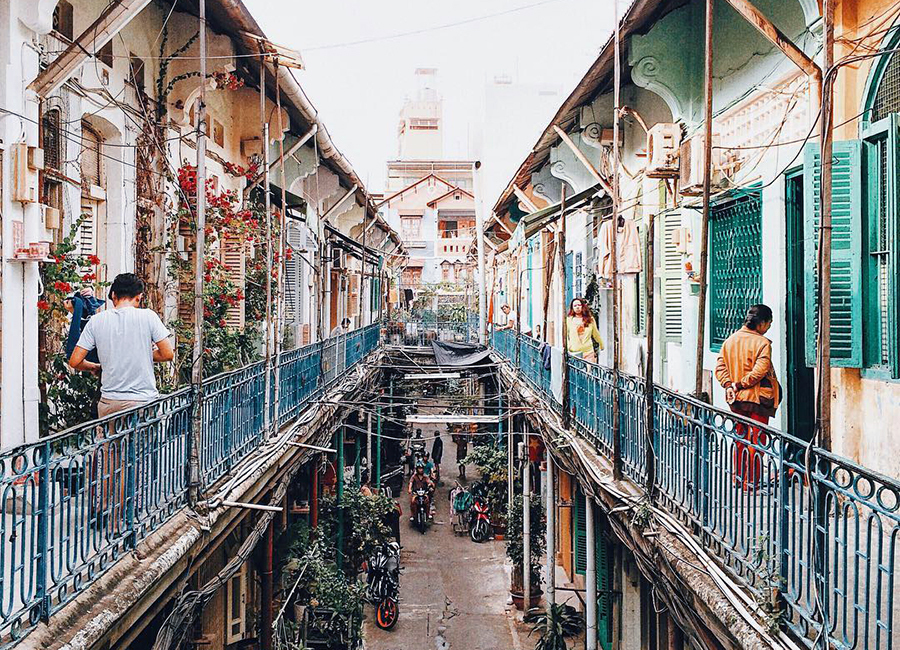
Hao Sy Phuong is the “virtual living” coordinates of Saigon youth with a space like something out of Hong Kong movies. Although it has existed for more than a hundred years, this apartment building still retains its ancient and modern architecture, with a 2-story wall-to-wall housing system, leading up to a common staircase. Decorating the house with red couplets or arranging a heavenly altar in front of the door are also characteristic of Chinese culture and are easy to find in this area.

Stopping at Hao Sy Phuong, you will not only take countless photos to check in at Saigon Cholon but also see the simple activities of the Chinese-Vietnamese community. This is also an opportunity to enjoy a cup of “racket coffee” at a local shop in Phung Hung market, which has been open for more than 60 years, only about 1km from Hao Sy Phuong. In addition, you can also enjoy a variety of Chinese specialties in this residential area, such as banh tam bi, banh khot, spring rolls, etc
Address: 206/17 Tran Hung Dao, Cho Lon Ward
Tasting Cholon’s unique specialties
Cholon cuisine is always “listed” on the list of must-try dishes when coming to Saigon. Here, there is a harmonious blend of many different cuisines; each dish has its own unique characteristics, making Cholon’s cuisine more diverse and attractive than ever.
And below are famous dishes that you must try when you have the opportunity to come to explore the Cholon area:
Pha Lau (offal meat)
Pha lau is an extremely famous dish in Saigon. Pha lau is prepared with parts such as ears, nose, tongue,… or entrails of pork, beef, or chicken. To complete this dish, one must thoroughly wash and remove the fishy smell of the meat, then cut it into small pieces and marinate it with five-spice powder, white wine, soy sauce, sugar, and other additives.

But most importantly, pha lau must always be cooked with fresh coconut water to create the right flavor. In addition, depending on the dish, some people add coconut milk or fresh milk to increase the fat content. In Saigon, this dish “pha lau” is “created” in varieties, such as: pha lau eaten with bread, grilled pha lau, pha lau hotpot, pha lau instant noodles, pha lau bread,…
Roasted duck
Currently, in Cholon, the most popular and busiest area is along Bui Huu Nghia street, with more than 10 large and small roasted duck shops, ranging from a few decades old to a few years old.

In the past, roast duck was a dish served only to kings, as it was quite elaborately prepared. The criteria for a delicious roasted duck are that the skin must be crispy, the outside must be golden brown and shiny, the duck meat must be soft, and, when bitten, it must still retain the fresh, sweet juices of the meat.

Served with roasted duck in the past was usually hot, crispy bread. But now, many places have started adding steamed or fried dumplings to increase a sense of fullness.
Pulled noodles
Fresh pulled noodles are made on the spot on traditional carts, which we often see in Chinese movies and are still very much present in real life. This is also a dish you must try when you have the opportunity to visit the Cholon culinary area. These noodles are not the same as instant or packaged noodles, which you can find at the market or supermarket.

The noodles are always made right in the shop, kneaded entirely by hand in the traditional way, and cooked only on the same day. The noodles are always very chewy, soft, and regular, creating a feeling of never getting bored because of their freshness. But being delicious is not enough. What people enjoy about this dish is that they can see with their own eyes the process of kneading a lump of dough, which in just a split second and after a few juggles, turns into thin, even noodles. Pulling noodles is only for those with good hand strength, dexterity, and experience.

This fresh pulled noodle dish is best served with steamed duck or char siu.
Chicken stew with herbs
More than just a dish, Chicken stew with herbs is also an extremely useful remedy to nourish the body. This dish is made from a black chicken (a chicken with black skin and white feathers) and then stewed with traditional herbs such as ginseng, goji berries, mulberry, jujube, and ginkgo. …

For some people unfamiliar with this dish, it can feel quite strange because of the strong smell and slightly bitter liquid from the herbs. But the chicken meat is very soft and extremely sweet. Chicken stew with herbs, according to Oriental medicine, can nourish and benefit the kidneys, help with anti-aging, osteoporosis, and blood-boosting, and is good for people who have just recovered from illness, especially pregnant and postpartum women.
Dimsum
Dimsum is a collection of traditional Chinese breakfast dishes that, according to some ancient documents, originated in Guangdong, China.

Preparing Dimsum is not an easy task. The filling inside must be selected from fresh ingredients. In addition to shrimp, crab, fish, meat,… there must also be vegetables, tubers, mushrooms,… included; all must be finely minced and mixed well. The seasoning process must also be skillful so that the filling does not lose its natural sweetness and freshness while still being rich. There are many ways to enjoy Dimsum, such as steamed, boiled, fried,…
Almost all Dimsum dishes are very small in size, so it’s convenient to put in your mouth when eating. When serving, Dimsum is placed in bamboo baskets with lids to retain the heat and flavor of each different dish.

From the processing to the shape to the way of serving, everything is meticulously detailed. So it can be said that Dimsum is one of the most artistic and quintessential dishes of Chinese cuisine. In the Cholon area, Dimsum is served at almost every Chinese restaurant.
Sweet soups
Different from other types elsewhere, the sweet soups in the Cholon area are processed to be less sweet and less fatty. Famous among the sweet soup dishes here are: egg tea sweet soup, linguine extract, stewed papaya, ginkgo biloba, black sesame sweet soup,…

Egg tea is chicken seeds cooked with black tea until the tea soaks into the yolk. Because the tea is absorbed, the egg white will feel chewy and taste slightly acrid when eaten. But what’s interesting is that the yolk is very rich yet not greasy, with a mild tea flavor, making many people even more addicted to it.
Cholon is really an attractive place for those who would love to find somewhere to admire the Chinese architectural sculptures in Vietnam. Visitors can take our Saigon city tour or package tour to explore Cholon and other attractions such as the Opera House, the War Museum, Ben Thanh Market, and Independence Palace, and enjoy local food…Don’t hesitate to contact Vietdreamtravel if you need any tourist information in Vietnam.
Source: collected by An
Comment (0)