
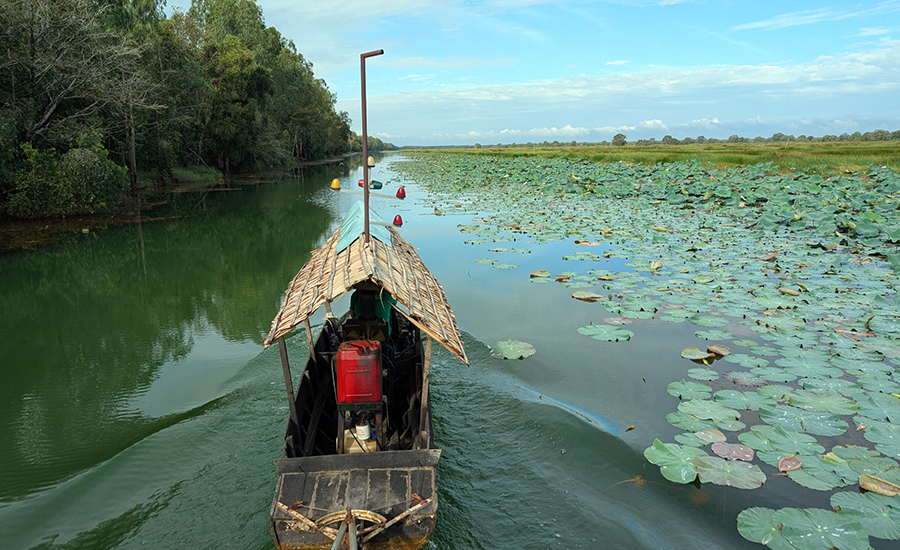
Dong Thap (Vietnamese: Đồng Tháp) Province is an ideal destination for a weekend break or a long holiday. Visitors not only have the opportunity to admire the beauty of nature with immense rice fields and fragrant lotus lakes, but also stand out with a dense system of rivers, rich fruit gardens, long-standing traditional craft villages, and countless delicious dishes of the Mekong Delta River. And let us share some very useful travel experiences when explore Dong Thap, to make your trip more interesting.
Overview of Dong Thap
Dong Thap is a newly established province in the Mekong Delta region of Vietnam. The land of Dong Thap was reclaimed by Lord Nguyen around the 17th and 18th centuries. Dong Thap province was established by merging Kien Phong and Sa Dec provinces in 1976, and later by merging Dong Thap and Tien Giang provinces in 2025.
Dong Thap province, where the Tien River flows into Vietnam, is famous for its lotus fields, which are present everywhere in Dong Thap. Lotus shoots and seeds have become specialties of this region. In addition, Dong Thap is well-suited for ecotourism.
What is the best time to explore Dong Thap?
Dong Thap has a warm, sunny, tropical climate year-round, with mild temperatures and no cold or stormy seasons, so you can travel to Dong Thap in any season. The climate is divided into two distinct seasons: the rainy and the dry season. The rainy season lasts from May to November, during which time you will enjoy the fruit and admire the lotus in full bloom.
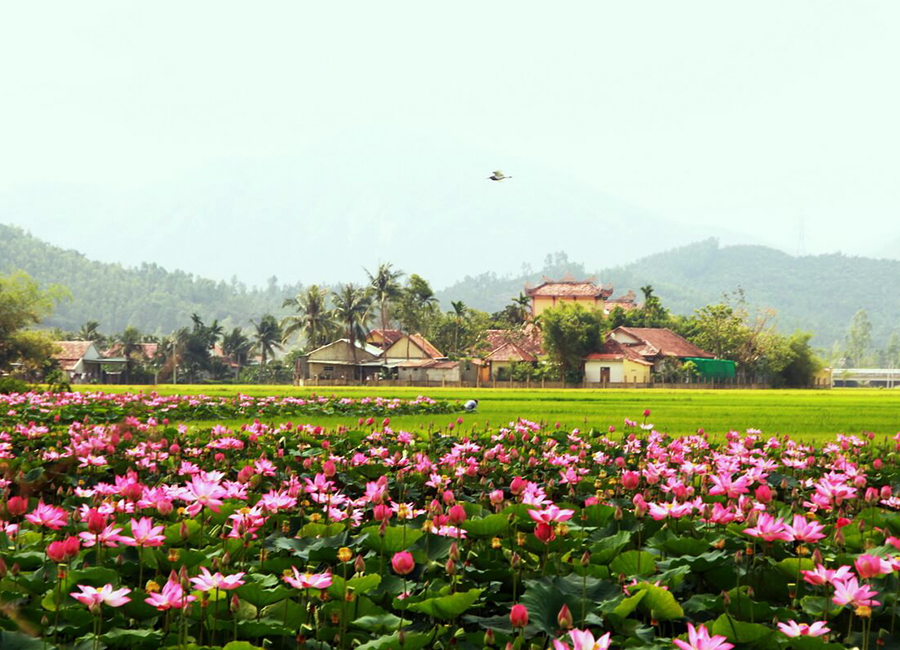
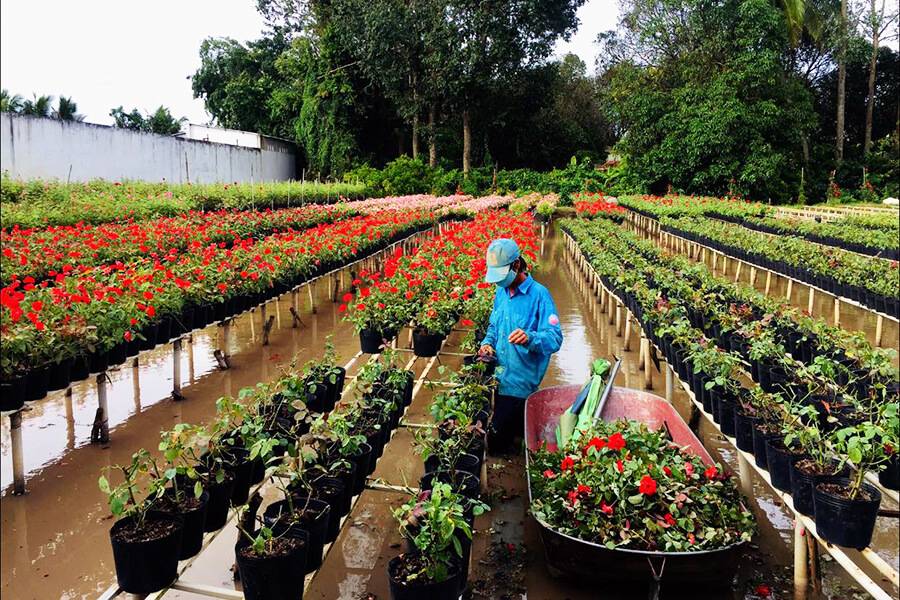
The dry season starts from December to April; after this season, it is close to Tet. The area is brilliantly beautiful with the favorite spring-blooming flowers when the new year comes. This is also the harvest season of Lai Vung tangerine – the most popular fruit in this province.
But if you want to enjoy all the beauty and specialties of Dong Thap, you should go in the floating water season. The floating water season is from August to November of the lunar calendar.
How to get here?
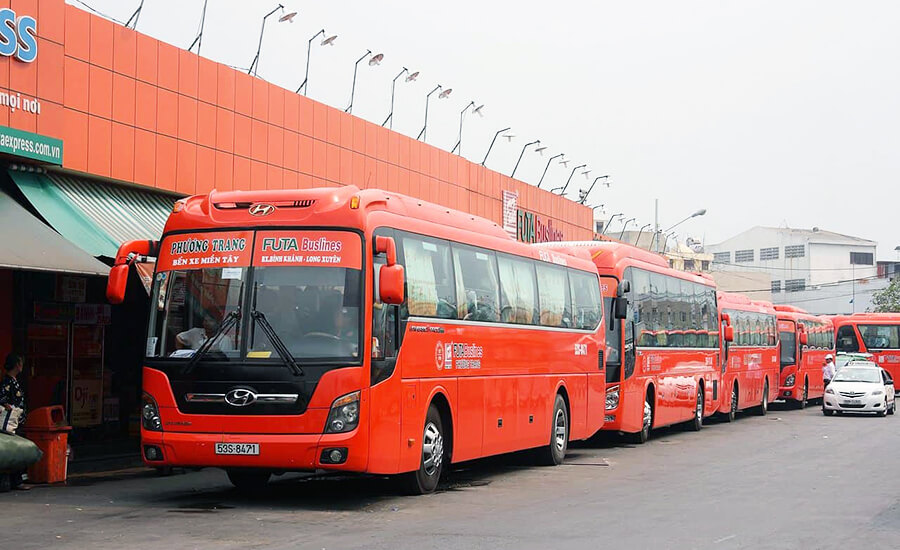
Dong Thap does not have an airport yet; visitors should fly to Ho Chi Minh City or Can Tho and then use road transportation. Tourist buses from Ho Chi Minh City to Dong Thap depart from Mien Tay bus station or a few points in the city. Popular bus companies: Phuong Trang, Tam Nong, Tai Loi, Quang Phat, Kim Cuong. The ticket costs from 200,000VND depending on the type of bus you want to take.
Also, if you’re traveling with a group, don’t forget to book a private car from Ho Chi Minh to Dong Thap, which includes pick-up and drop-off service, is flexible to stop along the way, and makes it easy to admire the beautiful views along the road.
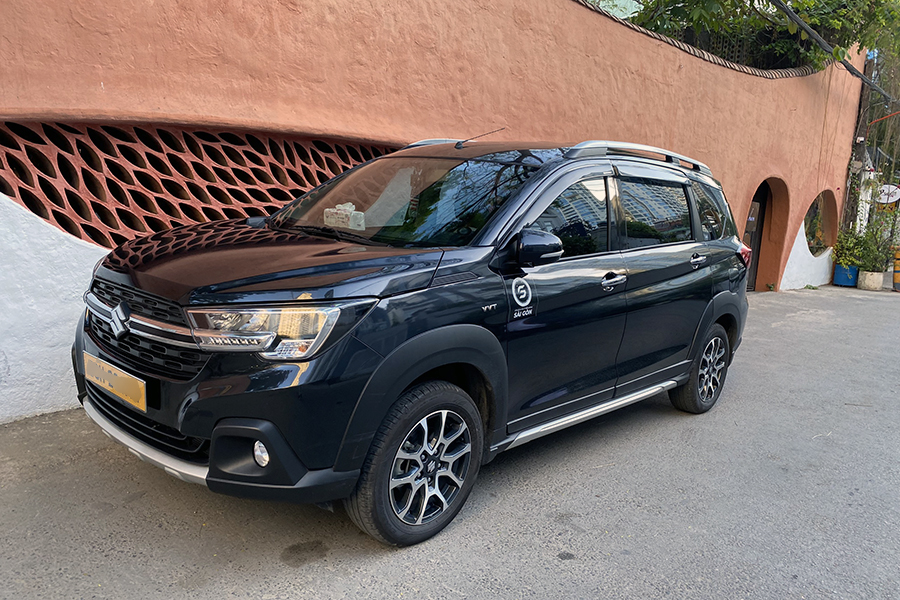
Between Can Tho and Dong Thap, tourists can also travel by waterway on the Hau River. The operating hours are from 6:00 a.m. to 20:00 p.m. Ticket prices range from 10,000 VND to 20,000 VND depending on the mode of transportation.
Tourist attractions in Dong Thap
Dong Thap does not have majestic mountains or clear blue beaches, but those who have once set foot here must be attached and passionate. Dong Thap has the dear rustic beauty of the lush Southern river region, immense lotus fields, fertile rice fields, canoes and birds chirping on rivers and canals … And here are some famous tourist destinations you should not miss in Dong Thap:
Garden and water world-discovering tourism
Thoi Son Islet
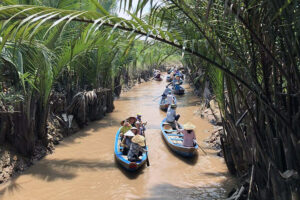 Thoi Son Islet, also known as Lan Islet (Unicon Islet), is located on the Tien River in Thoi Son Ward. This tourist area has become one of the most famous places in Tien Giang, attracting many visitors every year.
The islet is a place for those who like simplicity, rusticity, and the style of Western gardens. Coming to Thoi Son, you will be able to row a boat through the canals like a true gardener, enjoy the cool water, and breathe fresh air. In addition, you can also experience catching fish by hand – a popular activity when coming to this islet.
Fruit gardens, traditional craft villages making candy, rice paper, listening to folk music, enjoying honey tea, and riding a horse-drawn carriage on the village road… are what attract many people to the area. If you want to enjoy fresh fruit, you should go in the summer because that is the time when the fruit grows most abundantly.
Location: Thoi Son Ward.
Tan Phong Islet
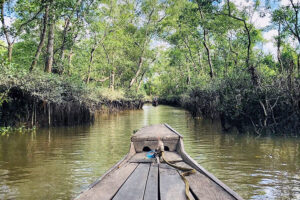
Following Thoi Son Island is the famous Tan Phong Islet located on the romantic Tien River, next to the Cai Be floating market. At Tan Phong, you can immerse yourself in the cool, green atmosphere of the garden areas. Along with that, you can also do boating activities, swimming, enjoy attractive specialties, participate in attractive folk games, experience “bathing in the islet”, etc.
The islet is also famous for its large, succulent rambutans, as well as fresh fruits from the Western Region.
Location: Hiep Duc commune.
Vinh Kim Fruit Garden
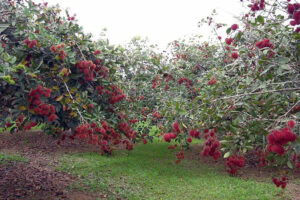
Vinh Kim fruit garden is one of the most attractive places to visit in Tien Giang. This region not only has many delicious, attractive fruits but is also a famous tourist destination with cool, fresh air and many delicious dishes.
Summer is also the time when many tourists come to Vinh Kim orchard to try the most famous specialties of old My Tho, such as Lo Ren star apple, Ngu Hiep durian, orange, … along with many fruits that have long been familiar to the daily menu of the Mekong Delta, such as rambutan, longan, tangerine, guava, mango…
Location: Vinh Kim commune.
Gao Giong eco-tourism area
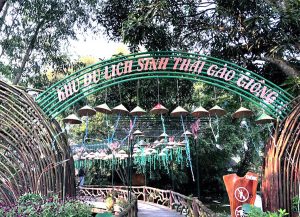
Gao Giong eco-tourism area is located in Hamlet 6, Phong My Commune, about 15 km from the center of Cao Lanh.
There are nearly 2,000 hectares of melaleuca forest and a population of 40, with more than 15 species of rare and precious birds living, nesting, and laying eggs, along with very rich and diverse aquatic resources. Visitors can go by land or by boat. Gao Giong is divided into four zones with more than 70 km of canals and 20 km of embankments.
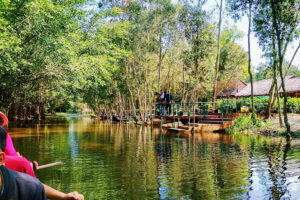 To get to Gao Giong, you have to go through a 2 km-long canal through the green cajuput forest on a three-leaf boat – one of the specialties of the people in the Mekong Delta.
By climbing to the observatory at 18 meters high, visitors can admire the entire bird sanctuary, especially at dawn or sunset, when flocks of white storks fly in search of food or return to their nests.
Also, during the dry season, this is an ideal place for camping under the foliage of the cajuput forest. You can enjoy specialties of the Plain of Reeds, such as grilled snakehead or fish soup with Sesbania sesban flower.
Phuong Nam Cultural Tourist Area
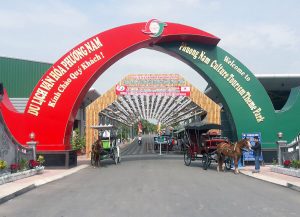 Phuong Nam Cultural Tourist Area began construction on October 30, 2009, and officially opened to welcome visitors on December 24, 2017, on an area of up to 17 hectares, with many works.
However, the highlight is Nam Phuong Linh temple, built in the ancient wooden architectural style, using new wood and featuring a traditional Hue-style house. The temple is a place to honor and commemorate 125 historical figures who have publicly reclaimed, preserved, and glorified the southern land, and 21 bronze statues of the public who open the door.
Phuong Nam Cultural Tourist Area is located in Tan Khanh Trung commune.
Dong Sen Thap Muoi eco-tourism area
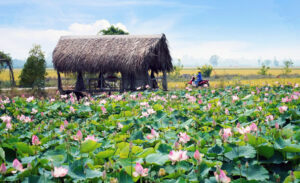
This is where visitors can admire the largest lotus flowers in Dong Thap. The best time to visit Dong Sen Thap Muoi eco-tourism area is from June to November every year. If you can’t come during the peak blooming season, you can still come here at any time to enjoy the air and a quiet moment.
If you come here, you can notice the unique color change of the lotus flower. Usually, in the morning, the flowers will be light pink, then turn pink at noon. And the time when the lotus is considered the most beautiful of the day is around 15 pm, because at this time the flowers will bloom quite large, showing off yellow sepals that sparkle in the sunlight. Then, in the afternoon, the lotus color gradually deepens to a darker pink, and at sunset it is as red as the sunset.
Scared temples and pagodas
Vinh Trang Pagoda
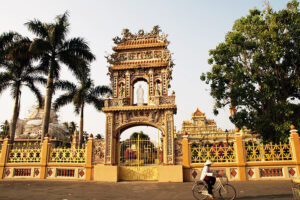
Vinh Trang Pagoda is one of the oldest and most famous architectural temples in Tien Giang. The splendid yet simple features of this Buddhist structure result from the fusion of Eastern and Western architectural styles. The pagoda is surrounded by gardens of ornamental trees and bonsai, creating a peaceful atmosphere.
At the pagoda, there are 60 Buddha statues carved and cast in wood, bronze, and cement, and all are covered in bright yellow. These statues were cast in the late 19th or early 20th century and represent the pinnacle of sculpture in the Mekong Delta.
Address: My An Hamlet, My Phong Ward.
Get 10 – 15% off our daily tour to visit Vinh Trang Pagoda and Thoi Son islet.
Sac Tu Linh Thuu Pagoda
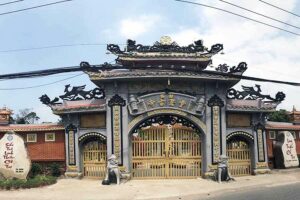
The Sac Tu Linh Thuu Pagoda was built in the 18th century and is commonly known as the Long Tu Pagoda. Although it has been restored many times, the pagoda still retains its distinct ancient architectural features.
The main hall of the pagoda is decorated with great dignity. It is also a repository of many ancient statues, giant bells, and many couplets. There is also a cluster of stone statues depicting the life of Shakyamuni Buddha from his birth to his awakening. Listed as an ancient pagoda in Dong Thap, Linh Thuu Pagoda is a famous pilgrimage site that draws many Buddhists for daily worship.
Location: Cho hamlet, Long Hung commune.
My Tho Roman Catholic diocese
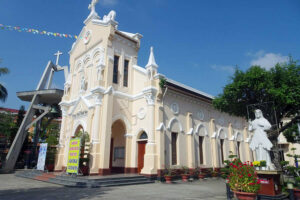
The Roman Catholic diocese is among the oldest buildings in My Tho Ward. It was built around 1906 and is located at No.32, Hung Vuong Street. The church was built in the Greek-Roman Renaissance style, with round columns supporting the dome and decorated with meticulous, sophisticated, and elaborate patterns. Using a predominantly white color scheme, the interior of My Tho Cathedral creates a sense of airiness, spaciousness, and luxury, with the floor completely lined with smooth ceramic tiles. Meanwhile, the ceiling area is adorned with gorgeous European chandeliers. The arched door is adorned with sophisticated patterns following the Greek-Roman architectural style of the Renaissance. The sanctuary of My Tho Cathedral features a yellow main color, white trim, and a red-tile roof. This conveys majesty and antiquity while demonstrating the parish’s steadfast, well-developed beauty after more than 100 years of formation.
Kien An Cung Temple
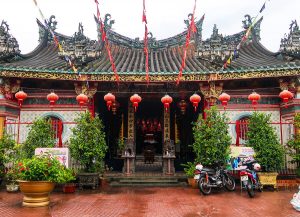
Kien An Cung Temple, also known as Ong Quach Pagoda, is one of the architectural works with typical Chinese cultural features. The temple was constructed in 1924 and completed in 1927 by Chinese people from Fujian Province for the purpose of worshipping ancestors, teaching children, building strong community relations, organizing meetings, discussing trade, and exchanging information. Like many other Chinese pagodas, Kien An Cung has bold, unique architecture, splendid and solemn. In 1990, the pagoda was recognized by the Ministry of Culture, Sports and Tourism as a national-level historical and cultural monument. The temple has two major festivals on February 22 and August 22 (lunar calendar), welcoming many visitors.
Location: 39 Phan Boi Chau Street, Sa Dec Ward.
Phuoc Kien Pagoda
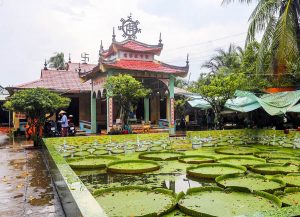 Phuoc Kien Pagoda is also known as the Lotus Leaf Pagoda because it possesses a very special lotus leaf – the Victoria amazonica, which was imported from the Amazon in extremely large sizes.
This type of lotus has very large leaves, up to 3-4 m in diameter and 7–8 m in length. This giant lotus leaf alone has become a significant tourist attraction in Đồng Tháp.
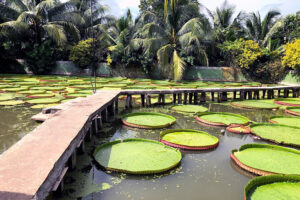 The leaf edge is about 3 to 5cm higher than the water surface; its shape resembles the traditional Vietnamese flat palm hat “Nón quai thao,” which is made from leaves or a flat basket. The lotus can support a person weighing 70-80 kg.
Even though the lotus leaves are so large, their flowers are very small. Furthermore, the flowers take up to 48 hours to fully open and continue to change color. It is white on the first night and pink on the second night.
In addition, the pagoda is home to a hundred-year-old turtle (and a total of 6 elderly turtles). Especially, these turtles all eat vegetarian foods and are “addicted” to listening to Buddhist scriptures.
Location: Tan Nhuan Dong commune.
Famous markets
Cai Be floating market
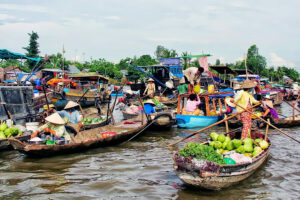
The market was established by local people who cultivated and settled down in the delta during the XVII – XVIII centuries. During its heyday, the Cai Be floating market was known as the unsleeping market. Every day, lots of boats and rafts gather here from 3.00 – 5.00 am until late in the afternoon. They sell everything from fabrics and seafood to appliances and drinks…but the most outstanding was fruit.
Currently, agricultural products and food are being offered to tourists and local people in this market. Although the market is often open all day, the busiest time is at sunrise.
Location: Cai Be commune.
Join our daily tour to explore Cai Be and go kayaking with 10% discount
Historical and cultural relics
Xeo Quyt relic area
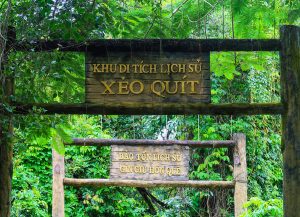
Xeo Quyt relic area is located in My Hiep commune, more than 30 km from Cao Lanh Ward. The green forest, with cool, fresh air, is nestled in a low-lying area with many cajuput trees, reeds, rushes, water lilies, lotuses, and lianas characteristic of the Plain of Reeds. It would be a great opportunity to enjoy sailing along small creeks and explore this area.
Furthermore, Xeo Quyt is not only an ideal tourist attraction but also a historical and cultural relic. It served as the base (from 1960 to 1975) of the Dong Thap Provincial Party Committee, leading the people to fight against America. Xeo Quyt has a system of relics that has been preserved and restored, including fortifications, fences, secret tunnels, the clerical area, and the province’s radio zone.
The tomb of Mr. Nguyen Sinh Sac
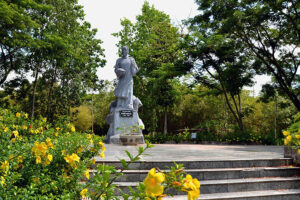
Junior Doctoral Laureate of the Court exams, Nguyen Sinh Sac, was the father of President Ho Chi Minh. Mr. Nguyen Sinh Sac was born and raised in Nam Dan, Nghe An province.
In 1901, he gained a second-rank (pho bang) position as a magistrate in the old Binh Khe district (Binh Dinh province), until he was demoted. Then he moved to the Mekong Delta and lived in Hoa An village in Dong Thap province, teaching and helping the poor until his death.
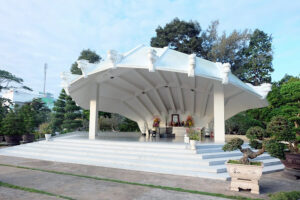
To commemorate his merits, Dong Thap authorities and local people have built Nguyen Sinh Sac’s mausoleum at No. 123/1 Pham Huu Lau Street, Cao Lanh Ward, for visitors to pay their respects and celebrate him.
It was completed in 1977, and covers an area of about 3,6 hectares. There are many ethnic and modern projects on this campus, including Nguyen Sinh Sac Temple and his statue, a gallery on his life, and Ho Chi Minh’s house beside the fish pond (restored to the Hanoi prototype).
Go Thap national relic
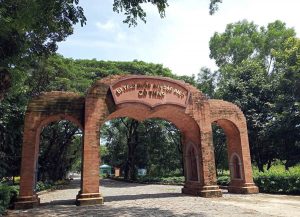 The Go Thap relic site is known from the late nineteenth century, when several French researchers came here to survey and publish significant findings about ancient architecture, worshiping statues, stelae, and ancient script. There are still relic populations of the Funan Kingdom, and there have been wars between Vietnam and the French, and between Vietnam and the US. Go Thap is well known for 5 main highlights: Thap Muoi Hill, Co Tu Tower, Thien Ho Duong and Binh Kieu Temple, and Lady Chua Xu Temple.
You can also learn about the mystery of the Oc Eo civilization, as well as the historical vestiges and folk beliefs that make this relic unique. With unique historical value, the Go Thap was designated a Heritage Site by the Ministry of Culture and Information in 1998.
Go Thap relic area is located in Doc Binh Kieu commune, 43 km northeast of Cao Lanh ward.
Huynh Thuy Le ancient house
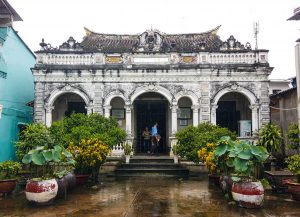 The ancient house is not only beautiful because of its unique East-West architectural blend, but is also famous for its connection to a love story that transcended borders between its owner, Huynh Thuy Le, and Marguerite Duras, a well-known French writer who penned the novel L’Amant (The Lover).
The house was built by Mr. Huynh Cam Thuan (Huynh Thuy Le’s father), a well-known Chinese businessman in Sa Dec, in 1895 in the bustling shopping town of Sa Dec riverfront. When Mr. Thuan died, Mr. Le inherited the house and renovated it in 1917. After Le’s death in 1972, his wife and children moved overseas, leaving the house unused. Later, the house became an administrative building in 1975 and a tourist destination in 2007. In 2009, it was recognized as a national relic site.
The Huynh Thuy Le ancient house is associated with the famous novel L’Amant. Later, it was transformed into a movie and shot in Vietnam in 1990.
Address: 255A, Nguyen Hue Street, Sa Dec Ward.
Rach Gam – Xoai Mut Victory Historical Relic
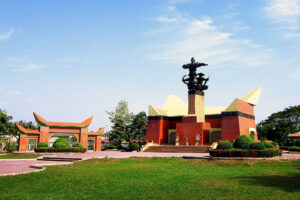 The relic was put into use on January 20th, 2005, on the occasion of the 220th anniversary of the Rach Gam – Xoai Mut victory, covering an area of 1.5 hectares and including 03 exhibition houses displaying a series of ceramic mosaics and many artifacts related to the battle. At the Rach Gam – Xoai Mut Victory Relic Area, there is also a monument to national hero Nguyen Hue located right in the central area. The statue is made of bronze, weighs 20 tons, stands 8 meters tall, and is set on a pedestal that simulates the shape of a warship.
The statue is designed in a heroic sword-drawing posture. Not only that, but next to the statue, there is also a soldier holding a bow and an indigenous person rowing a boat, forming a perfect unity.
Location: Dong hamlet, Kim Son commune, next to the bank of the Tien River, right in front of provincial road 864, about 12 km west of My Tho.
Orchards and traditional villages
Sa Dec ornamental flower village
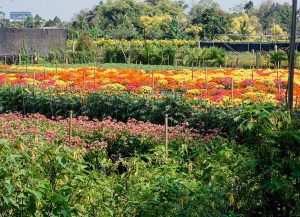
Located on the south bank of the Tien River, next to the provincial road belt in Sa Dec Ward, Sa Dec ornamental flower village is a traditional craft village with a history of ups and downs over a hundred years. This is the fatherland of hundreds of “uncanny flowers and strange herbs”.
The current flower village still preserves over 50 varieties of roses, such as velvety roses; lotus violet-graded roses; pink Cleopatra roses; bridibat roses; bark-brick-colored roses; fortini roses; orange macra roses; metsai roses…
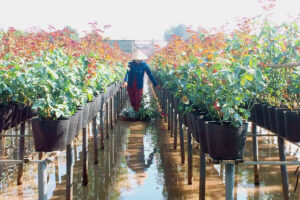
Furthermore, Sa Dec flower village is also home to many rare and priceless bonsai with a lifespan of hundreds of years. There are very simple trees close to the life of farmers, such as areca, fig, thistle, Ocha atropurpurea, but through the skillful, industrious, talented hands of artisan-artists, they become highly valuable products.
Sa Dec flowers and ornamental products are supplied to provinces in the Mekong Delta, Ho Chi Minh City, the central provinces, and to international markets such as Cambodia, Thailand, and China.
Dong Hoa Hiep ancient village
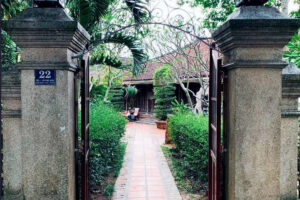 Dong Hoa Hiep ancient village is in Cai Be Commune, Dong Thap province, along the lower Mekong River.
Dong Hoa Hiep ancient village has a total of 7 hamlets, with nearly 4,000 households living mainly from fruit gardens of all kinds: Hoa Loc mango, orange, green-skinned grapefruit, longan, Vinh Kim star apple… and traditional crafts such as rice paper making, milk puff rolling, and green rice cake…
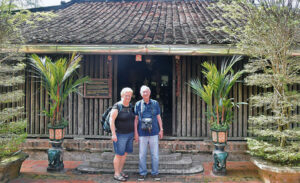 These ancient houses are mostly located along rivers, canals, and streams. In front of the house, there is usually an open, spacious area with a low fence and ornamental flowers. Around and behind the house, the area is gently surrounded by fruit gardens, small ditches for watering in the dry season, and drainage ditches in the rainy, flood season.
Currently, Dong Hoa Hiep ancient village has 7 ancient houses built between 150 and 220 years ago and 29 houses built between 80 and 100 years ago. Recognizing its rich cultural and architectural heritage, the Dong Hoa Hiep ancient village was designated a National Monument by the Ministry of Culture, Sports and Tourism in 2017.
Nature, wildlife conservation areas
Tram Chim National Park
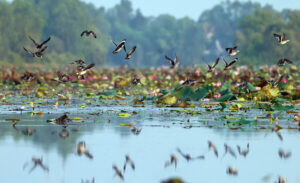 With a natural area of more than 7,000 hectares, this area is home to rich, diverse flora and fauna and is considered a “miniature Plain of Reeds” because it fully encompasses the wetland ecosystem.
As for flora, more than 130 species are found here. Some of the prominent species are lotus, water lily, Oryza rufipogon, Panicum repens, etc. At the same time, this place is home to over 100 species of vertebrates, 40 species of fish, and 147 species of waterbirds.
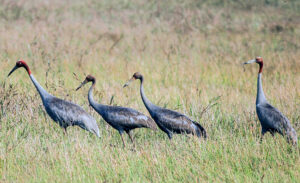
There are 13 rare bird species in the world, such as the white-winged duck, grey-headed lapwing, pelicans, and lesser adjutant. Especially, the red-headed crane and the crested crane are listed in the World Red Book as in need of protection.
Every year, from December to the end of April, when you come to Tram Chim National Park, you will be amazed by many flocks of cranes flying in the sky in the early morning or late afternoon, birds’ nests hovering on cajuput branches, and so on. And the best way to explore nature and learn about residents’ customs and habits is to travel by motorized boat through a network of canals.
Location: Tram Chim commune.
Dong Tam snake farm
The Dong Tam snake farm is the center for breeding snakes producing venom for local and export. The snake farm is also known as one of the largest snake conservation areas in southern Vietnam.
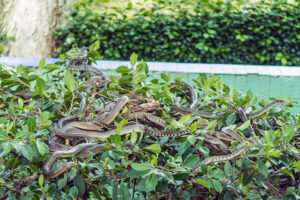 The farm has an area of up to 30 hectares, which includes many services, such as eco-tourism, snake reservation, snake museum, traditional house, restaurant, and herbal garden…Here, visitors can observe the lives of more than 40 species of snakes and other animals, as well as specimens, including more than 200 king cobras.
When visiting Dong Tam Snake Farm, tourists can learn about the biological characteristics, habits, and habitats of many reptile species through a system of enclosures designed to replicate natural conditions. In addition, the museum here displays many specimens of wild animals, helping visitors gain a better understanding of the diverse ecosystem of the Mekong Delta.
Address: Kim Son Commune.
Specialties of Dong Thap
Dong Thap is famous not only for its attractive tourist destinations but also for its delicious Mekong Delta dishes.
My Tho clear rice noodle soup
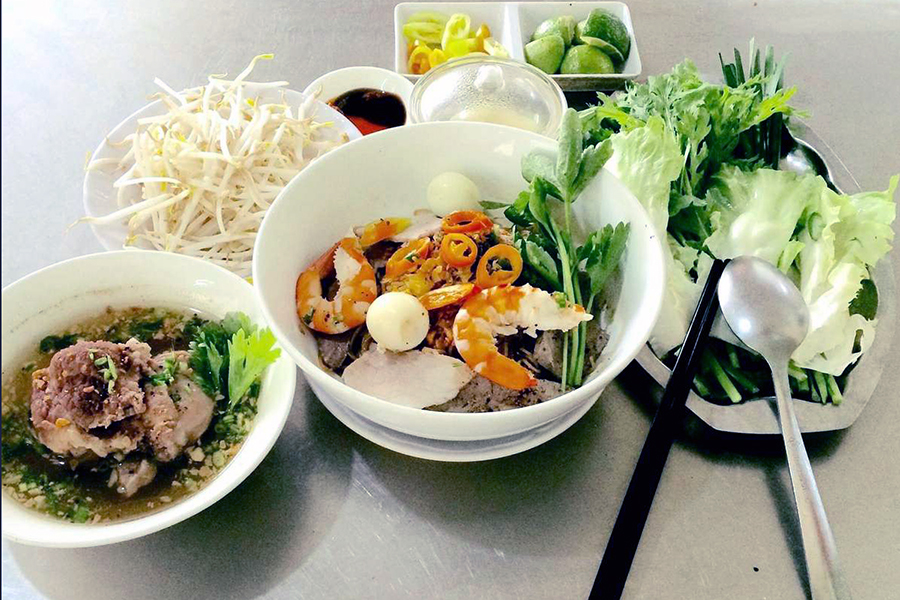
My Tho clear rice noodle soup (hu tieu My Tho) is a mix of broth, tender rice noodles, toppings, fresh vegetables, and herbs… The food is usually topped with seasoned ground pork, the small intestine of the pig, toasted ground dried shrimp, pork liver, coriander, green onion, and char siu pork… depending on visitors’ preferences.
Bloating fern-shaped cakes
Bloating fern-shaped cakes (banh beo) in Hang Bong market: this food comprises three different parts: the plain cake made from rice flour, the filling made from mung bean, shrimp, deep-fried onion, pork skin, and the sauce made from fish sauce, garlic, sugar, and chili pepper.
Grilled snakehead
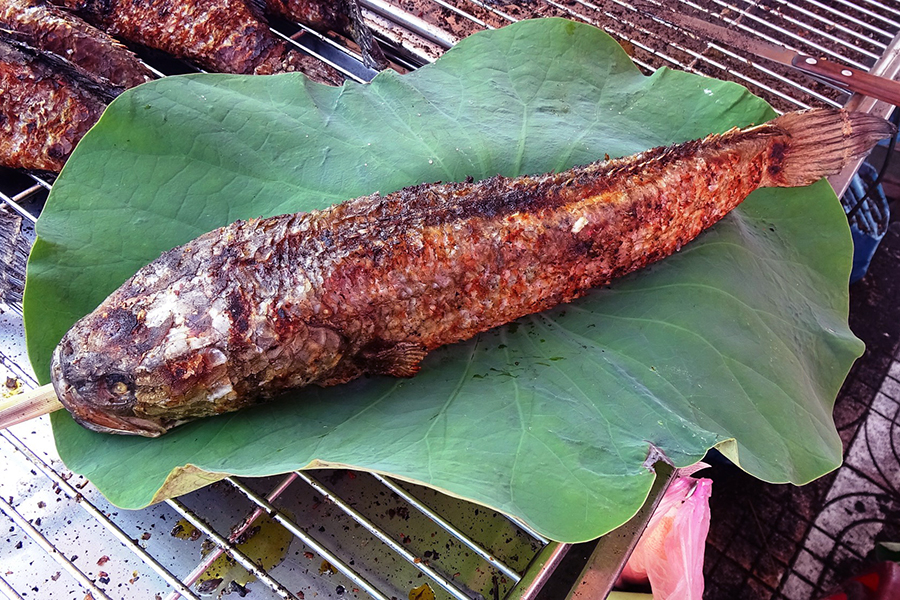
Grilled snakehead: the main ingredient in “cá lóc nướng trui” is a wild, large, fresh snakehead. The snakehead will be grilled on rice straws, then served with raw vegetables and tamarind sauce, sweet and sour…
Tan Phong rice snail
The rice snail is a hot-boiled snail usually used with a mix of chili-lime fish sauce and ginger. There are other ways to process these snails, such as steamed snails with coconut water, fried snails with garlic and chili, and rice snails rolled with rice paper. Every dish is delicious and full of flavors.
Dishes from lotus
And for many years, Dong Thap has compiled a list of 200 lotus dishes to promote to tourists. Therefore, it would be a mistake not to try this frugal yet delicious dish. Popular dishes include lotus seed rice, lotus root salad, lotus stewed chicken, lotus root stewed soup, lotus seed stewed soup, lotus root sour soup, lotus root salad, lotus leaf tea… etc, and many lotus sweet soups.
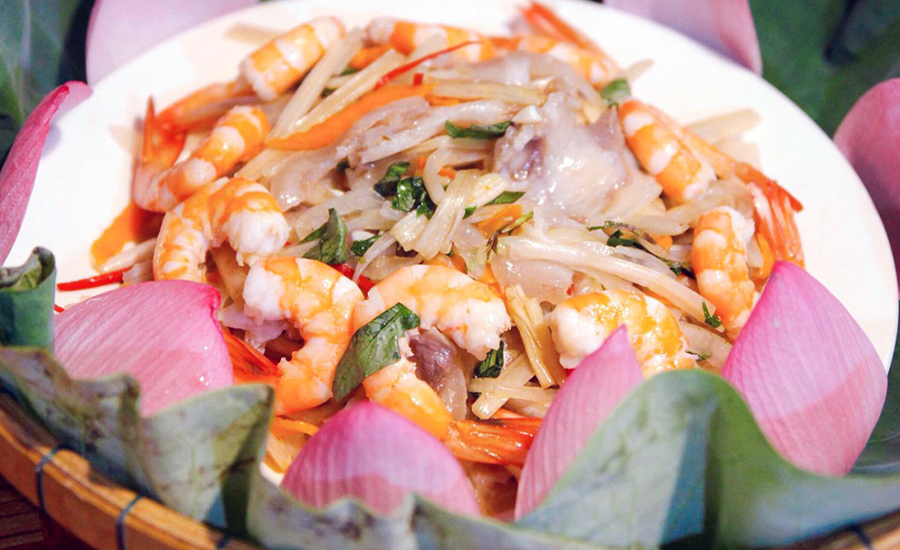
And here are some addresses: Dam Sen ecological cuisine area, Song Sinh restaurant, Co Ba restaurant, Dai Nam restaurant, Sen Le Bo Community Ecotourism Area… where there is a food court with many lotus dishes, prepared by the locals in a popular style, helping you get a full experience during your trip to explore Dong Thap.
Source: collected by An
Follow us for the best deals on Vietnam package tours and visa services!
Comment (0)