
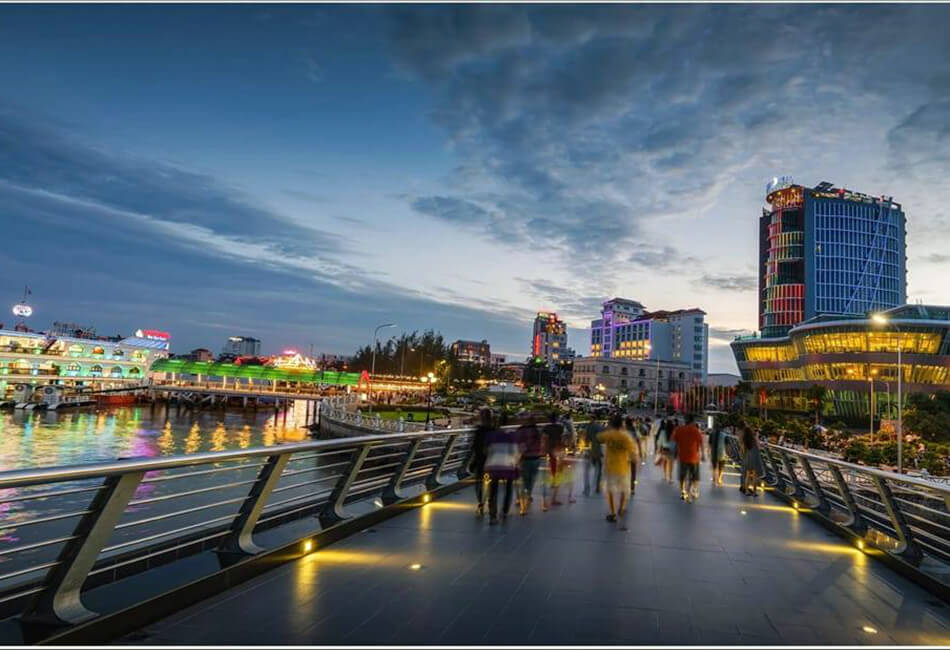
Can Tho (Vietnamese: Cần Thơ) is an administrative unit after the merger of Soc Trang province, Hau Giang province, and Can Tho City, with a natural area of more than 6,360 km². The Mekong Delta is famous for its gentle rivers and water beauty, lush green orchards, and the cheerful and hospitable temperament of local citizens, which have captivated tourists. Can Tho tourist itinerary explores the land known as “the capital of the West,” with a cool, fresh climate, bold South landscapes, immense fields, tangled canals, ancient houses, and many rustic delicacies found only in the South West.
Vietdreamtravel would like to share some travel experiences and useful information selected over the years to help you have a meaningful trip to this city.
Overview of Can Tho City
Can Tho is one of six centrally-governed cities in Vietnam. This is the most bustling and developed city in the Mekong Delta. In addition to its geographical characteristics as an important traffic hub between provinces in the region, Can Tho is also known as a river city. The city has a dense river system, large areas of fruit gardens and fields, and is famous for Ninh Kieu Wharf and Cai Rang Floating Market, a typical cultural activity of the South.
After merging with Soc Trang and Hau Giang in 2025, provinces with diverse ethnic groups, creating a multicultural environment, Can Tho has become an ideal destination waiting for you to explore.
When is the best time to explore Can Tho?
Can Tho has a tropical climate with warm, sunny weather year-round. The weather is pleasant, less stormy, and hot and humid year-round, with no wintertime. The annual average temperature is about 28ºC, so when traveling to this city, you should bring sunscreen, sunglasses, a hat, sun cream, and insect repellent.
Also, like other areas, Can Tho has 2 seasons: rainy season and dry season. The dry season is from December to April next year. The rainy season lasts from May to November; you should bring an umbrella or a raincoat. Each season has its own interesting things, such as the following:
Fruit season: Can Tho has fertile alluvial soil, so fruit trees grow year-round. But the months of June, July, and August are the times with the ripest fruits. So if you are a fan of fruit, you should go in the summer.
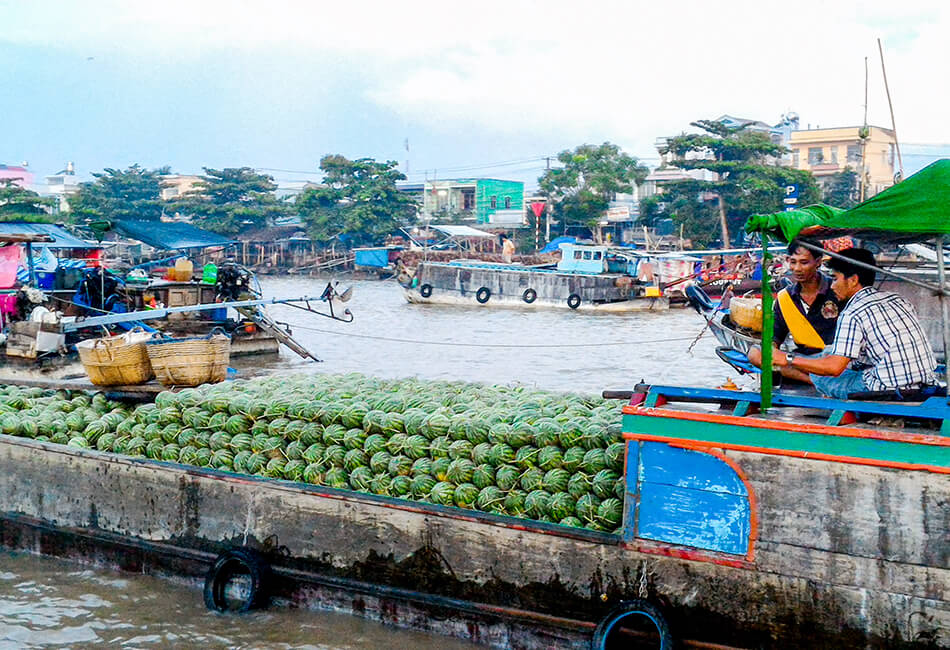
Floating water season: From September to November, you will see the field flooded. It’s also a good chance to take a boat to explore the fields, sail along a floating market, or explore countless creeks in the province.
Blooming season: From December to January, February in the solar calendar is near the Tết holiday. Come to Can Tho on this occasion to immerse yourself in the colorful flowers, specialties, and cultural activities.
How to get here?
From the capital Hanoi and Da Nang, you can buy air tickets from Vietnam Airlines, Bamboo Airways, and Vietjet Air… Round-trip tickets cost about 2,000,000 to 2,500,000 VND.
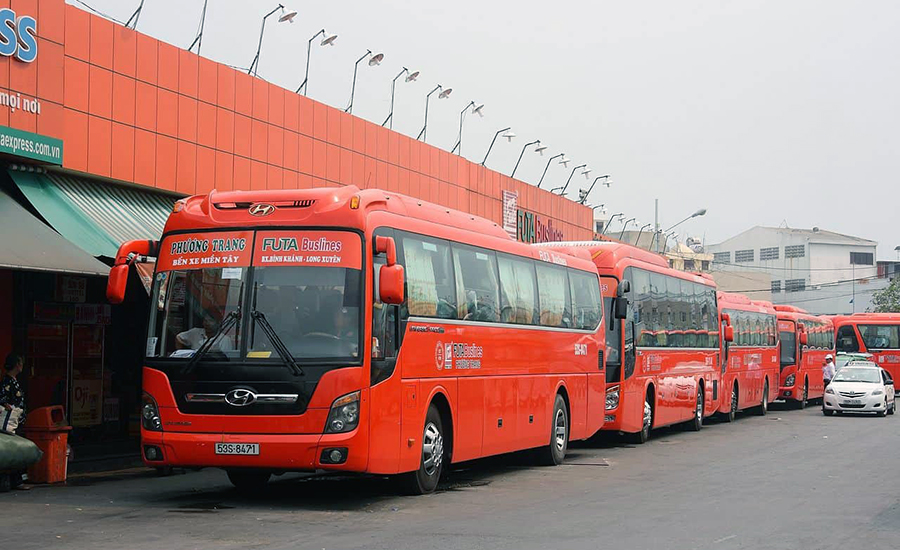
From Ho Chi Minh City, visitors can travel by motorbike or private car to Can Tho by following National Highway 1A. The distance is about 170 km, and it takes 3 to 4 hours to reach the city center. If you take a bus, you can buy tickets at the Mien Tay (Western) bus station. The bus fare from Ho Chi Minh City to Can Tho is about 130,000-250,000 VND per ticket.
Accommodations in Can Tho
Visitors can choose to stay at a homestay in the city center or a riverside resort depending on their budget. Some high-end accommodations are Azerai Can Tho Resort and Victoria Can Tho Resort, with prices ranging from about 1,200,000 to 5,000,000 VND per night.
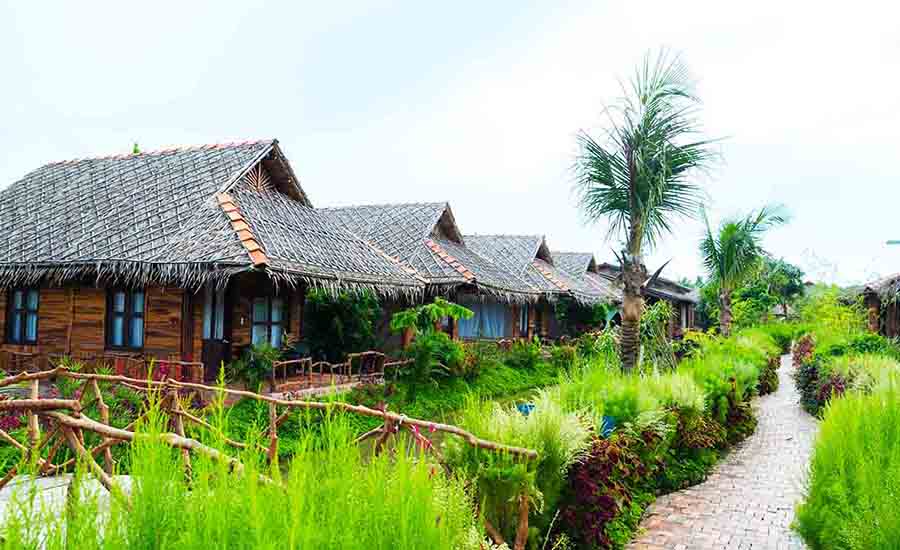
Can Tho is not well developed for homestays; you can rent a hotel near Ninh Kieu Wharf for convenient travel. The average room rate is 300,000 VND per night.
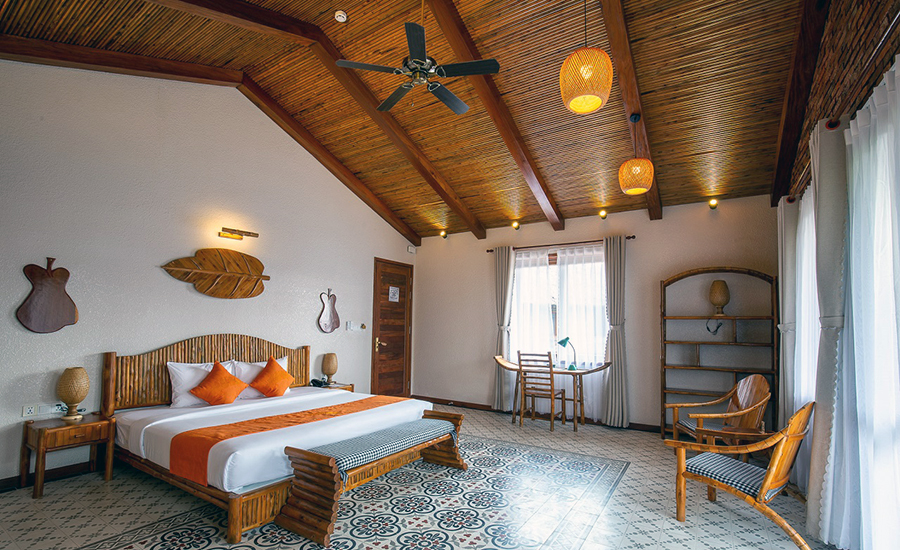
If you choose to stay in Soc Trang or Hau Giang, there are many 2-3 star hotels with prices ranging from 300,000 VND to 700,000 VND per night… Tourist attractions are not too far from the center, so visitors can stay in city hotels, visit sightseeing places during the day, and return to stay overnight.
Tourist attractions in Can Tho
Can Tho tourist destinations are famous for their idyllic beauty; the friendliness and hospitality of the local people are closely tied to the river year-round. Below are famous tourist destinations that you must definitely visit when you come here.
Historical sites
Kham Lon Historical Site
Kham Lon historical site is located at No. 8, Ngo Gia Tu Street, Ninh Kieu Ward. Kham Lon was built by the French colonial authorities in the years 1878-1886 as a tool of colonial administration. During the anti-American period, Kham Lon continued to be 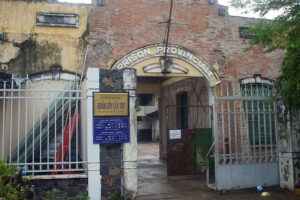 reinforced and expanded in space. With 21 large and small cells, divided into two rows of female prisoners and male prisoners, and cell columns, there are rooms used for solitary confinement of dangerous prisoners. On all four sides, there are walls about 3 to 5 meters high, with barbed wire on top. Observation towers on all four sides are built about 6 meters high, with a wide viewing range, so that soldiers can take turns guarding the prison rows.
At night, bright headlights make it easy to control prisoners. Besides some old buildings that still exist, this place also preserves a number of torture tools, artifacts made by prisoners, and some precious pictures and documents…
On June 28, 1996, the Ministry of Culture and Information signed Decision No. 1460/QD-VH classifying that prison area as a national historical-cultural relic.
Gian Gua
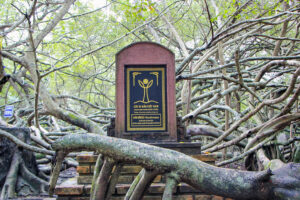
Gian Gua is a famous historical relic site in Can Tho associated with the country’s two resistance wars against the French and the Americans. With a large natural space, covered with bamboo trees, it forms a solid forest. When visiting this Can Tho tourist destination, visitors will experience historical landmarks and remaining war ruins that are still clearly visible in this relic area.
You will be overwhelmed by a solid primeval tree stand, with many trees and branches interwoven and tightly intertwined like a giant net, so sometimes you may not know which is the root and which is the branch.
There are branches that still bear traces of war with cuts and spots caused by bombs and bullets. However, with strong vitality, those branches still sprout, sprout, and spread their shade.
Location: Nhon Ai commune, Can Tho City.
Can Tho Museum
If you are a history and culture lover, you cannot miss Can Tho Museum on your trip. This is a unique destination to learn about the history and culture of this city, along with wonderful collections of art and antiques from hundreds of years ago.
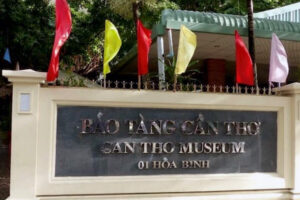 Can Tho Museum was built in 1976 and is located at No.1 Hoa Binh Revenue, Ninh Kieu Ward. The museum includes many galleries with collections on the history, culture, art, and antiques of Can Tho and the Mekong Delta.
The history gallery introduces the development and heritage of Can Tho city, from prehistoric times to the present day. Art galleries display works by Can Tho’s contemporary artists, including paintings and sculptures. The museum’s collections of antiques are also very diverse and rich, from household items, jewelry, and religious objects to ancient calligraphy, ancient books, and paper money and coins.
Not only does it have wonderful collections, but the Can Tho Museum is also beautifully designed, with common areas, green grounds, and lakes, providing a quiet and comfortable space for tourists. This is an interesting destination for those who love art and history, and a great place to learn about Vietnam and its people.
Soc Trang Khmer Museum
Soc Trang Khmer Museum, like many museums elsewhere, is a popular tourist destination here. The museum displays 730 valuable artifacts, including many donated by local people, reflecting the life and culture of the Khmer people over many generations. This 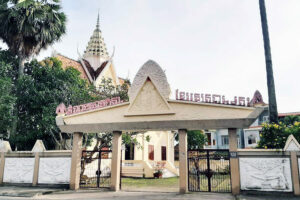 is a place specifically for tourists who want to learn about the beauty of culture, history, and patriotic traditions of fighting against foreign invaders of the Kinh, Khmer, and Chinese through the ages. In addition, the Museum is also a place to visit, learn, and study history for students inside and outside the province.
Upon entering the Museum gate, visitors can see artifacts and weapons of our people and soldiers from the war, such as V100 armored vehicles, M48 tanks, and 122 mm long-barreled guns.
The ground floor is designed to introduce: an overview of the old Soc Trang province (currently merged into Can Tho City); natural 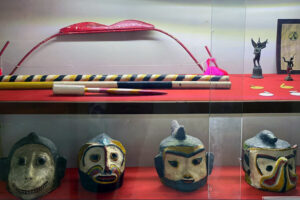 resources, history of land formation and ancient culture; peoples; population and lifestyle, including agricultural artifacts, means of transportation, and house architecture of 03 ethnic groups; daily life clothes from everyday to funerals and weddings; religious beliefs. Floor 01 is designed to introduce: the history of the fight against French colonialism and American imperialism across periods; the formation and leadership of the Soc Trang Party Committee in the resistance; and the period of innovation towards industrialization and modernization.
In addition, inside the Museum, there are stage models of Ro Hash and Du Ke to attract visitors to learn about the theater art of the Southern Khmer people. The image of the miniature Ngo boat also sparks greater curiosity among tourists about the Ooc om Boc Festival and the Ngo Boat Race, held annually in Can Tho. There are quite a few new artifacts from the collection on display at the Museum, which are highly appreciated by many visitors.
Address: 53 Ton Duc Thang, Soc Trang Ward.
Long My historical site
Long My is a former district in old Hau Giang province (currently part of Can Tho City). It’s about 60km southwest of Can Tho City center. Two hundred years ago, it was forested land; in 1920, it was reclaimed and developed into a well-off rural area.
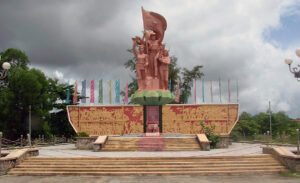 During the two resistance wars in Vietnam, Long My was a revolutionary base of Hau Giang and the western part of South Vietnam. Many fierce battles took place there.
Long My historical site has a complex where visitors can learn about the glorious history of the two resistance wars. There are also facilities for entertainment and recreation.
In Long My, one should not forget to drop in at the stork sanctuary in Xa Phien. Established in 1986, the sanctuary now boasts tens of thousands of storks and 30 typical bird species in South Vietnam. Tourists have the opportunity to enjoy the sanctuary’s fruits and listen to the chirping of birds amid the beautiful landscape and natural surroundings.
Temples & pagodas
Ong Temple
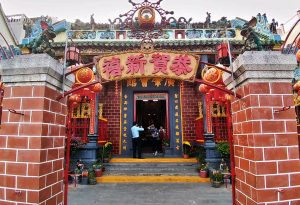 Ong Temple is one of the ancient pagodas in Can Tho, with its delicate architecture and unique patterns that reflect Chinese culture. The temple also plays an important role in the spiritual lives of the Hoa community (Chinese people living in Vietnam) in the Southwest region. During the war, the Ong Temple served as a base for revolutionary forces fighting against American troops and their allies, contributing to the country’s unification.
The temple is also a place where the cultural and religious activities of the Hoa people living in Can Tho are held. The beauty of the temple endures and was designated a National Heritage Site in 1993.
Address: 32 Hai Ba Trung Street, Ninh Kieu Ward.
La Han Pagoda
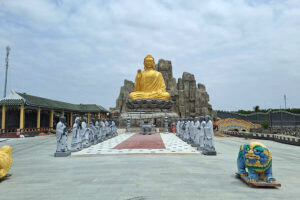
La Han Pagoda is a beautiful sightseeing destination that tourists should not miss when explore Can Tho. This Chinese pagoda has an ancient and majestic beauty, like a massive castle in the Mekong Delta, where indigenous people often come to make pilgrimages and pray for peace, luck, and fortune. Not only that, but La Han Pagoda also has a particularly distinctive feature in the design of its walls.
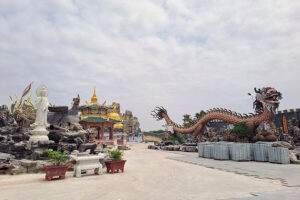 Most of the walls surrounding the pagoda are not made of wood or concrete but of stone, creating an impression of solidity and grandeur. In recent years, La Han Pagoda has become increasingly famous, attracting many young tourists from near and far to visit and take photos because of its impressive scenery.
The pagoda is located at 131 Dien Bien Phu Street, Soc Trang Ward. This is one of the pagodas in Soc Trang that possesses a uniquely distinctive architecture, with spacious grounds and green grounds, very suitable for people to visit and make pilgrimages on full moon occasions and major holidays.
Kh’Leang Pagoda
Kh’Leang Pagoda is one of the ancient Khmer pagodas in the Mekong Delta region with a history of nearly 500 years. Kh’Leang Pagoda bears the mark of highly sophisticated Khmer architecture, yet still blends Vietnamese and Chinese styles in its decoration.
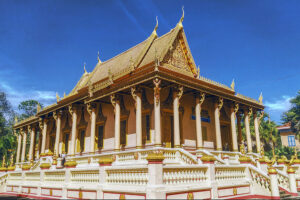 Kh’Leang Pagoda is located on Ton Duc Thang Street, Soc Trang Ward, on a large campus, shaded by ancient trees, most of which are palm trees, a tree species associated with the life and culture of the Khmer ethnic people. Here, visitors can enjoy fresh air, learn about ancient Khmer documents and legends about the origin of Soc Trang, and admire the pagoda’s unique architecture.
The name of Kh’Leang Pagoda is associated with the legend of the place Soc Trang. According to the bibliographies, the pagoda was built in 1533; at first, it was a thatched pagoda, but after many restorations, it was 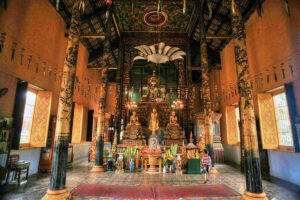 rebuilt in brick and tile. The current pagoda architecture, including the main hall and Sala, was built in 1918.
Khleang Pagoda’s architectural complex is arranged harmoniously on high ground. Another unique point is that most of these works at Kh’leang Pagoda are built in the traditional stilt-house style of the ancient Khmer people of the South. Each work was sculpted and carved with intricate patterns and motifs that reflect ancient Khmer architecture, creating a unique look that draws many visitors to come and admire.
With symmetrical, harmonious architectural lines and unique, diverse works of art, the main hall of Kh’Leang Pagoda is truly a work of special artistic value. In 1990, the Ministry of Culture, Sports and Tourism designated it a national historical and cultural relic, classified as an architectural and artistic relic. This is an interesting tourist destination you should not miss when visiting Soc Trang.
Bat Pagoda
Bat Pagoda is located on Van Ngoc Chinh Street in Phu Loi Ward. The pagoda features typical Khmer architectural motifs, with many small towers on its roof, and the gable end is carved with a delicately winding Naga snake. The entire roof of the pagoda is a 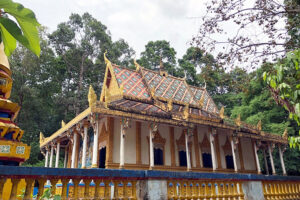 great architectural work expressing the concepts and philosophy of the Buddha and the Khmer people’s Heaven.
At Bat Pagoda, there are also scriptures inscribed on palm tree leaves, artifacts, history books, etc., which are extremely rare and have unique cultural values of the people of the Southwest that need to be preserved. The most interesting thing for visitors when coming to the pagoda is to admire the sight of thousands of bats hanging like fruits on branches and leaves. At peak times, the pagoda attracts more than a thousand bats.
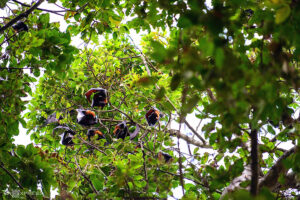
The bats at the pagoda are mainly large flying foxes, weighing 1-1.5 kg and with a wingspan of up to 1.5 m. They are fruit bats and live in lush fruit gardens, but they never eat fruit in pagoda, but often fly far away to find food.
Therefore, when dusk falls, the scene at the pagoda is strangely bustling, with the noisy sound of bats flapping their wings, calling to search for food at night.
Bat Pagoda is the first pagoda to be ranked as a National Monument and Scenic Landscape in Soc Trang. This is both a center for educational activities and for organizing traditional religious festivals.
Chen Kieu Pagoda
Located in the Southern Khmer pagoda system in old Soc Trang, Chen Kieu Pagoda, also known as Sa Lon Pagoda, is one of the pagodas with a “unique” architectural style that leaves a deep impression on visitors. The outstanding feature of this pagoda is the 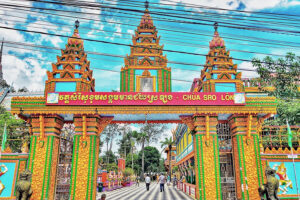 walls. It is not evenly cemented, tiled, or painted like other pagodas, but is covered with pieces of cups, plates, and ceramics that look unique yet extremely beautiful and aesthetically pleasing.
In 1815, Chen Kieu Pagoda began to be built from materials such as leaves, wood, and soil, like many other Khmer pagodas. During the war, under the devastation of bombs and bullets, the main hall of the pagoda was seriously damaged. In 1969, the pagoda was rebuilt in accordance with contemporary architectural principles, including a main hall, a sala (a type of meeting room), a stupa, and a place for prayer books.
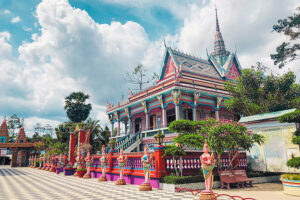
During construction, due to a lack of materials, the monks came up with the idea of having the villagers donate cups and plates to cover the wall. This idea not only saves construction costs but also creates impressive decorative motifs. Since then, the pagoda has also been known by the people with its second name: “Chen Kieu Pagoda”. Khmer artisans cleverly used these cups and plates to decorate the walls and towers, creating a harmonious and impressive architectural work.
For tourists who love to explore or check in with ancient architectural works, this is an ideal place. Every corner of the pagoda can serve as an artistic backdrop for thousands of likes, guaranteed to surprise many people when posted.
Chen Kieu Pagoda is located on Highway 1, My Xuyen Ward.
Som Rong Pagoda
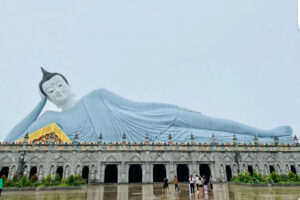
Botum Vong Sa Som Rong Pagoda, also known to locals as Som Rong Pagoda, is located at 367 Ton Duc Thang, Soc Trang Ward. The pagoda is decorated in Khmer style combined with modern architecture to create a highlight for the pagoda. Against the clear blue sky, the temple, with its yellow tones, looks majestic and splendid.
The pagoda grounds are divided into many different areas, the most prominent being the main tower. Wat Pătum Wongsa Som Rong Pagoda becomes more poetic in the late afternoon. By coming here at this time, visitors not only worship at the temple and pray for peace but can also take impressive, unique photos.
Bon Mat Pagoda
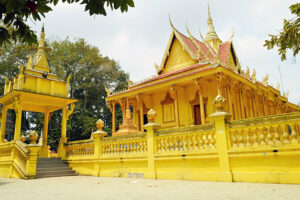
Built nearly 500 years ago, Bon Mat (Four-faced) Pagoda, also known as Buôl Pres Phek Pagoda, is a typical aesthetic architectural work of the Khmer people in the South, a cultural and historical heritage. The pagoda covers an area of 6.5 hectares, located in Phuoc Thuan hamlet, Thuan Hoa Commune.
When mentioning the pagoda, people often talk about the legend of a Buddha statue with four faces facing four directions; each direction has 5 Buddhas found by the Khmer people during the process of reclaiming wasteland. This was a good omen, so people built the pagoda and brought the Buddha statue to worship in 1537.
Binh Thuy Temple
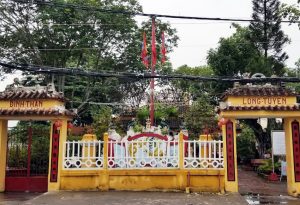
Among all the remaining ancient temples in the southwestern region, it can be said that Binh Thuy temple in Can Tho is the most majestic and beautiful superstructure. The temple is located at 46/11A Le Hong Phong, Binh Thuy Ward. Binh Thuy Temple, also known as Long Tuyen Ancient Temple, is a place of worship for Thanh Hoang, a deity enshrined in the village.
This is a very unique project, signifying the strong vitality of the village community in the South from the reclamation period, the spirit of respect, ancestor worship, and people with meritorious services to the country … It also shows the skillful hands of local people. Every year, the local people organize the festivities from April 12 to April 14, and on December 14th and 15th. The festival has a lively and joyful atmosphere with folk games such as duck-dropping, tug-of-war, singing, racing boats, and cooking local foods …
Truc Lam Phuong Nam Monastery
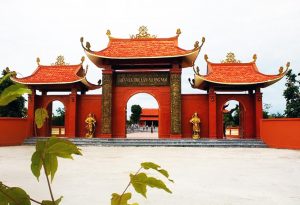
Truc Lam Phuong Nam Monastery is located in My Nhon Hamlet, An Binh Ward. It is a unique artwork built in the style of Ly – Tran dynasty and is a famous spiritual tourist destination. The monastery followed the Truc Lam Yen Tu sect of Emperor Tran Nhan Tong, who led the Vietnamese against the Mongol invasions. When the country was at peace again, the emperor ceded the throne to his son and went to Yen Tu mountain to practice on his own. He founded the Truc Lam Yen Tu sect, showing influence from Confucian and Taoist philosophy
The peaceful and serene beauty of Truc Lam Phuong Nam Monastery attracts numerous followers and visitors. After admiring the monastery, you can combine visiting the nearby Phong Dien orchards, which are only about 1km away.
Phat Hoc Pagoda
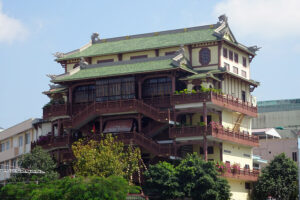
As a place with many spiritual sites and many beautiful ancient pagodas and temples, when coming to explore Can Tho, do not forget to visit Phat Hoc Pagoda – a familiar place for Buddhist followers and a spiritual tourist destination that attracts many tourists.
It is a famous place located in the center of Can Tho City, where traffic is heavy, but the pagoda’s interior still retains its purity and majesty. The pagoda has a long history, was built in 1951, has a relatively simple architecture, and was previously the headquarters of the Nam Viet Buddhist Association of Can Tho province. The pagoda has a spiritual and pure beauty. Outstanding with 5 floors of authority, worshiping 3 famous Buddhas: Amitabha Buddha, Shakyamuni Buddha, and Medicine Buddha.
Address: No. 11 Hoa Binh Avenue, Ninh Kieu Ward.
Pothi Somron Pagoda
Another Can Tho tourist destination with spiritual features not to be missed when exploring the city is Pothi Somron Pagoda. The space and architecture here will definitely be an ideal place for Buddhists and those who love Buddhism.
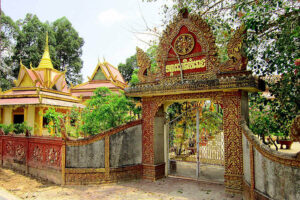 This pagoda has ancient Khmer architecture, has existed for 3 centuries, and was built in 1735 on a land area of 8,600 square meters. Its space has a quiet, contemplative atmosphere. Ancient architecture, an airy campus, and many old trees. The beauty of Pothisomron pagoda is further enhanced by a large perennial sala tree, said to have been brought back from India and planted in a corner of the yard in 1969, which always blooms with elegant, fragrant flowers.
Inside the pagoda, visitors will admire many antiques. These are wooden swallow wings made in 1856, carved with images simulating stories about Shakyamuni Buddha; more than 100 sets of Satra sutras (leaf books); and 17 wooden statues nearly 200 years old.
Address: 1144 QL91, O Mon Ward.
Munir Ansay Pagoda
If you love Khmer architecture, you cannot miss the renowned Munir Ansay Pagoda when visiting Can Tho. This is not only a beautiful spiritual address but also helps visitors understand the culture and customs of the Khmer people.
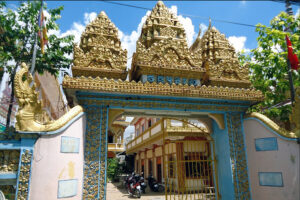 It is a Khmer pagoda, built in the distinctive Angkor architectural style. From the main gate to the inner campus, everything is intricately carved, imbued with cultural features. The pagoda is divided into many areas: main hall, monks’ row, kitchen, hall, ash tower, relic tower, main gate area…Not only does it stand out with its unique design style, but the pagoda is also a pioneer in preserving the traditional identity of the Khmer people.
Every year, at Munir Ansay Pagoda, major holidays are held such as Cholchonam Thomay – New Year (March 13, 14, 15 of the lunar calendar), Ok-om-Book – moon worship ceremony (October of the lunar calendar) , Donta – Ancestor worship ceremony (8th lunar month), Khmer people’s Clothing Offering Ceremony… The ceremony is held joyfully and solemnly, with many local folk games, enriching the cultural life spirit of the Khmer people in particular and the people of Can Tho city in general.
Address: No. 36 Hoa Binh Avenue, Ninh Kieu Ward.
Architectural buildings
Ninh Kieu Wharf and Pedestrian Bridge
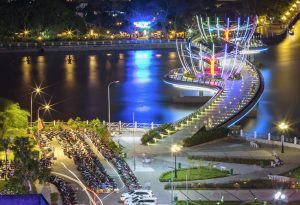
Referring to the famous tourist destinations in Can Tho, it is impossible not to mention Ninh Kieu Wharf. Located in the heart of the city, the poetic Ninh Kieu Wharf and the charming river are considered symbols of the province and are a typical destination for tourists visiting this city. In particular, this place has the first tourist pedestrian bridge in the Mekong Delta, connecting Ninh Kieu Wharf and Cai Khe islet.
The pedestrian bridge is illuminated by colorful lights. Here, visitors can enjoy the cool breeze from the Hau River and admire the shimmering landscape of Can Tho city at night.
Binh Thuy Ancient House
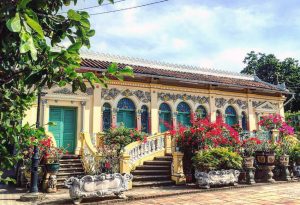
The Binh Thuy ancient house is one of the most beautiful old houses in Can Tho, over 100 years old. Located at No. 144 Bui Huu Nghia, Binh Thuy Ward, the house has become an attractive destination for its harmonious architecture. The living room is decorated in European style, but one of the most important places – a worshipping area decorated in the traditional style of the locals in the Mekong Delta. In addition, the house has also preserved many valuable antiques for centuries.
With its unique ancient beauty, the communal house of Binh Thuy has become a famous filming location for many Vietnamese films, and one you may know is L’Amant (The Lover), directed by director Jean Jacques Annaud.
Local Markets
Can Tho Market
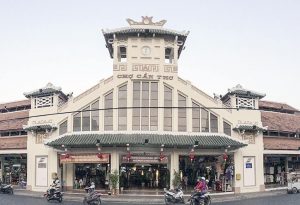
The Can Tho Market was built in 1915 at the same time as Ben Thanh Market and Binh Tay Market in Saigon. This is one of the major markets in the western region of South Vietnam. The market is located on a rectangular campus with a total area of 1,723 m², with curved ceilings and roof tiles in the yin-yang style. In addition to sightseeing, shopping, and admiring the architecture, what excites many people about coming here is discovering the delicious culinary delights of Europe and Asia, especially at night. In 2009, Can Tho began implementing a project to build a walking street, food court, night market, and souvenir sales area at Ninh Kieu Wharf and Hang Duong Market. This area operates from about 18:00 p.m the previous day until 4:00 a.m the next day, to create the best conditions for people to shop, visit or have fun.
Thanks to that, we can also walk around the market and enjoy delicious dishes and drinks in the cool breeze blowing from the Hau River.
Location: Hai Ba Trung Street, Ninh Kieu Ward.
Cai Rang Floating Market
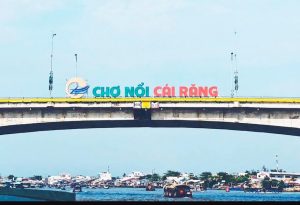 Cai Rang Floating Market is one of the three largest floating markets in the Mekong Delta region. The simple beauty, everyday life, and village activities have created a unique image of this area.
Activities in the floating market start quite early, from around 4 or 5 am, many boats come to the market for trading, so this is the ideal time for you to visit. In the market, each boat will sell a different item, from fresh, delicious fruits to household appliances for daily use. The boat owners will hang the items they sell on a pole so buyers can easily spot them from afar. This form of “selling goods” is a unique trade culture found only in floating markets – a way of advertising products that is not noisy or hasty, but that brings interesting things to tourists as well as customers.
Ninh Kieu night market
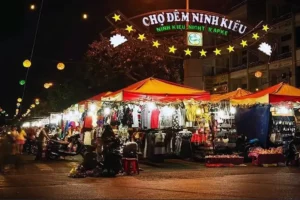
If you are planning to visit Can Tho city during your trip, you definitely cannot miss Ninh Kieu Night Market – one of the most interesting and vibrant destinations of this city.
Ninh Kieu Night Market is open after 17:00 p.m. This is home to many small traders and street vendors who sell food, clothing, accessories, household appliances, handicrafts, and other products at reasonable prices. At Ninh Kieu Night Market, you can enjoy Can Tho specialties such as pancake, noodles, bread, grilled spring rolls, and other street foods.
In addition, the Ninh Kieu night market is a great place to experience Can Tho’s local culture, with many activities featuring amateur music and folk games. You can also find unique art products of local people at stalls at the night market. With a joyful, vibrant atmosphere, this will be a great place to experience the city’s typical culture and cuisine. We encourage you to visit Ninh Kieu night market during your trip and enjoy wonderful experiences here.
Location: Phan Chu Trinh, Ninh Kieu Ward.
Nga Nam Floating Market
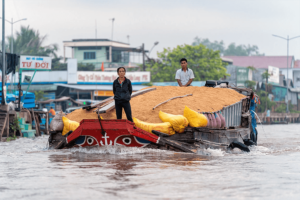
Nga Nam floating market in Nga Nam town, about 60 km from Soc Trang Ward, is a place that attracts tourists to visit and experience Western river life.
The name Nga Nam appeared when the French dug the canal around the Phung Hiep route. This canal and Xang canal cross Xeo Chinh canal to form five river branches flowing to 5 intersections: Ca Mau, Vinh Quoi, Long My, Thanh Tri, Phung Hiep.
Nga Nam floating market usually opens quite early and lasts until 8 o’clock, after which it gradually dissipates. The busiest time is usually from 5 a.m. to 6 a.m., with hundreds of boats gathering and making a bustling noise across the river wharf. This is the most ideal time to experience the floating market.
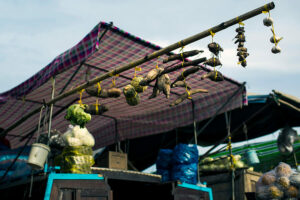
The goods at Nga Nam floating market are very rich and diverse, from famous, delicious rice from large rice granaries in the area to garden vegetables and fruits; from agricultural products and seafood to daily living and household items. To help transmit information easily between sellers and buyers, the pole tree (cây bẹo) is an effective means of advertising in the floating market. This tool is usually made from old bamboo, bent straight, about 4-5 m long, with sharp corners for easy insertion, and is used with pliers when parked. The top is perforated to allow a rope to be skewered through to hang goods. Buyers just need to stand from afar, look at the pole trees, and find the type of goods they want to buy.
Currently, due to the increasingly improved road transportation system, some traders have switched to onshore market groups. However, the floating market still operates bustlingly, retaining the Mekong’s typical soul, a tourist destination not to be missed in Soc Trang and Can Tho.
Garden and water world-discovering tourism
Fruit gardens in Phong Dien
Can Tho is known not only as one of the largest cities in the Mekong Delta but also as a famous garden tourism city, with many large and small fruit gardens that support ecotourism and supply fresh fruit to many markets. Phong Dien is about 15km from the center of Can Tho City, which is famous for lush fruit gardens, and intertwined canals create a fresh environment. During the fruit season, visitors will enjoy a variety of sweet fruits, garden spaces, and the daily life of the sincere Phong Dien people. Below is a list of the most famous orchards in Phong Dien Commune, Can Tho, for you to explore.
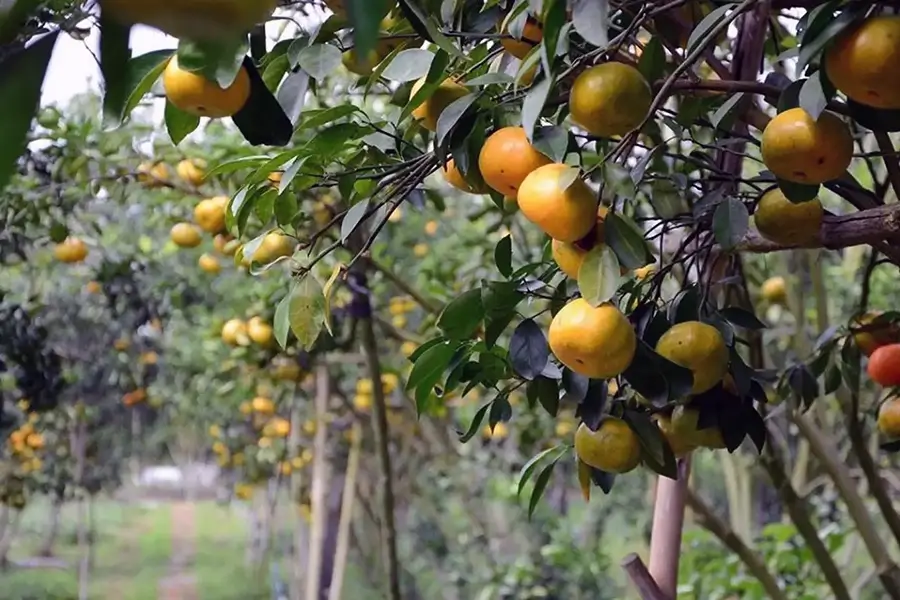
- My Khanh Fruit Garden at 335 Lo Vong Cung, An Binh Ward.
- Chin Hong Fruit Garden is located at 398/31 My Nhon Hamlet, An Binh Ward.
- Rach Ke Fruit Garden: located at 396A My Nhon, An Binh Ward.
- Giao Duong Fruit Garden: at My Khanh, An Binh Ward.
- Vam Xang Fruit Garden: at Lo Vong Cung, An Binh Ward.
Son Islet
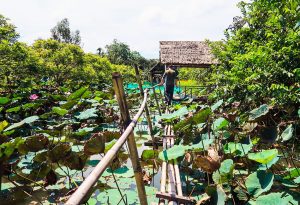 Son Islet is the ideal place for tourists to find peace, away from the noisy and bustling city, and find the most comfortable feeling in the countryside. This is a small floating land on the Hau River with an area of about 70 hectares, located in Bui Huu Nghia ward, Binh Thuy Ward, nearly 1km from the mainland and about 6km from Ninh Kieu wharf.
Traveling to Son Islet, visitors can only ride bicycles, walk on small village roads, or paddle among the immense fruit trees. The people’s way of life has a bold southwestern style, a unique feature for Son Islet that attracts and holds tourists.
Tan Loc Islet
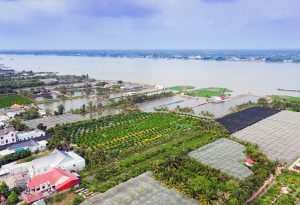 This islet is located in Tan Loc ward, Thot Not Ward, more than 40km from the center of Can Tho city, and is about 15 minutes by ferry. This place not only attracts tourists with its charming scenery and fruit orchards but also impresses with the ancient houses and cultural symbols of the southwestern land.
With the rustic beauty of a village, Tan Loc Islet is well-suited for developing ecotourism in various forms, such as excursions, fishing, sightseeing, enjoying specialties, and learning about the cultural features of the delta river region.
My Khanh tourist village
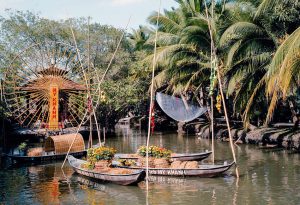
My Khanh tourist village is considered a miniature Mekong Delta – this is a famous ecotourism destination in Can Tho, with a green, comfortable space and many interesting activities for tourists to participate in. Located about 20km from the city center, My Khanh tourist area is a large ecological garden featuring distinctive architectural works, diverse entertainment activities, and unique experiences. Come here, enjoy all kinds of fruits in the garden and specialties, visit traditional craft villages, and listen to folk songs of the South.
At the same time, do not miss folk games such as tree climbing, sack jumping, pig racing, …very suitable for team-building and family trips.
Address: 335 Lo Vong Cung, An Binh Ward.
Bang Lang stork garden
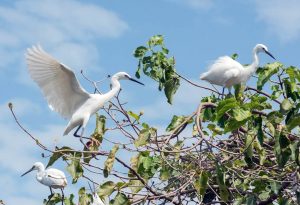
Located about 60km from Can Tho City, is Bang Lang stork garden. The entrance ticket for Vietnamese tourists is 10,000 VND / per person; for foreign visitors, it is 20,000 VND / person. There are many types of storks such as cattle egret, Chinese pond heron, Bubulcus ibis, striated heron, scarlet ibis …The stork garden is “busier” in each breeding season, from August (lunar month) until January (lunar month) next year. Only the Chinese pond heron species is from February to April (lunar calendar). You can climb up to the 8m-high observatory to enjoy the panoramic view of the stork garden.
Every day from 6 am to 7 am, thousands of storks fly out to search for food and return around 5 pm – 6 pm, creating a peaceful scene in the rural areas of the Mekong Delta River.
Tan Long stork garden
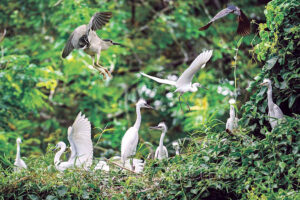
Tan Long stork garden is located in Tan Long Commune, about 60km from Soc Trang ward. This place is not simply a bird sanctuary but is also known as a stork conservation area, thanks to its highly favorable natural conditions for their growth and development.
Currently, in addition to individual storks, the stork garden also has several hundred individuals of the moldy heron; this is a large, rare bird species, weighing over 3 kg and with outstanding gray plumage.
When visitors come here, they will learn about storks and their very affectionate and faithful habits. They live in pairs, incubating eggs and raising young.
Traditional villages
“Hu tieu” (rice noodle)
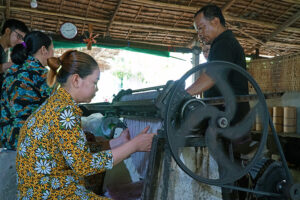
The traditional village is located in An Binh, Ninh Kieu Ward, near the Rau Ram bridge. Boats are the main means of transportation, often carrying rice to local businesses that make noodles and then bringing dry noodles to their customers. It’s also the best way for tourists to visit this area after exploring the Cai Rang floating market.
Setting foot into the traditional craft village of making rice noodle in the morning, tourists can witness the whole procedure of making fresh hu tieu, from mixing, coating, drying, cutting noodles, packing…all done by hand. Each workshop has its own technique for making the noodles stand out from the others.
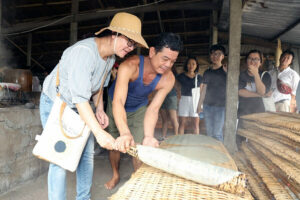
However, the most important step is sourcing high-quality raw materials, mainly from Sa Dec or Dong Nai. Then the rice will be soaked before being ground and mixed with other ingredients. The powder phase step is usually done the night before. The next day, it will be coated to become cakes. After that, the cakes need to be placed on bamboo frames to air-dry for a couple of hours before being cut into regular noodles. Visitors can join and participate in the coating and cutting stages. Of course, the final stage is still to pack and deliver to buyers.
Some outstanding noodle shops in Can Tho include:
- Mr. Sau Hoai – 476/14 kv7, Lo Vong Cung, Ninh Kieu Ward.
- Que Toi – No. 2 Lo Yen Ha, Cai Rang Ward.
- Chin Cua – 474c/14a, Area 7, Ninh Kieu Ward.
- …
Thuan Hung Rice Paper Village
Thuan Hung is a traditional craft village in Can Tho that has existed for more than 200 years, with 500 baking ovens burning day and night to produce quality products for the market.
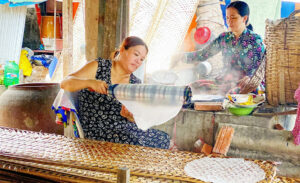 Thuan Hung rice paper making was formed in the mid-19th century and has been passed down through generations by local people. The largest number of rice paper makers are in Tan An and Tan Phu areas, including 68 households producing using traditional manual methods and 3 households investing in modern production machinery. Thanks to the people’s tireless efforts to preserve the “soul of the profession” over the years, the Thuan Hung rice paper-making village was included on the List of National Intangible Cultural Heritage by the Ministry of Culture, Sports and Tourism on March 6, 2023.
Visiting the traditional craft village, you will have the opportunity to observe the process of making rice paper with the secret passed down from your ancestors, experience participating in the cake-making activity under the guidance of the people, and especially choose delicious batches of cakes to bring home to enjoy as well as give as gifts to relatives after the Can Tho tour.
Location: Tan Phu, Thuan Hung Ward, Can Tho City.
Thoi Long weaving village
When mentioning traditional craft villages in Can Tho, many people often think of Thoi Long weaving village. In this craft village in Thoi Long village, every year from May to October of the lunar calendar, it is bustling because of the need to provide traps (tools 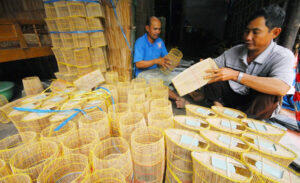 to catch fish, shrimp, prawns …) for people living in the Mekong Delta in time for the seafood fishing season (flood season).
In the beginning, people in the area made traps to catch fish and shrimp for family meals. Later, people from other regions came to place orders, and it gradually developed into a craft village specializing in the production of seafood fishing tools.
Visiting Thoi Long village, you can easily see families dividing up each stage. Depending on each stage, there will be a separate price for the product for the craftsman. The products from Thoi Long village are highly regarded for their quality. The craft village offers many types for customers to choose from, such as shrimp, fish, and eel traps.
Vung Thom Pia cake craft village
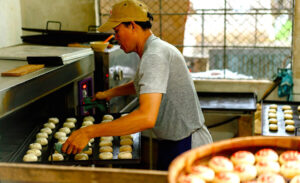 Pia cakes are said to have appeared in the 17th century, originating from the Han Chinese in China who migrated to the South. Pia cakes were originally eaten by the Han Chinese and were later adapted by the Vietnamese to suit their tastes.
Vung Thom is one of the most famous Pia cake-making villages in the old province of Soc Trang (now part of Can Tho City). Visitors to the village will have the opportunity to observe the process of making a complete cake, enjoy its delicious flavor, and choose quality products as gifts for others.
Vi Thuy water hyacinth weaving village
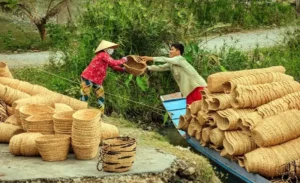 Vi Thuy weaving village is a place that produces handicrafts made from natural materials such as water hyacinth and coconut. The handicrafts are extremely diverse, including handbags, hats, mats, and carpets, often chosen by tourists as gifts for relatives after the trip.
Hiep Thanh boat and canoe building village: To meet the needs of river and stream travel for people in the West, more than 50 years ago the boat and canoe building village in Hiep Thanh was established and continues to produce quality products for the market to this day. Visiting the craft village, you will be able to observe firsthand the process of boat and canoe production; from wood selection to planing, carving, and finishing activities
What’s Can Tho specialities?
Can Tho is a place where the Kinh, Chinese, and Khmer ethnic groups have lived and interacted for many centuries, giving the city its unique culinary characteristics. Anyone who has traveled to Can Tho once will certainly not forget the aftertaste of these rustic but hard-to-find dishes. We would like to introduce visitors to delicious dishes and Can Tho specialties that you must try.
Bun nuoc leo (Noodle soups)
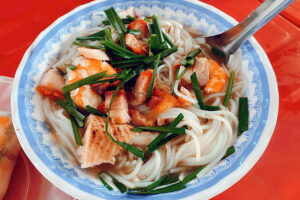 Noodle soup is a famous dish in Can Tho thanks to a combination of ingredients that gives it a flavor unlike any other region. People call the noodle soup a solidarity dish because it combines the quintessence of the Kinh, Khmer, and Chinese ethnic groups, with each ingredient reflecting the characteristics of the three ethnic groups.
In the bowl of noodle soup, people see the flavors of Khmer fish sauce (traditionally prahok), Chinese roasted pork and noodles, fish, and Kinh vegetables…. Each individual dish is a specialty, combined harmoniously and delicately by local people to create a truly unique noodle soup. Currently, in Soc Trang Ward, many roads and streets have many shops selling noodle soup. Some shops sell from morning until night to serve diners who want to enjoy this unique noodle dish. Not only that, but this noodle dish is also on restaurant menus for customers to choose from.
Cong cake
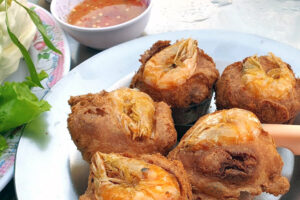
Soc Trang’s specialty dish scores points thanks to the combination of the rich taste of green beans, the sweetness of shrimp and meat, and the crispy crust.
Local people eat cong cake with lettuce and herbs, and sweet-and-sour fish sauce with pickles and cucumbers; many places also add a little vermicelli to fill their stomachs. The crispy golden cong cake is cut into many small pieces, rolled with vegetables, and dipped in a bowl of fish sauce with a little chili. When eating, you will feel the rich taste of green beans and taro, the aroma of shrimp and meat, and the crispy crust mixed with vegetables and dipping sauce. If you want to eat Cong cake properly, you must eat it at the market area in Dai Tam commune.
Pia cake
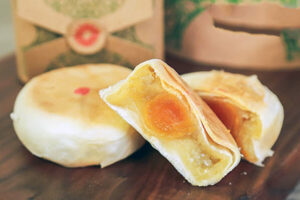
The cake has a characteristic durian smell; each thin layer of cake covers the sweet, flexible green bean filling. When you put a piece of pia cake in your mouth, you immediately feel the unique flavor of durian filling, the fatty taste of salted eggs combined with green beans, all blending together to slowly melt in your mouth. On the outside are thin layers of skin stacked on top of each other, which can be peeled off piece by piece, so it is also called a skin cake.
A delicious cake has a soft crust. With a round, flat, small shape wrapped in yellow and red, symbolizing luck, fullness, and prosperity, Pia cake is often chosen by visitors from far away at the end of their trip to explore Soc Trang and Can Tho as a gift. In addition to durian, the cake also comes in flavors such as taro and lotus seeds, with many different fillings.
Mi Sua (sua noodles)
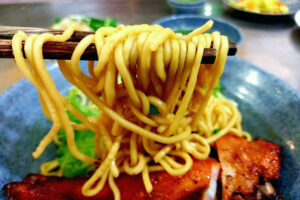
Sua noodles is a traditional dish of the Chinese community in old Soc Trang. It is made with soybeans as the main ingredient, so the noodles are golden in color and usually larger than other types of noodles. There are two types of noodles: salty and non-salty. Each type is processed into different dishes, such as salty noodles (best when stir-fried), and sweet noodles are used to make sweet soup. When eating fried-sua-noodles, you will feel the chewy, crunchy taste of the noodles mixed with the fatty, sweet taste of the meat.
A bowl of stir-fried noodles is often eaten with a bowl of broth to reduce boredom. The broth can be stewed with pork trotters, along with the aroma of coriander leaves, green onions, fried onions, and ground pepper, making the eater feel sweeter and more refreshed with each spoonful. Sua noodles are not salty; they are often cooked with boiled eggs and have a very sweet taste, and are used at parties and birthday celebrations. In this context, the red color of egg yolk is a wish for a luckier and more fulfilling life.
Sour soup with catfish
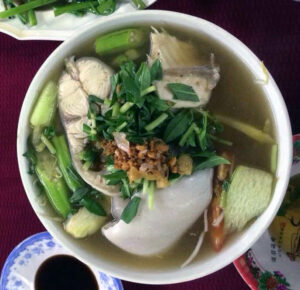
For a long time, dishes made from catfish – one of the specialty fish species of the Hau River- have created a very unique culinary flavor at restaurants and eateries in Can Tho.
Catfish meat is white, fragrant, delicious, not fishy, and healthy, so it can be used to make many delicious dishes. In particular, catfish cooked in sour soup is a delicious, refreshing, nutritious dish that is popular with many people, especially on hot days.
The sour soup is a rustic dish, sour, sweet and fatty, rich in the flavor of the homeland with the sour taste of tamarind/star fruit, the fragrant taste of coriander, spiny coriander, the fatty taste of catfish and vegetables such as mint, tomatoes, bean sprouts, okra, banana flower, eaten with vermicelli or white rice, both delicious, helps to cool down effectively, often with chili, fried garlic, served with chili fish sauce.
Fish Sauce Hotpot
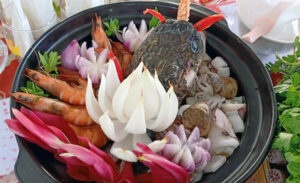
When coming to the Mekong Delta, you cannot miss the familiar fish sauce hotpot, with the rich aroma of local fish sauce, mixed with fresh fish, shrimp, squid, and many kinds of green vegetables such as: Chinese cabbage, lotus, sesbania, squash blossoms, water spinach, water mimosa, eggplant, etc. This is a delicious specialty of Can Tho that you must try.
At first, you will find the smell of the hotpot a bit strong, but when you start to taste it, be careful, you will be “addicted”.
Above is a combination of travel guides to explore Can Tho City. Vietdreamtravel is also running daily tours; package tours; car/bus rental services and Vietnam visa services to explore this lovely destination. Don’t hesitate to contact us at (+84)28 3838 8322 +(84)918 709 338 for more details.
Comment (0)