
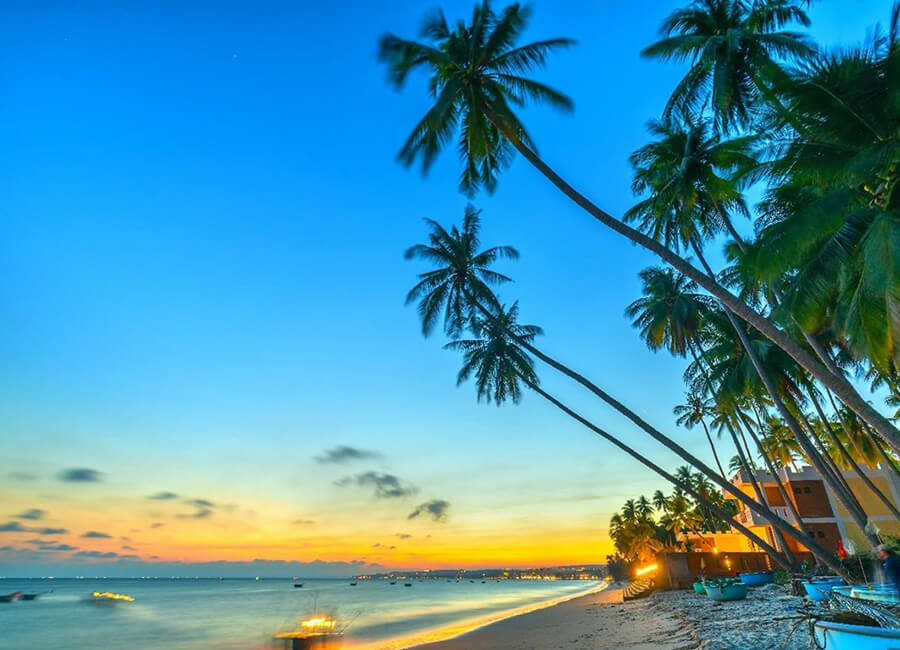
Binh Thuan (currently merged into Lam Dong Province) is a famous area with many scenic spots and historical monuments of Champa culture. Furthermore, the province has one of the best beaches – Mui Ne Beach, and vast sand dunes like the desert, which offer many outdoor activities for you to experience.
What is the best time to explore Binh Thuan?
You can go to Binh Thuan at any season of the year. The climate here is divided into two distinct seasons, the rainy season and the dry season. Depending on your schedule, you can choose the most ideal time.
From April – May: this is the hottest weather, suitable for swimming and relaxing on the beach.
The rainy season usually starts from May to October, and the dry season from November to April next year. But in fact, the rainy season only focuses on August, September, and October. However, if you want to go here for surfing or kitesurfing, the days between August and November are the perfect times for big waves and strong winds.
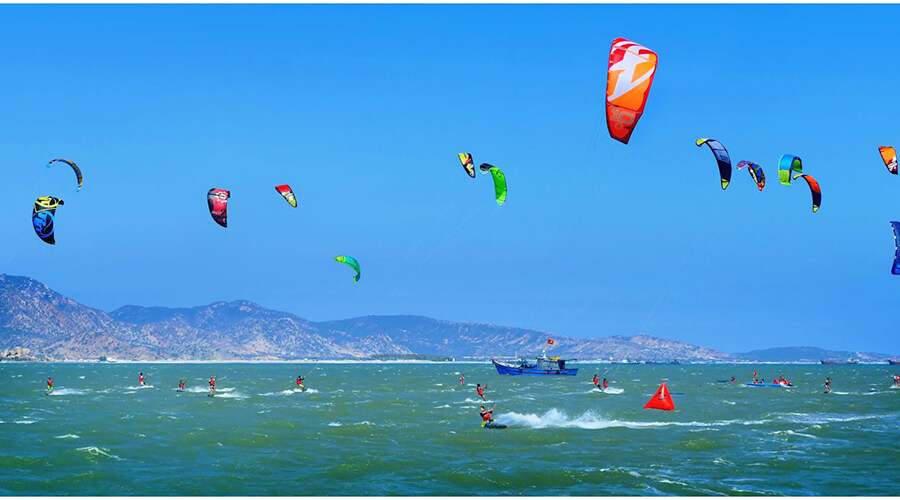
According to Vietdreamtravel, the best time to visit Binh Thuan is from December to March, when the sky is sunny , and the beach is just amazing with yellow sand and blue water.
How to get to Binh Thuan?
Currently, tourists can travel to Binh Thuan by local bus, private car, or train. Tourists from the Northern provinces can fly to Ho Chi Minh City or Cam Ranh, then continue by bus or car to Binh Thuan.
Based on our travel experience, tourists should choose Phan Thiet as their destination. From here, visitors can easily find transportation, such as taxis, and rent motorbikes or cars to continue on to Binh Thuan tourist destinations.
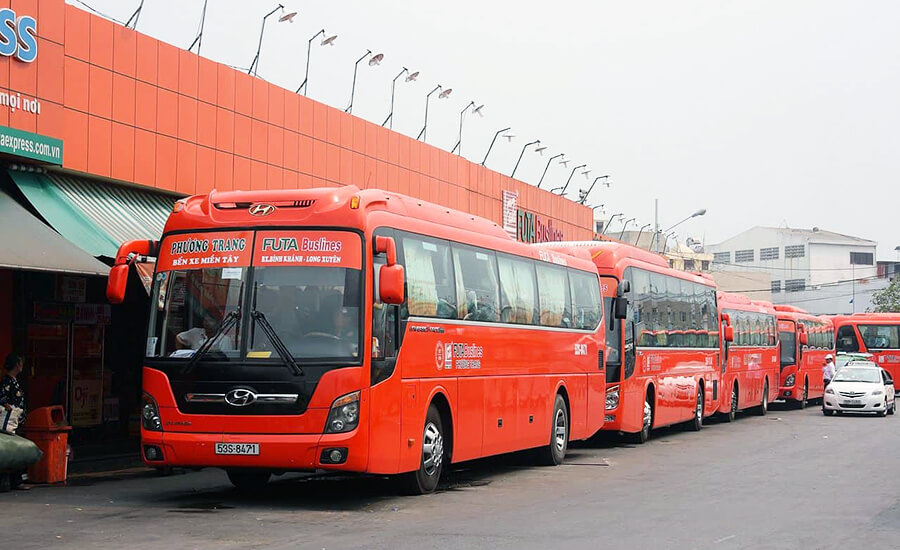
The distance between Ho Chi Minh City and Phan Thiet is approximately 200km. Traveling by bus will take about 3 hours, so many tourists can book bus tickets departing at 07:00 – 08:00 am to arrive in Phan Thiet at noon to check into the hotel. Popular bus companies operating the Saigon – Phan Thiet route include Trung Nga, Futa, Hanh Cafe, Tam Hanh, and ADT Limousine, with prices ranging from 200,000 VND/ticket and higher, depending on the type of bus and seat or bed you prefer.
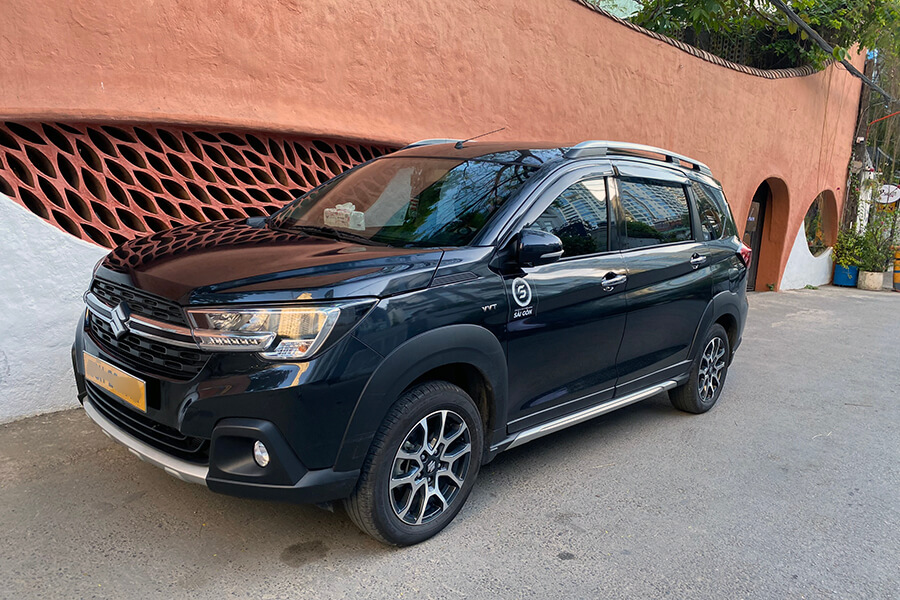
Also, booking private car to Phan Thiet or renting a bus to get here is another way to explore Binh Thuan, especially when you’re traveling with a group as it’s easy to pick up and drop off, or flexible for you to stop and visit tourist spots along the way.
Besides buses and cars, trains are also a popular choice among tourists. The SPT2 train departs from Saigon train station at 06:45 and arrives at Phan Thiet station at 10:40, with ticket prices starting at 200,000 VND/ticket.
Things to do when coming to explore Binh Thuan
The itinerary for exploring Binh Thuan will take you to beautiful places, landscapes, and countless delicious, unique specialties. If you are a “travel addict”, this is definitely extremely necessary information to make your trip more complete and unique.
Visit Mui Ne
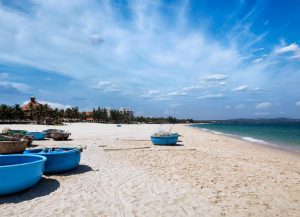 Located 22km northeast of Phan Thiet Ward, Mui Ne is a fishing village and a popular tourist destination in Binh Thuan Province.
There are many unspoiled and pristine beaches in Mui Ne. It is also a popular windsurfing destination, with ideal waves for those new to the sport. You can learn to surf and rent a surfboard at the beach shops.
 There are 02 main beaches: Ganh Beach and Suoi Nuoc Beach; both have many resorts, shops, and restaurants. But the most highly developed area is Rang Beach in Ham Tien, which is often erroneously called “Mui Ne Beach” by foreigners.
Besides its famous beach, numerous things for you to do in Mui Ne include explore local fishing village to admire beautiful scenery from anchored fishing boats, the bustling scene of the market, the beauty of the labor of the fishermen; visit Fairy stream to enjoy fresh air and admire the terrain frames the unique view of the stream; and sand dunes which considered “unique” in Vietnam, originating from an ancient iron mine and now has become a popular picnic place and sand-sledding is a common activity here.
Ke Ga Cape
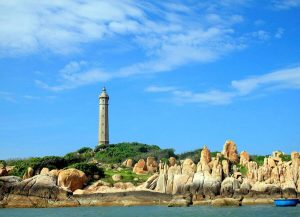 Ke Ga Cape is also known as Khe Ga Cape in Tan Thanh Commune. This is a cape jutting out of the East Sea about 40 km southwest of Phan Thiet.
Ke Ga Cape is actually a small island about 500 meters from the mainland, customarily called Hon Ba. At high tide, Ke Ga is isolated as an island, surrounded by blue sea. But when the tides recede, a strip of sand will reveal, connecting Ke Ga Cape to the mainland.
The cape has a lighthouse, which the Vietnamese record book center has confirmed as the tallest and oldest in Vietnam. According to maritime history in this area, Ke Ga Cape is considered an extremely dangerous position of the sea from Phan Rang to Vung Tau.
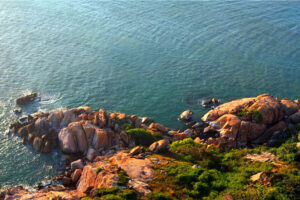
In previous centuries, many merchant ships passing through this area were sunk due to the unidentifiable coordinates and direction. Hence, within 2 years (1897-1899), the French had surveyed the area to build the lighthouse, aiming to support their military transport and foreign merchant ships. Inside the lighthouse, there are 183 spiraling steel steps leading to the top of the lighthouse. There was a big 2,000W light visible for 22 nautical miles (approximately 40 kilometers).
Currently, Ke Ga Cape has become an attractive tourist destination for visitors to Binh Thuan, thanks to its unique architectural relic.
Poshanu Tower
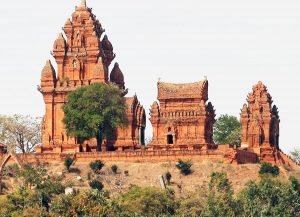
Poshanu Tower, or Po Sah Inu, also known as Pho Hai Cham Tower, is a group of tower remains of the ancient Cham Kingdom, located on Ba Nai Hill, Phu Hai Ward, 7km away from the center of Phan Thiet and about 13km from the center of Mui Ne town. It was built more than 1,200 years ago with the aim of worshiping the Shiva – is one of the revered Hindu deities. However, only three towers remain (main, medium, and small).
This tower was built following the Hoa Lai architectural style – one of the ancient art styles of the Cham Kingdom. Although it is only a small tower, it embodies the quintessence of the ancient Cham’s architectural techniques and decorative arts, evoking majesty and mystery. In 1991, this relic was designated a national architectural monument by the Vietnamese government.
Location: Phu Hai, Phan Thiet City, Binh Thuan.
Ta Cu Mountain
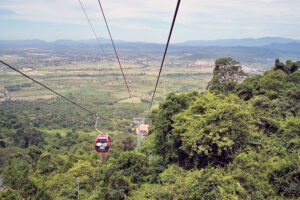 Ta Cu Mountain is located along National Highway 1A, Ham Thuan Nam Commune, 28km south of Phan Thiet. This is a climbing site with a peak of 649m above sea level. The scene here is pristine and marvelous, with identical mountains.
There are two ways to go up Ta Cu Mountain: spend more than 2 hours hiking through the verdant rainforest or take a 15-minute cable-car ride to reach the top.
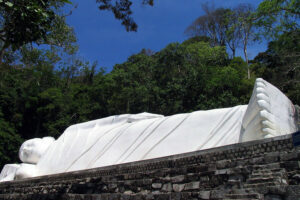
Set atop Ta Cu Mountain, Linh Son Truong Tho Pagoda stands at an altitude of over 400m, featuring several towers, Buddhist statues, and caves amid ancient green trees.
The main attraction is a 49m long and 7m high statue of a reclining Buddha, one of the largest and most distinctive statues in Southeast Asia. It was made from reinforced concrete and covered with white lime on a stone base, leaning on the mountain.
The statue was begun in 1963, was finally completed 4 years later, and has become a favorite hotspot for tourists and Buddhist pilgrims.
Bau Trang (White Lake)
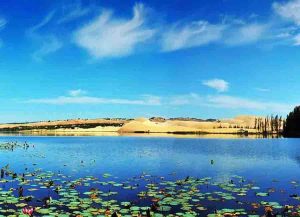 Bau Trang is the name of a freshwater lake about 35km from Mui Ne in Hoa Thang Commune. Bau Trang is divided into 2 parts by a crossing sandhill. The local people called the small one Bau Ong (Male lake) and the other Bau Ba (Female lake).
Bau Ba is also known as Bau Sen (Lotus Lake) because the lotus covers the whole lake. Lotus is planted by residents for seed harvesting. However, lotus cultivation in this area makes the landscape even more distinctive. Bau Trang is still an unspoiled, very worthwhile tourist destination when traveling to Mui Ne. The best time to explore Bau Trang is early in the morning, when you cannot only hunt for great photos but also admire the wonderful scenery.
Duc Thanh School
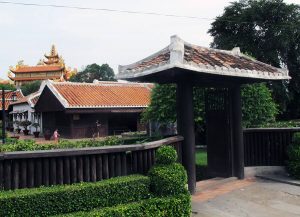 Duc Thanh is the name of a school founded by patriotic scholars in Phan Thiet, Lam Dong province in 1907 in response to the Modernization Movement led by Phan Chau Trinh, Tran Quy Cap, and Huynh Thuc Khang. Duc Thanh School is a source of pride for local residents, as Nguyen Tat Thanh (later President Ho Chi Minh) stopped by and taught for a while before going abroad in 1911.
The main structure of the school consists of 2 large wooden houses used as classrooms, a small house – is a place for reading books, discussing, meeting, and the boarding house where he and his pupils lived.
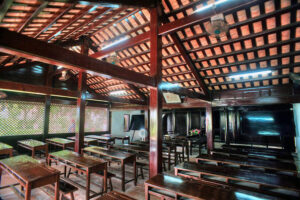 Until now, the school still has many precious objects closely associated with teacher Nguyen Tat Thanh, such as a desk, an ink slab, a sofa, a carambola tree that Thanh cared for in his free time, and a brick well nearby.
In 2014, the Vietnam Record Association recognized Duc Thanh School as one of the top ten historical vestige sites commemorating Nguyen Tat Thanh that attract the largest number of tourists.
Address: 39 Trung Nhi Street, Phan Thiet Ward.
Po Dam Tower (Po Tam)
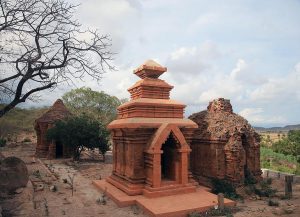 Po Dam or Po Tam is the name of a group of Cham towers in Lac Tri village, Lien Huong commune, Lam Dong Province. This tower was built to worship King Po Dam, also known as Po Kathit (Pan La Tra Duyen) of the Cham people. The time to build the tower is unknown, but by comparing art styles, archaeologists have tentatively identified the Po Dam tower as of the same age as Hoa Lai-style towers (in Khanh Hoa), possibly dating to the end of the 8th century to the 9th century. However, when comparing with the history of Champa, the reign of Po Dam is 1433-1460.
According to the legend of the Cham people, there was a challenge between King Po Klong Garai and Po Dam (who was then the mandarin), who built the tower first, and Po Klong Garai won. The construction techniques and architectural arts are similar to those of the Poshanu Tower; all belong to the Hoa Lai art and architectural style. Po Dam Tower was an annual ritual site and a place of worship for the King of the Cham people. Po Dam Tower was ranked by the State as a National-level architectural monument in 1996.
Van Thuy Tu
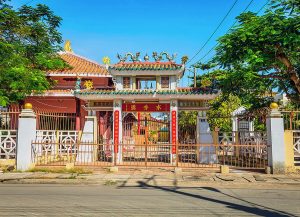 The communal house was built in 1762 by local fishermen to worship Lord Whale, as they believe whales are benevolent creatures that protect fishermen from bad weather and the dangers at sea.
The house displays and preserves whale skeletal remains, fishing boats, conical hats, an antique bronze bell, terracotta statues, an incense table, and authentic artifacts from the Nguyen Dynasty.
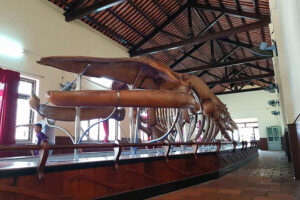 However, the most attractive feature of Van Thuy Tu for tourists is the largest and longest gray whale in Vietnam, which is 22 meters long and has been well preserved for more than 100 years.
There is an annual festival that takes place on June 20 of the Lunar calendar each year to pray for smooth sailing, good weather, and a good fishing harvest. Van Thuy Tu was recognized as a national treasure in 1996.
Van Thuy Tu is located on 54 Ngu Ong Street, Phan Thiet Ward, Lam Dong Province.
Co Thach Pagoda
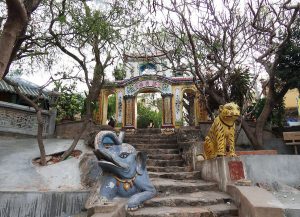 Co Thach Pagoda, also known as Hang Pagoda or Da Co Pagoda, is located on the beach of Lien Huong Commune, 100 km north of Phan Thiet. The pagoda is located on a mountain slope 64m above sea level. This is a Buddhist architectural complex comprising a hermitage, temple, and cave, built in scattered, continuous, and adjacent locations to the rocky caves, covering more than 2,000 m².
Each cave worships a Buddha, a Bodhisattva, or a monk. Inside the cave, which worships the Co Thach Temple founder, monk Bao Tang, there are many other statues of monks and ancestral tablets of others who contributed to the temple’s establishment.
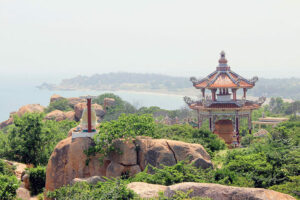
The temple was built in the middle of the 19th century. At first, it was just a small temple with wood walls and a leaf roof. After many restorations, the temple is not only larger and more spacious but also recognized as a national monument and scenic spot in 1996.
After visiting the scene of the temple, you can move to Ca Duoc, a multi-colored rocky expanse that stretches for nearly 1km along the coast. Recently, a new Co Thach tourism village was constructed with many attractive small houses available to both tourists and pilgrims.
What’s speciality dishes of Binh Thuan?
Seafood
Coming to the coastal land of Binh Thuan, you cannot miss seafood dishes. Binh Thuan seafood is fresh, delicious, and affordable, and it is processed into many attractive dishes.
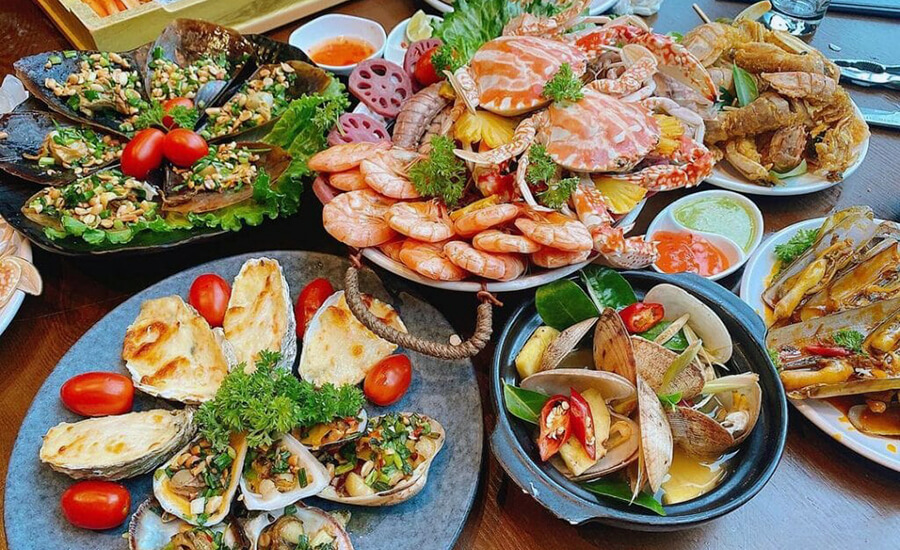
Some delicious seafood dishes you should try include fish salad, snails, squid tooth rolls, and steamed crab. In particular, we cannot help but mention the steamed squid eggs, dipped in lemon pepper and salt. Eat with Vietnamese coriander and pickles.
Quai Vac cake
The cake is quite similar to Hue tapioca flour but smaller. The crust is made from filtered flour, and the filling is made from fresh shrimp and stir-fried pork belly. Sweet and sour fish sauce, made from high-quality Binh Thuan fish sauce and hot chili, is what makes Banh Quai Vac unique.
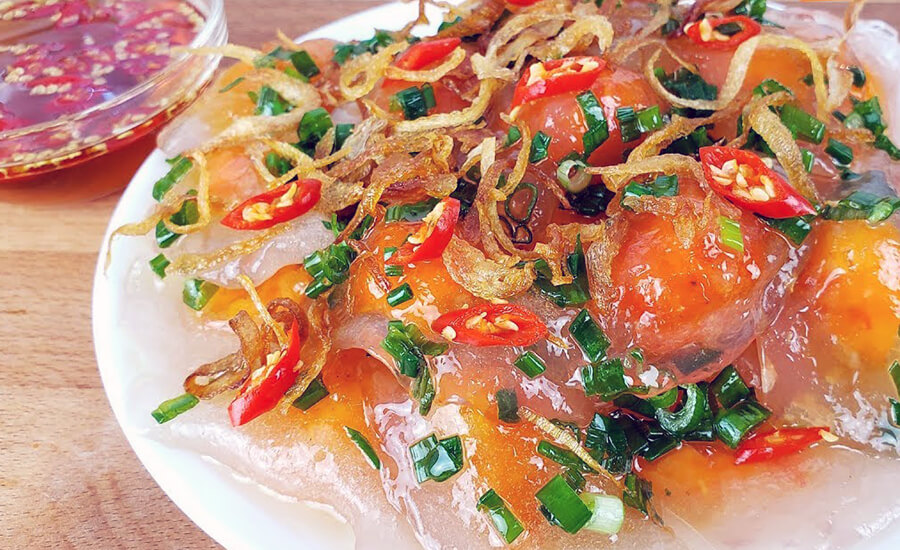
Quai Vac, sprinkled with fried onions and onion fat, then drizzled with sweet and sour fish sauce, is a delicious, nutritious, and cheap snack popular in Binh Thuan.
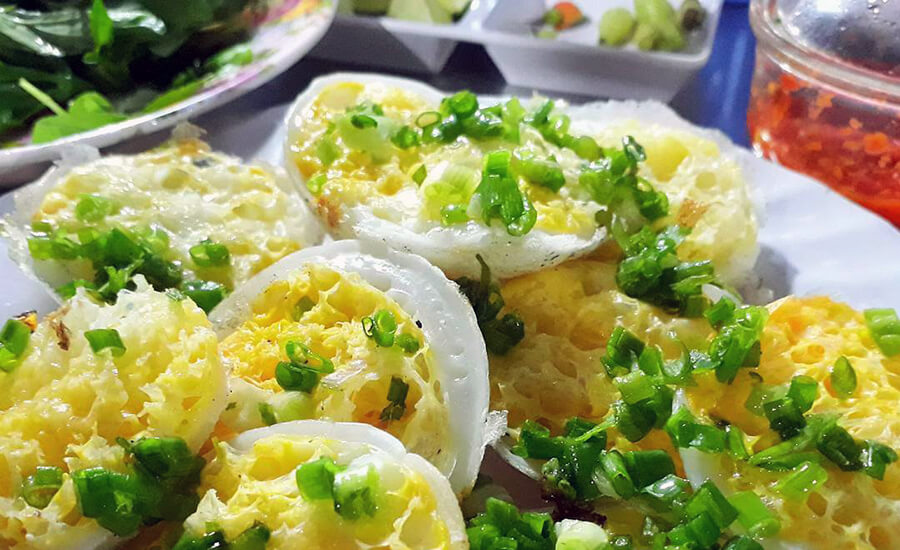
Can cake
Can cake is a rustic, simple but extremely attractive dish from Binh Thuan. Rice flour is mixed in proportion, poured into an ungreased clay mold, and baked, so the cake has a smoky smell and a hot, crispy bottom. The cake is eaten with sweet fish sauce or braised fish sauce, blending all the delicious flavors of the sea.
Vietdreamtravel also offers package tours and car/bus rental services for exploring Binh Thuan. Do not hesitate to contact us for any booking requirements.
Source: collected by An
Best regards,
Comment (0)